
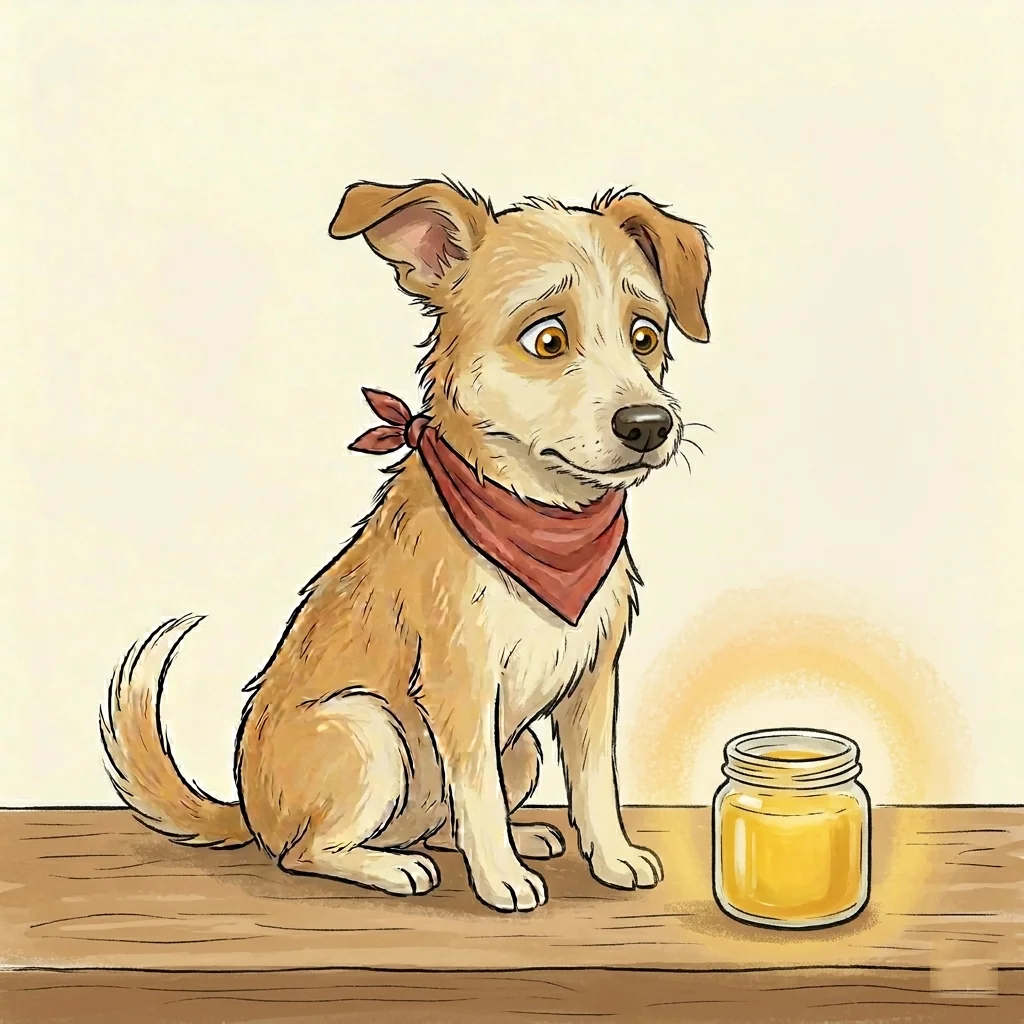

One teaspoon of ghee is about 45 calories. For a 5 kg Pomeranian, that is more than a tenth of everything the dog should eat in a day, delivered in a smear you would not even notice on a roti.
Ghee occupies an odd place in Indian dog care. It gets added to a dog’s rice “for the coat”, stirred into food “for digestion”, and spooned over roti out of straightforward affection. One of the things people say about it is completely correct. Most of the rest is not.
Is ghee safe for dogs?
Ghee is not toxic. It is butter that has been simmered until the water boils off and the milk solids brown and are strained out, which leaves something in the region of 99% pure butterfat. There is nothing in it on the ASPCA’s list, and a dog that licks a ghee spoon is fine.
The danger is not poisoning. It is the fat load. Ghee runs about 900 calories per 100 grams, which makes it the most calorie-dense thing you can put in a dog’s bowl from an Indian kitchen. High-fat foods are an established dietary trigger of acute pancreatitis in dogs, a painful and sometimes life-threatening inflammation of the pancreas. Miniature Schnauzers, Yorkshire Terriers and Cocker Spaniels carry a recognised predisposition, but any dog can develop it, and a single unusually greasy meal is a common trigger in the case histories.
Then there is weight, which is the slower version of the same problem. A teaspoon of ghee added daily to a 10 kg dog’s dinner is roughly 16,000 extra calories a year that nothing in the diet plan accounts for. Nobody notices a teaspoon. Everyone notices the dog a year later.
How much ghee can your dog have?
Treats and extras of every kind should stay under 10% of a dog’s daily calories. One teaspoon of ghee is about 5 grams and 45 calories.
| Your dog | Daily calories | 10% treat ceiling | Sensible ghee portion |
|---|---|---|---|
| 5 kg (Shih Tzu, Pom) | ~375 kcal | 37 kcal | ¼ tsp (1.5 g, 13 kcal) |
| 10 kg (Beagle, small Indie) | ~630 kcal | 63 kcal | ½ tsp (2.5 g, 22 kcal) |
| 20 kg (Indie, Cocker) | ~1,060 kcal | 106 kcal | 1 tsp (5 g, 45 kcal) |
| 30 kg (Labrador) | ~1,435 kcal | 144 kcal | 1½ tsp (7 g, 63 kcal) |
| 40 kg (GSD, Rottweiler) | ~1,780 kcal | 178 kcal | 2 tsp (10 g, 90 kcal) |
Daily calories assume a neutered adult dog at a healthy weight, calculated as 1.6 × 70 × (weight in kg)0.75. Portions are set at roughly half the treat ceiling, because ghee is almost never the only extra a dog gets in a day.
Compare this table with any other on this site. A Labrador gets nine cubes of watermelon or five spoons of curd rice. It gets one and a half teaspoons of ghee. And that quarter teaspoon in the top row is not a typo: it is what happens when you divide a small dog’s treat budget by the most calorie-dense food in the kitchen.
The one dairy claim the internet gets right about ghee
Most adult dogs produce far less intestinal lactase than puppies do, which is why milk gives so many of them gas and loose stools. People try to work around this by reaching for a dairy product that has “had the lactose removed”, and they are usually wrong about which ones qualify.
With ghee, they are right. Lactose and casein both live in the milk solids, and making ghee is precisely the process of cooking those solids until they separate and then straining them out. What is left is essentially butterfat. Ghee carries only trace amounts of lactose and milk protein, which is why it is tolerated by many people and dogs who react badly to milk itself.
This makes ghee genuinely different from paneer, where the same claim is repeated and is false: paneer is unaged, so it holds roughly twenty times the lactose of a mature cheese. Ghee gets the credit paneer is wrongly given.
It just does not help you very much. Being low in lactose makes ghee gentler on the gut than milk. It does not make it less fattening, and fat is the reason to be careful with ghee in the first place. A lactose-free way to overload a dog with calories is still a way to overload a dog with calories.
The claims it gets wrong: coat, joints and constipation
“Ghee gives a shiny coat.” There are no controlled trials showing that dietary ghee improves coat quality in dogs. What does have real evidence behind it for skin and coat is omega-3 fatty acid supplementation, usually from fish oil, and ghee contains essentially none. It is roughly 60% saturated fat. If the coat is the goal, you are buying the wrong fat.
“Ghee is good for joints.” This one traces back to traditional human use rather than to any canine evidence. The joint supplements with actual data behind them in dogs are omega-3s and, more modestly, glucosamine and chondroitin. Ghee is not in that conversation, and an overweight dog carrying extra kilos on arthritic joints is worse off for the calories than it is better off for anything in the fat.
“A spoon of ghee fixes constipation.” This is the most common one in Indian households and the most likely to backfire. Constipation in dogs is usually about water and fibre, not lubrication. A slug of pure fat is more likely to produce diarrhoea than a normal stool, and in a susceptible dog it is a pancreatitis risk taken for no reason. A dog that has not passed a stool in more than two days, or is straining without result, needs a vet, not a spoon.
Dogs with a history of pancreatitis, dogs on a prescribed low-fat diet, and overweight dogs should have no ghee at all.
How to serve ghee, if at all
Measure it, never pour it. Use an actual measuring spoon. Ghee melts and spreads, and an eyeballed “little bit” is routinely two or three times what was intended.
Plain and unsalted. Homemade ghee has nothing else in it. Some commercial ghee is fine too, but read the label, and never use a flavoured or salted cooking fat.
Count it against the treat budget, not on top of it. If your dog gets a quarter teaspoon of ghee, that is most of a small dog’s allowance gone, and the biscuits have to come out of the same envelope.
As a carrier, when a vet has asked for one. Some medications are absorbed better with fat. If that is why you are using ghee, follow the dose you were given and stop when the course ends.
Skip ghee-fried anything, skip the roti soaked in it, skip halwa, ladoo and any sweet made with it, and do not use ghee as a way to get a fussy dog to eat. That last one works, which is exactly the problem: it teaches the dog to hold out for the ghee.
Questions people still ask
Is ghee good for a dog’s coat?
There is no good canine evidence that it is. A dull coat in a dog usually points at an underlying issue — parasites, allergies, thyroid disease, or a diet short on essential fatty acids — and adding saturated fat does not address any of those. The nutrient with real evidence behind it for skin and coat is omega-3, which ghee does not supply. If your dog’s coat has changed, a vet visit will find the cause faster than the ghee tin will fix it.
Can dogs eat roti with ghee?
A plain roti with a scrape of ghee is not dangerous for most dogs, but it is worth understanding what you are handing over: a wheat flatbread offers a dog very little it needs, and the ghee turns a modest snack into a calorie-dense one. If roti is already part of your dog’s routine, serve it plain and keep the ghee for your own. Read our full guide on whether dogs can eat roti before making it a habit.
Can ghee help a constipated dog?
It is not the right tool. Canine constipation usually responds to more water, more fibre and more exercise rather than to added fat, and a large dose of pure fat frequently produces the opposite problem. It also carries a pancreatitis risk that is not worth taking for a home remedy. If your dog has gone more than 48 hours without passing a stool, is straining unproductively, or seems uncomfortable, that is a veterinary problem and it can have causes — an obstruction, prostate disease, dehydration — that no kitchen fix will touch.
Related guides
Part of our human food for dogs guide. See also: can dogs eat paneer, can dogs eat curd, can dogs eat coconut and can dogs eat roti. For the bigger picture, see our dog nutrition guide.
When in doubt about your dog and a new food, ask your vet. It is the cheapest insurance there is.
Sources: USDA FoodData Central, butter oil (ghee), Merck Veterinary Manual, nutritional requirements of small animals, Merck Veterinary Manual, pancreatitis in small animals, ASPCA people foods to avoid.
Wondering about a different food?
🦴 Can my dog eat this?
Type a food to see if it is safe, needs caution, or is a hard no.
Get more dog stories in your inbox. Join Woofs & Words on LinkedIn.
Subscribe on LinkedIn