
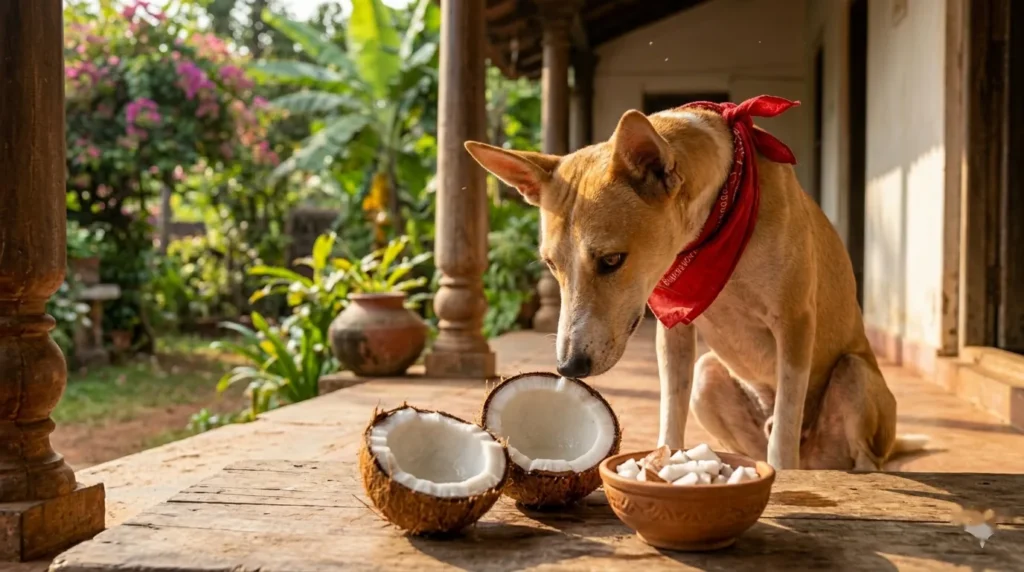

A tablespoon of coconut oil carries roughly 120 calories. For a 5 kg Shih Tzu, that is a third of everything the dog should eat that day, delivered in one spoon.
Coconut is the food dog owners most consistently misjudge, because it arrives wrapped in health language. It is not poisonous, it is not dangerous in small amounts, and there is nothing wrong with a few shavings. The trouble starts the moment somebody calls it a supplement.
Is coconut safe for dogs?
The white flesh is. Coconut does not appear on the ASPCA’s list of toxic foods for dogs, and a dog that steals a piece of fresh coconut off the kitchen counter is in no danger.
Two parts of the coconut are not food at all. The shell is hard enough to fracture a carnassial tooth, and the fibrous husk does not digest. Both show up in veterinary case reports as intestinal foreign bodies. If your dog is the sort that chews whatever is left on the floor, the empty shell belongs in a closed bin, not the garden.
The real limiting factor is fat. Fresh coconut meat runs about 33 grams of fat per 100 grams and 354 calories, which puts it closer to cheese than to fruit. High-fat treats are one of the recognised dietary triggers of acute pancreatitis in dogs, and breeds with a known predisposition, including Miniature Schnauzers, Yorkshire Terriers and Cocker Spaniels, have less room for error than most.
How much coconut can your dog have?
Treats of every kind should stay under 10% of a dog’s daily calories. One teaspoon below means about 5 grams of fresh shredded coconut, roughly 18 calories.
| Your dog | Daily calories | 10% treat ceiling | Sensible coconut portion |
|---|---|---|---|
| 5 kg (Shih Tzu, Pom) | ~375 kcal | 37 kcal | 1 tsp (5 g, 1.7 g fat) |
| 10 kg (Beagle, small Indie) | ~630 kcal | 63 kcal | 2 tsp (10 g, 3.4 g fat) |
| 20 kg (Indie, Cocker) | ~1,060 kcal | 106 kcal | 1 tbsp (15 g, 5.0 g fat) |
| 30 kg (Labrador) | ~1,435 kcal | 144 kcal | 4 tsp (20 g, 6.7 g fat) |
| 40 kg (GSD, Rottweiler) | ~1,780 kcal | 178 kcal | 5 tsp (25 g, 8.4 g fat) |
Daily calories assume a neutered adult dog at a healthy weight, calculated as 1.6 × 70 × (weight in kg)0.75. Portions are set at roughly half the treat ceiling, because coconut is almost never the only treat a dog gets in a day.
Notice how small these numbers are. A single tablespoon of fresh coconut is a reasonable serving for a Labrador and a clear overdose for a Pomeranian. Every other fruit on this site gives you a handful. Coconut gives you a spoon.
The coconut oil claim, and what it is actually worth
Coconut oil is sold to dog owners on two promises: a shinier coat and a metabolic boost from medium-chain triglycerides. Both deserve a closer look.
The MCT claim is shakier than it sounds. Coconut oil is roughly 50% lauric acid, a 12-carbon fatty acid. Lauric acid is counted as an MCT by the chemical definition, but metabolically it behaves far more like a long-chain fat: the bulk of it is packaged into chylomicrons and absorbed through the lymphatic system rather than going straight to the liver the way C8 and C10 fats do. The energy-shortcut story that sells coconut oil mostly does not apply to coconut oil.
The coat claim has no strong canine evidence. There are no controlled trials showing that dietary coconut oil improves coat quality in dogs. What does have evidence behind it for skin and coat is omega-3 supplementation, which coconut oil contains essentially none of.
The calories are real, though. Coconut oil is pure fat at about 120 calories per tablespoon and 40 per teaspoon. One teaspoon uses up more than the entire daily treat allowance of a 5 kg dog. If your vet has recommended it for a specific reason, follow that advice and count the calories. If a blog recommended it, you can skip it without your dog missing anything.
Coconut water, milk and the dried stuff
Coconut water. A few licks will not hurt a healthy dog, but it carries roughly 250 mg of potassium per 100 ml, which is why it is a poor idea for any dog with kidney disease or on medication that affects potassium. It is also not a rehydration fluid for a sick dog. That is a vet’s job.
Coconut milk and cream. Far more fat than the flesh, often with added sugar or stabilisers, and a reliable route to a night of diarrhoea. Skip it.
Desiccated and sweetened flakes. Plain unsweetened desiccated coconut is concentrated flesh, so the same portions apply by weight but it is much easier to overfeed because it looks like nothing. The sweetened baking kind is a sugar product. Read the packet.
Coconut chutney, barfi and laddoo. Sugar, ghee, and often milk solids. None of it belongs in a dog.
How to serve coconut
Fresh and shredded. Crack it, prise the flesh out, shred it, and measure. Shredding is what makes the portion honest.
Frozen into a Kong. A teaspoon of shredded coconut mixed with plain curd, packed and frozen, stretches a small portion into a long chew.
Introduce it alone. Give it on a day when nothing else new is on the menu, so a loose stool tells you something useful.
Never give the shell as a chew toy, and never leave the husk where a bored dog can work on it. Both are obstruction risks, and neither is worth the vet bill.
Questions people still ask
Can dogs have coconut oil?
In tiny amounts it is not harmful, but the benefits people claim for it are not well supported in dogs, and it is 40 calories a teaspoon. If you want to use it, a quarter teaspoon for a small dog or a teaspoon for a large one, mixed into food, is the usual starting point, and it comes out of the treat budget. Dogs with a history of pancreatitis should not get it at all without a vet’s say-so.
Can dogs drink coconut water?
A small amount of plain, unsweetened coconut water is fine for a healthy dog. Avoid it for dogs with kidney disease, heart medication or any condition where potassium is being managed, because it runs around 250 mg potassium per 100 ml. It is not a substitute for water and it is not a treatment for dehydration.
Is desiccated coconut safe for dogs?
Plain, unsweetened desiccated coconut is safe in the same small quantities as fresh. Sweetened flakes, the kind sold for baking, are not worth giving. Check the ingredients list for added sugar and preservatives, and remember that dried coconut is denser than fresh, so a teaspoon of it carries more fat than a teaspoon of the fresh shavings.
Related guides
Part of our human food for dogs guide. See also: can dogs eat peanuts, can dogs eat banana, can dogs eat mango and can dogs eat guava. For the bigger picture, see our dog nutrition guide.
When in doubt about your dog and a new food, ask your vet. It is the cheapest insurance there is.
Sources: USDA FoodData Central, coconut meat raw, Merck Veterinary Manual, nutritional requirements of small animals, ASPCA people foods to avoid.
Wondering about a different food?
🦴 Can my dog eat this?
Type a food to see if it is safe, needs caution, or is a hard no.
Get more dog stories in your inbox. Join Woofs & Words on LinkedIn.
Subscribe on LinkedIn