
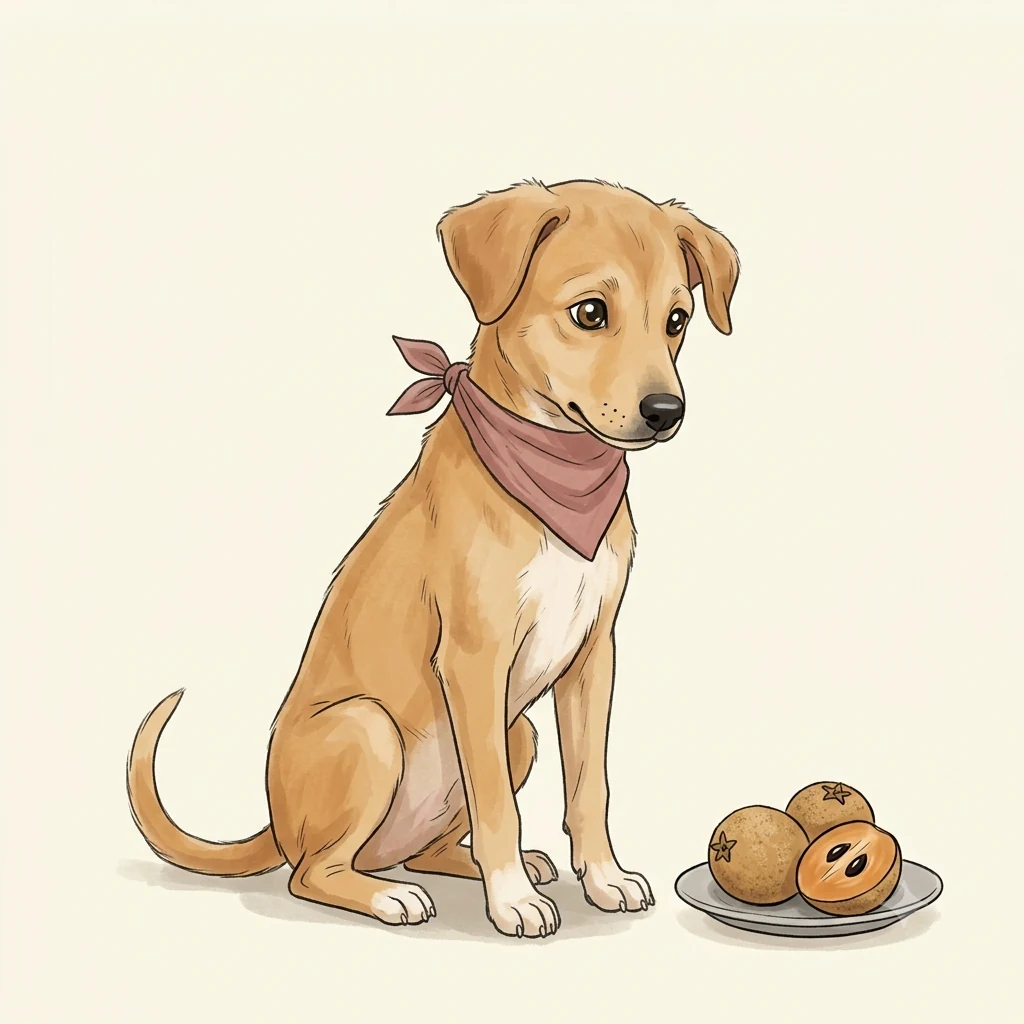

Chikoo is the fruit that gets handed to dogs most often in Indian homes. It is soft, it is sweet, it does not need cutting, and a dog will take it off your hand without being asked twice.
It also has three to six seeds in it, and each one is shaped like a fish hook.
Is chikoo safe for dogs?
The flesh of a ripe chikoo is safe. It is not toxic to dogs, it is not on any poison-control list, and a spoonful of ripe pulp is a perfectly reasonable treat.
The seed is the problem, and not for the reason you have read. Sapodilla seeds are large, hard, glossy black and, critically, carry a small hooked projection at one end. That hook is a mechanical hazard. A seed that would otherwise pass through the gut can catch on tissue on the way down. Most swallowed seeds do pass uneventfully, but this is the fruit where the shape of the seed matters more than its chemistry.
The sugar is the second problem. Chikoo carries about 20 g of carbohydrate per 100 g, of which roughly 14 g is sugar. That is more than mango. In a dog that is already overweight, or diabetic, or getting biscuits from three people in the house, chikoo is not a light snack.
Unripe chikoo is a different food entirely. More on that below, because it is the mistake most people make without realising they made it.
How much chikoo can your dog have?
Portions below are set at roughly half the treat ceiling, with the sugar spelled out, because sugar is the reason chikoo adds up faster than it feels like it should.
| Dog’s weight | Daily calories | Treat ceiling | Chikoo portion (seeds out) | Sugar in it |
|---|---|---|---|---|
| 5 kg (Pug, Shih Tzu) | ~375 kcal | 37 kcal | ~20 g (a quarter of one) | ~2.8 g |
| 10 kg (Indie pup, Beagle) | ~630 kcal | 63 kcal | ~38 g (just under half) | ~5.3 g |
| 20 kg (Indie, Cocker) | ~1,060 kcal | 106 kcal | ~64 g (two-thirds of one) | ~9 g |
| 30 kg (Labrador) | ~1,435 kcal | 144 kcal | ~85 g (one small chikoo) | ~12 g |
| 40 kg (GSD, Rottweiler) | ~1,780 kcal | 178 kcal | ~105 g (one large chikoo) | ~15 g |
Daily calories assume a neutered adult dog at a healthy weight, calculated as 1.6 × 70 × (weight in kg)0.75. Portions are set at roughly half the treat ceiling, because chikoo is almost never the only treat a dog gets in a day. Chikoo is taken at 83 kcal per 100 g; the sugar figure of about 14 g per 100 g is an estimate, since ripeness moves it considerably. A medium chikoo is taken as 90 g of flesh.
Here is the number that reframes it. One medium chikoo holds roughly 12 g of sugar. That is three teaspoons. You would not spoon three teaspoons of sugar into your dog’s bowl, and the fruit does not change the arithmetic.
The seed is not poisonous. It is shaped like a fish hook.
Search for chikoo and dogs and you will find the claim that the seeds are toxic, usually with a vague mention of cyanide borrowed from apple pips. That is the wrong warning, and it makes people relax about the right one.
Sapodilla seeds contain saponins, which are irritant rather than deadly. A dog that chews one may get an upset stomach. That is not what should worry you.
What should worry you is the hook. Each seed carries a hard, curved projection at one end, which is exactly the kind of feature that turns a smooth-passage problem into a stuck-somewhere problem. Combine that with a seed roughly 2 cm long and you have an object that a small dog should never have access to at all.
So the rule is not “avoid the seeds because they are poisonous.” The rule is count them out. Halve the fruit, dig every seed out with a spoon, and check the halves again before the bowl goes down. A chikoo has three to six seeds, and the one you miss is the one that matters.
Unripe chikoo: the part nobody warns you about
An unripe chikoo is full of latex and tannins. It is mouth-puckeringly astringent, and that astringency is chemically real, not just unpleasant.
In a dog it causes mouth irritation, drooling, and often vomiting. The tannins bind up saliva and gut proteins, and the latex adds its own irritation. This is a much more common reason for a dog to be unwell after chikoo than any seed.
Ripeness is easy to check. A ripe chikoo gives under gentle thumb pressure, the skin scratches away to reveal brown rather than green flesh, and there is no milky sap at the stem. If it is firm, if it squeaks when you scratch it, or if a white bead appears where you snapped the stem, it is not ready for you and it is definitely not ready for the dog.
How to serve it, and who should skip it
Peel it, halve it, remove every seed, and cut the flesh into pieces your dog cannot inhale whole. Serve it plain. No sugar, no chaat masala, no milkshake. Chikoo milkshake in particular is a bad idea: milk on top of that much sugar is a reliable way to get loose stool.
Skip chikoo entirely if your dog is diabetic, is on a weight-loss plan, has pancreatitis in its history, or is a small dog with a habit of swallowing things whole. Frozen chikoo pulp in a lick mat works well in summer and slows the whole thing down, which is worth more than it sounds.
Introduce it the way you would any new food: a small piece, then twenty-four hours of watching before you offer more.
Questions people still ask
My dog swallowed a chikoo seed. What should I do?
Call your vet and tell them the seed is roughly 2 cm long with a hooked end, because that detail changes how they think about it. Most seeds do pass, particularly in a large dog, and the usual advice is to feed normally and watch the stool for two to three days. Do not induce vomiting on your own; bringing a hard hooked object back up the oesophagus can do more damage than letting it go down. Go in immediately, without waiting, if your dog vomits repeatedly, refuses food, strains without producing stool, has a tense or painful belly, or becomes quiet and withdrawn. In a dog under about 10 kg, treat a swallowed seed as a same-day vet call rather than a wait-and-see.
Can diabetic dogs eat chikoo?
No, and this is one of the clearer nos in the fruit category. Chikoo’s sugar is largely fast-absorbing, and a diabetic dog on a fixed insulin dose is managed on predictable meals. An unplanned sugar hit works directly against that. If you want to give a diabetic dog something to chew, ask your vet about a low-sugar option like cucumber or a piece of the dog’s own kibble held back from the meal. The same caution applies to a dog that has had pancreatitis, where the issue is fat rather than sugar but the principle of not improvising is identical.
Can puppies eat chikoo?
A small piece of ripe, de-seeded flesh will not harm a healthy puppy over about four months, but there is little reason to offer it. Puppies need their calories going into a balanced growth diet, and treats of any kind should stay well under the 10% ceiling because the ceiling itself is smaller. The seed risk is also at its worst here: a puppy is small, indiscriminate, and fast. If you do give it, one piece, seeds counted out, and not as a daily habit.
Related guides
Part of our human food for dogs guide. See also: can dogs eat mango, can dogs eat guava, can dogs eat banana and can dogs eat amla. For the bigger picture, see our dog nutrition guide.
When in doubt about your dog and a new food, ask your vet. It is the cheapest insurance there is.
Sources: USDA FoodData Central for sapodilla composition; Merck Veterinary Manual, gastrointestinal obstruction in small animals; Merck Veterinary Manual, nutrition in small animals.
Wondering about a different food?
🦴 Can my dog eat this?
Type a food to see if it is safe, needs caution, or is a hard no.
Get more dog stories in your inbox. Join Woofs & Words on LinkedIn.
Subscribe on LinkedIn