
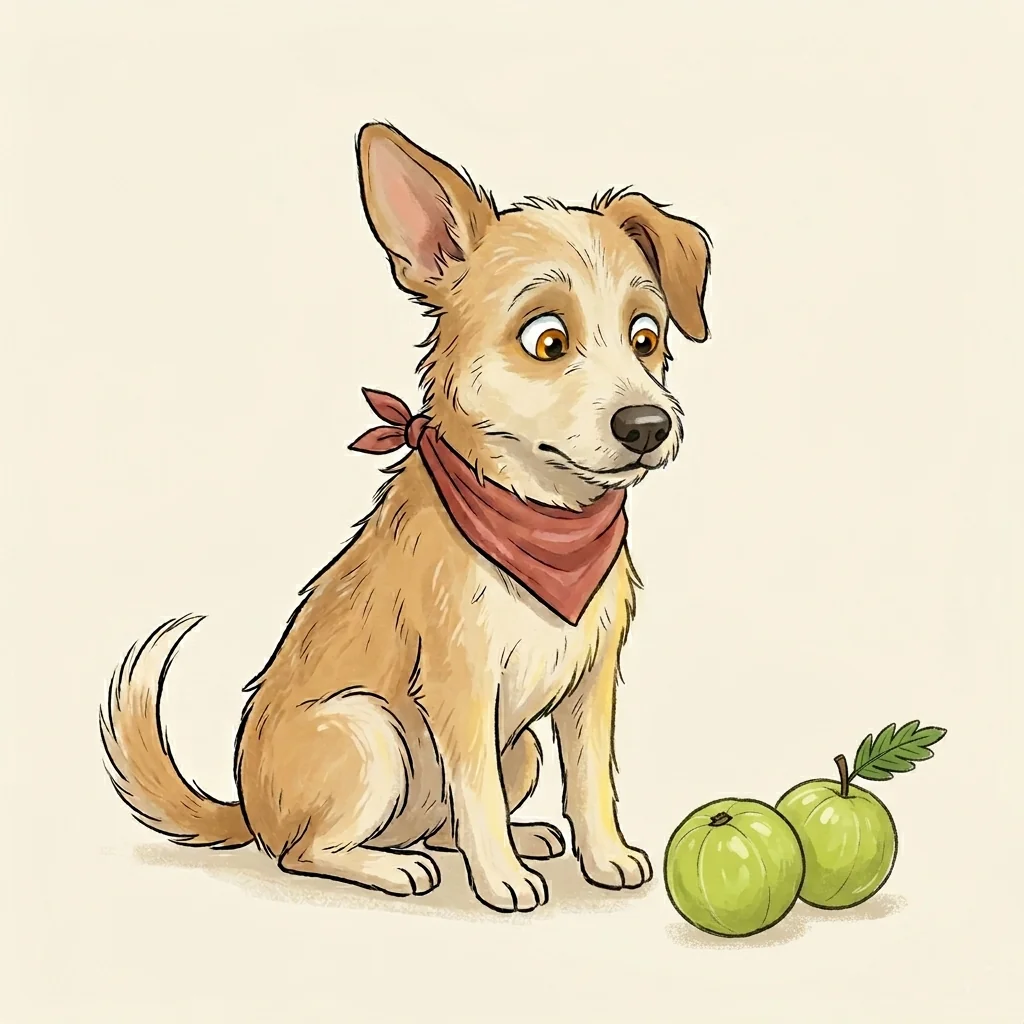

It is November, there is a bowl of amla on the counter and a jar of murabba in the fridge, and someone in the house has decided the dog should have some because it is good for the coat.
The fruit will not hurt him. The reasoning behind it is wrong in an interesting way.
Is amla safe for dogs?
Fresh amla flesh is safe. It is not toxic, it is not on any poison-control list, and small amounts are fine for a healthy dog.
The stone is the mechanical risk. An amla has a single hard, ridged, six-segmented stone in the middle, and it does not soften. A dog that bolts fruit whole can crack a tooth on it or, in a small dog, swallow it and run into an obstruction. Cut the flesh off the stone every time.
The tannins are the reason to keep the portion small. Amla’s astringency is not a flavour note; it comes from a genuinely high hydrolysable-tannin load. Too much causes drooling, nausea, vomiting and loose stool. Most dogs will make the point themselves by spitting it out.
Amla contains oxalate. That matters for the breeds that form calcium oxalate stones, which in practice means Miniature Schnauzers, Shih Tzus, Lhasa Apsos, Yorkshire Terriers and Bichons, and for any dog with existing kidney disease. For those dogs, skip it.
How much amla can your dog have?
Amla is not a calorie problem. Even two whole fruits are under 20 calories, which barely dents a treat budget. The limits below come from tannin load, and the last two columns are there because they are the whole argument.
| Dog’s weight | Amla portion (stone out) | Vitamin C it delivers | Vitamin C the dog already makes daily |
|---|---|---|---|
| 5 kg (Pug, Shih Tzu) | 1/4 amla (~5 g) | ~30 mg | ~90 mg |
| 10 kg (Indie pup, Beagle) | 1/2 amla (~10 g) | ~60 mg | ~180 mg |
| 20 kg (Indie, Cocker) | 1 amla (~20 g) | ~120 mg | ~360 mg |
| 30 kg (Labrador) | 1½ amla (~30 g) | ~180 mg | ~540 mg |
| 40 kg (GSD, Rottweiler) | 2 amla (~40 g) | ~240 mg | ~720 mg |
A medium amla is taken as about 25 g whole, roughly 20 g of flesh once the stone is out. Vitamin C is estimated at 600 mg per 100 g of flesh; published figures for amla range widely, from about 300 to 900 mg per 100 g depending on variety, ripeness and assay method. Endogenous synthesis is estimated at roughly 18 mg per kg of body weight per day, a commonly cited figure rather than a precise one. Treat both columns as order-of-magnitude, which is all the comparison needs.
Read the last two columns across. In every row, the dog’s own liver produces about three times more vitamin C than the fruit does.
Dogs make their own vitamin C. That changes the whole argument.
Humans, guinea pigs and a few fruit bats lost the ability to synthesise ascorbic acid somewhere in evolutionary history. We carry a broken copy of the gene for the final enzyme in the pathway, which is why scurvy exists and why oranges matter.
Dogs did not lose it. A dog’s liver makes ascorbic acid from glucose every day, on demand. Vitamin C is therefore not an essential nutrient for dogs, and it does not appear as a required nutrient in AAFCO’s dog food profiles. A healthy dog eating a complete diet cannot become deficient in it.
So “amla is 20 times the vitamin C of an orange” is a claim about a nutrient your dog was already producing before you cut the fruit. It is an argument built for humans and copied across without checking whether the animal it was aimed at needed it.
There is a second wrinkle worth knowing. A meaningful share of amla’s famous vitamin C figure comes from hydrolysable tannins, emblicanin among them, which register as ascorbic acid in the older titration assays used for much of the published data. Some of the headline number is tannin behaving like vitamin C in a test tube, which is also part of why the reported range is so wide.
None of this makes amla bad. It makes it a low-calorie, high-fibre, mildly interesting treat, which is a perfectly respectable thing to be. It is just not medicine.
Murabba, candy, juice: the forms amla actually comes in
Almost nobody has plain raw amla lying around. What is in the house is one of three things, and all three are worse for a dog than the fruit.
Amla murabba is sugar syrup with fruit in it. The whole preparation exists to make amla palatable by soaking it in sugar for days. A single piece can carry more sugar than a dog should get in a day. Skip it.
Amla candy is worse than murabba. It is sugared, dried, and usually salted, and the salt is the part people forget. Salted, sugared, dried fruit is not something to hand to a dog.
Bottled amla juice is usually not just amla. Most commercial bottles carry added sugar or added salt, and many carry preservatives and other herbs. Some ayurvedic blends include ingredients that have never been tested in dogs at all. If you want to give amla, give the fruit.
How to serve it, and who should skip it
Wash it, slice the flesh off the stone in segments, discard the stone, and chop the segments small. Serve it plain, at room temperature, mixed into food if your dog objects to the sourness, which most do. Start with a piece the size of your fingernail and see what happens over the next day.
Skip amla entirely if your dog has kidney disease, has ever formed calcium oxalate stones, is on a prescription urinary diet, has a sensitive stomach, or is under about four months old. Also skip it if your dog is on medication and you have not asked your vet, because tannins can interfere with the absorption of some drugs and minerals when given at the same time as a meal.
Do not give it daily. Two or three times a week at most, and there is no benefit you are missing by not giving it at all.
Questions people still ask
My dog swallowed an amla stone. Should I worry?
In a large dog, usually not. The stone is around 1 cm, hard and ridged, and most pass through without incident over two to three days. Feed normally and check the stool. In a dog under about 10 kg, call your vet the same day, because the ratio of stone to gut diameter is what decides these things and a small dog has much less room. Do not make your dog vomit at home; bringing a hard ridged object back up can cause more damage than letting it move on. Go in straight away, whatever the size of your dog, if there is repeated vomiting, refusal of food or water, straining without stool, a tense abdomen, or unusual quietness. Cracked teeth are the other outcome worth knowing about, so if your dog crunched rather than swallowed, look at the back teeth.
Can amla help with hair fall or a dull coat?
There is no evidence for it in dogs, and coat problems almost always have a cause that responds to treatment. In Indian homes the common ones are flea allergy, environmental atopy, a secondary yeast or bacterial infection, hypothyroidism, and a diet short on fat or protein. Each of those has a different fix and none of them is a fruit. If your dog’s coat has changed, the useful move is a vet visit and possibly a thyroid panel, not a supplement. Where diet is genuinely the problem, the shortfall is usually essential fatty acids, and omega-3 supplementation has real evidence behind it, unlike amla.
Is amla safe for dogs with kidney disease?
No, treat it as off the list. Amla contains oxalate, and dogs with chronic kidney disease are managed on carefully controlled diets where every added ingredient risks upsetting the phosphorus, protein and mineral balance the diet was designed around. The same goes for any dog that has formed calcium oxalate stones or is on a prescription urinary food. If your dog is on a therapeutic renal diet, the honest rule for treats of any kind is to clear them with the vet who prescribed the diet, because the diet is doing a job and unplanned additions work against it.
Related guides
Part of our human food for dogs guide. See also: can dogs eat guava, can dogs eat chikoo, can dogs eat turmeric and can dogs eat curd. For the bigger picture, see our dog nutrition guide.
When in doubt about your dog and a new food, ask your vet. It is the cheapest insurance there is.
Sources: USDA FoodData Central for fruit composition; Merck Veterinary Manual, nutritional requirements of small animals on vitamin C synthesis in dogs; Merck Veterinary Manual, urolithiasis in small animals.
Wondering about a different food?
🦴 Can my dog eat this?
Type a food to see if it is safe, needs caution, or is a hard no.
Get more dog stories in your inbox. Join Woofs & Words on LinkedIn.
Subscribe on LinkedIn