
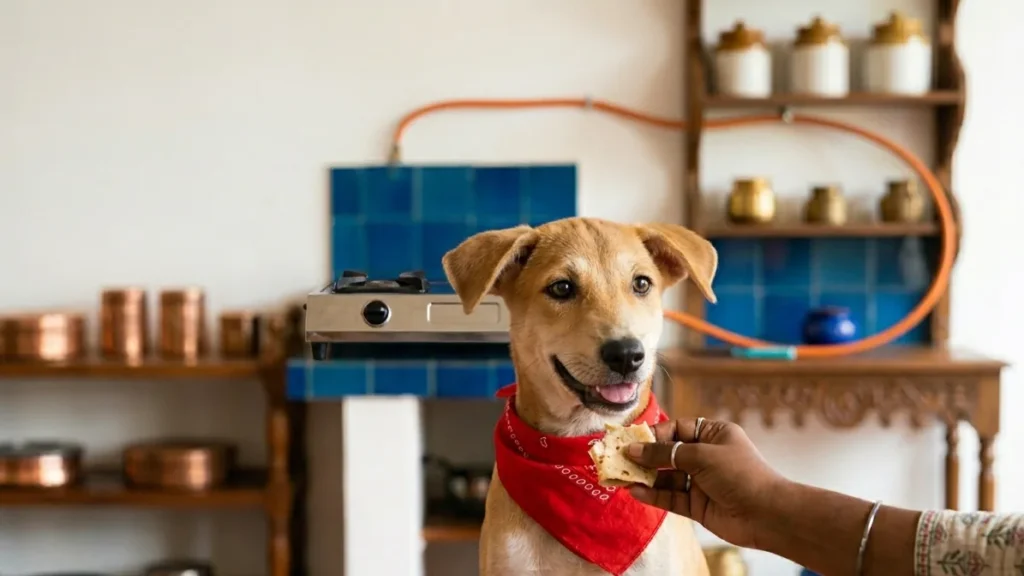

Dinner is served, the dog is under the table, and a torn-off piece of roti goes down without anyone deciding to give it. Then another at the next roti. By the end of the meal the dog has had a whole one.
Roti is not a problem food. It is a portion-control problem dressed up as a harmless habit.
Is roti safe for dogs?
Plain whole-wheat roti, made with atta and water and cooked dry on a tawa, is safe for most dogs. There is nothing toxic in it. Dogs digest cooked wheat starch perfectly well.
Ghee is what changes the maths. A teaspoon of ghee is 45 calories, so a chuppadi roti carries close to 50% more calories than a dry one. Two ghee-smeared rotis and a Beagle has eaten 300 calories, which is about half its day, from what everyone at the table thought of as scraps.
Salt in the dough is worth avoiding. Most households salt the atta. A dog does not need added sodium, and while a pinch will not hurt a healthy dog, it adds up in a household that hands over roti daily. Set aside a portion of unsalted dough if roti is going to be a regular thing.
The sabzi is a bigger risk than the roti. Almost every Indian gravy starts with onion and garlic, both of which oxidise canine haemoglobin and cause damage that accumulates over repeated small exposures. A roti dipped in dal or sabzi is not a plain roti any more.
How much roti can your dog have?
One medium chapati is roughly 40 g, 105 calories, 3.5 g of protein and 2.5 g of fibre, cooked dry. That figure assumes no ghee at all.
| Dog’s weight | Daily calories | Treat ceiling (10%) | Plain dry roti |
|---|---|---|---|
| 5 kg (Pug, Shih Tzu) | ~375 kcal | 37 kcal | 1/6 roti (a two-finger piece) |
| 10 kg (Indie pup, Beagle) | ~630 kcal | 63 kcal | 1/3 roti |
| 20 kg (Indie, Cocker) | ~1,060 kcal | 106 kcal | 1/2 roti |
| 30 kg (Labrador) | ~1,435 kcal | 144 kcal | 2/3 roti |
| 40 kg (GSD, Rottweiler) | ~1,780 kcal | 178 kcal | 3/4 roti |
Daily calories assume a neutered adult dog at a healthy weight, calculated as 1.6 × 70 × (weight in kg)0.75. Portions are set at roughly half the treat ceiling, because roti is almost never the only extra a dog gets in a day. Roti size varies a lot between households; a large Punjabi-style roti can be double the 40 g assumed here.
Not one dog in a hundred is served a third of a roti. They are served a whole one, from four different hands, at the same meal.
The gluten question, and the two breeds where it is real
“Dogs cannot handle gluten” is one of the most repeated claims in pet nutrition, and for the overwhelming majority of dogs it is simply not true. Canine food allergy is far more commonly to beef, dairy or chicken than to wheat.
But gluten sensitivity in dogs is real, and it is breed-specific. Irish Setters carry a documented hereditary gluten-sensitive enteropathy, described in the veterinary literature since the 1980s: affected dogs develop chronic diarrhoea and poor weight gain that resolve on a wheat-free diet. Border Terriers have a separate condition, paroxysmal gluten-sensitive dyskinesia, also called Spike’s disease or canine epileptoid cramping syndrome, where dogs have episodes of cramping and tremor that stop when gluten comes out of the diet.
Those are two breeds out of hundreds. If your dog is one of them and has unexplained chronic gut trouble or odd cramping episodes, wheat is worth raising with your vet. If your dog is an Indie or a Labrador with a normal stool, wheat is not your problem and cutting it will achieve nothing except a smug feeling.
Raw dough: the warning that gets misapplied to chapati
You will have read that raw dough is dangerous for dogs. That warning is accurate, and it is about yeasted dough: bread dough, pizza dough, anything proving on the counter. In a warm stomach the yeast keeps fermenting, producing gas that distends the stomach and ethanol that gets absorbed. It is a genuine emergency and dogs have died from it.
Chapati atta is unleavened. There is no yeast, so there is no fermentation, no gas production and no alcohol. A dog that eats a lump of raw chapati dough is not in the same category of trouble.
That said, do not treat it as fine. A dense ball of raw atta sits heavily, absorbs water, swells, and can cause vomiting or, in a small dog that ate a large amount, an obstruction. Watch for repeated retching, an unproductive urge to vomit, a swollen or painful belly, or restlessness, and call your vet if any of those show up. The distinction matters because it tells you whether you are watching or racing.
How to serve it, and who should skip it
Tear it into pieces rather than handing over a whole one. Dry-cooked, no ghee, no butter, from unsalted dough if you can manage it. Torn roti soaked briefly in warm water is easier for older dogs and small breeds to chew.
Skip roti if: your dog is overweight or on a weight-loss plan, is diabetic without your vet’s sign-off, is an Irish Setter or Border Terrier with unexplained gut or neurological symptoms, or is already getting most of its calories from home food rather than a complete diet.
The single most useful change in most households is not banning roti. It is deciding that one person gives the dog its piece, and everyone else gives none.
Questions people still ask
Can dogs eat roti with dal or sabzi?
No, not the way it is normally cooked. Dal is usually tempered with onion, garlic, salt, chilli and oil, and sabzi almost always starts with an onion base. Onion and garlic damage a dog’s red blood cells, the effect is cumulative across small repeated servings, and the anaemia that results often shows up days later rather than immediately. If you want to give roti with something, use a spoon of plain unsalted boiled dal set aside before the tadka, or plain curd.
Can puppies eat roti?
A small torn piece of plain roti will not harm a puppy on solids, but it is a poor use of a puppy’s appetite. Puppies have high requirements for protein, calcium, phosphorus and specific fatty acids, and every calorie of roti displaces a calorie of properly formulated puppy food that was carrying those nutrients. Keep human food under 10% of a puppy’s intake, and closer to zero during rapid growth in large breeds.
Is bajra or jowar roti better than wheat for dogs?
For a dog with a confirmed wheat sensitivity, yes, they are a sensible swap, since both are gluten-free. For every other dog there is no proven advantage. They are also denser in fibre than wheat, so introducing them suddenly tends to loosen stool. Switch gradually if you switch at all, and do not assume that millet is healthier for your dog simply because it is currently fashionable for you.
Related guides
Part of our human food for dogs guide. See also: can dogs eat rice, can dogs eat ghee, can dogs eat curd and can dogs eat garam masala. For the bigger picture, see our dog nutrition guide.
When in doubt about your dog and a new food, ask your vet. It is the cheapest insurance there is.
Sources: USDA FoodData Central for wheat flour composition; Merck Veterinary Manual, diseases of the stomach and intestines in small animals; ASPCA people foods to avoid.
Wondering about a different food?
🦴 Can my dog eat this?
Type a food to see if it is safe, needs caution, or is a hard no.
Get more dog stories in your inbox. Join Woofs & Words on LinkedIn.
Subscribe on LinkedIn