
They often call the Indian street dog a survivor; tough, wary, built to endure. The Indian pariah dog Aloka is proving he is something more: a teacher. Calm, steadfast, and quietly profound, he carries himself not like a mascot of endurance, but like a sage on four paws.
So what kind of dog is Aloka? He is an Indian Pariah Dog, the indigenous “Indie” street dog of the subcontinent, not bred and not bought. He was an ordinary stray in India who fell in step with a group of Buddhist monks and ended up walking thousands of miles for peace.
Scroll your feed and you’ll likely spot the headlines about a “viral dog” crossing America. The facts are compelling and widely reported: a 3, 700-kilometre journey, 19 Buddhist monks, and one desi dog padding alongside them, step for step. It’s the kind of story that makes for easy clicks and quick wonder.
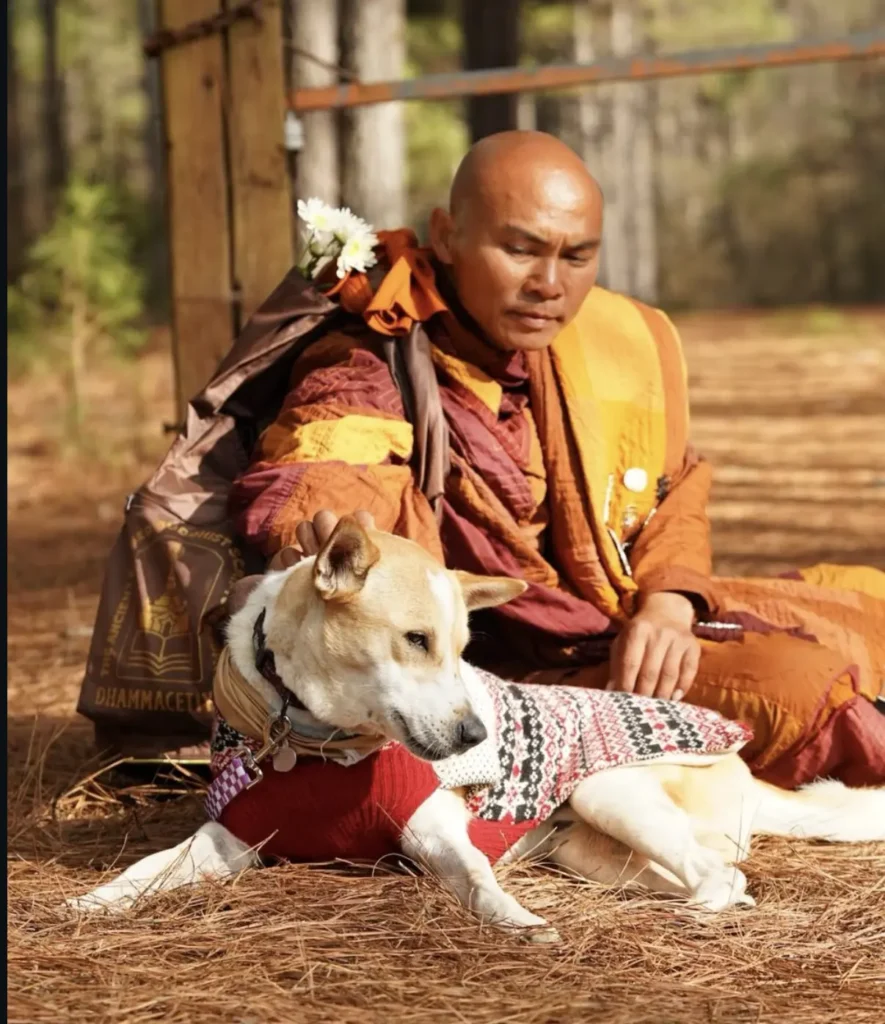
But for us at Dog with Blog, and for anyone who has ever met the steady, soulful gaze of an Indian “stray”, this is not a novelty. It’s a reckoning. Aloka’s walk is a quiet rebuttal to decades of stigma, a living answer to the question of what Indie dogs are capable of. We’ve seen it before. Years ago, Rupee, another rescued Indian dog, quietly rewrote expectations by becoming the first canine to reach Everest Base Camp. We’ve also chronicled how dogs adopted by monasteries often find not just shelter, but purpose, forming bonds rooted in routine, compassion, and shared silence.
Aloka’s journey belongs to that same lineage of truth-tellers. This is not just a charming update or a passing viral sensation. It is a vindication and a powerful reminder that what the world labels as “street dogs” are, in fact, athletes, companions, and quiet philosophers. This is the deeper story of Aloka the Indian Pariah Dog, marked by a heart-shaped patch on his forehead, and why his walk matters for every Indie still waiting to be seen, trusted, and chosen.
What Aloka Reveals About the Indian Pariah Dog
Where Aloka’s journey began
The story didn’t start on an American highway. It began on the chaotic, sun-baked roads of India.
The street dog who chose the monks
A group of Buddhist monks from the Huong Dao Vipassana Bhavana Center (based in Fort Worth, Texas) were undertaking a grueling 112-day Padayatra (peace walk) across the Indian subcontinent. Somewhere along that path, amidst the honking trucks and swirling dust, a scruffy, white-and-brown street dog began to follow them.
He had no collar. He had no name. What he had was an ancient instinct.
Unlike a pet dog who might follow for a treat and leave, this dog was seeking a pack. He walked for days. When he was struck by a passing car, a common, tragic fate for our street dogs, the monks didn’t leave him. They nursed him back to health. When he fell ill later in the journey, they placed him in a support truck to rest.
But here is the moment that defines the Indie spirit: Aloka refused to ride. Reports confirm that he jumped out of the moving support vehicle to rejoin the monks on foot. He didn’t want the easy ride; he wanted the journey.
“He is a constant presence, a true disciple of the path… a living reminder that all beings walk toward peace.”
, Walk for Peace Monks
The American Odyssey: 3, 700 Kilometers of Peace
From a Vietnamese street to an American highway
Recognizing a bond that transcended borders, the monks arranged for Aloka to travel to the United States. Now approximately four years old, Aloka is the unofficial mascot of the Walk for Peace 2025-2026. What sustains this journey is not spectacle but discipline of showing up each day. Entries from the Walk for Peace diary offer a glimpse into that rhythm. By Day 76, as the monks and Aloka walked through parts of South Carolina, reflections focused on a simple but demanding truth: peace is not the absence of hardship, but the ability to meet it with steadiness and wisdom.
A day on the Walk for Peace
The days begin before dawn with chanting and intention-setting, followed by long hours on foot through towns where strangers become hosts, offering water, food, and conversation. Again and again, Aloka appears not as a distraction but as a bridge, children approach first because of him, smiles follow, and questions naturally arise. In these small exchanges, repeated mile after mile, the walk’s purpose becomes visible. A former stray dog, moving calmly beside monks across unfamiliar roads, embodies the message the walk seeks to share: that compassion is learned through presence, patience, and consistency.
The Mission by the Numbers:
- Route: Fort Worth, Texas to Washington, D.C.
- Distance: ~2, 300 miles (approx. 3, 700 km)
- Timeline: Started Oct 26, 2025, Expected arrival Feb 2026
- Companions: 19 Buddhist Monks
- Aloka’s Role: Peace Ambassador & Guardian
While the monks walk to promote non-violence and compassion, Aloka embodies it. As of January 2026, he is trotting through the American Southeast (recently spotted in Georgia and South Carolina), often wearing a neon safety vest or a green sweater, behaving with a calm demeanor that has stopped thousands of strangers in their tracks.
Why Aloka Wins: The “Indie” Advantage
What Aloka teaches us about the Indian Pariah Dog
At Dog with Blog, we have always argued that the Indian Pariah Dog (INDog) is one of the most superior breeds on the planet. Aloka is the perfect case study.
1. The Super-Genetics of a Landrace
Aloka is not a product of human breeding; he is a product of nature. As a landrace breed, his ancestors survived for 15, 000 years on the Indian subcontinent through survival of the fittest.
- Endurance: Indies and many Indian dog breeds are built for long-distance travel. Their lean frames and efficient gait allow Aloka to cover 20-30 miles a day without the joint issues that plague many purebreds.
- Adaptability: From the tropical humidity of India to the freezing winter of the US East Coast, Aloka’s double coat and genetic versatility allow him to thrive.
2. Emotional Intelligence
Reports from the walk describe Aloka as “meditative.” He doesn’t bark unnecessarily. He is protective yet gentle with the crowds that gather to see him. This is a classic Indie trait: they are highly observant, emotionally attuned, and fiercely loyal to their chosen “pack.”
The Spiritual Lesson: Dogs as Gurus
The miles that nearly stopped him
Aloka’s road to the world stage ran straight through danger. During the monks’ months-long pilgrimage across India, he was hit by a car and later fell seriously ill. Each time, once he could stand, he picked himself up and limped back to the procession. That refusal to quit isn’t a charming quirk. It’s what an indie street dog is built on. Resilience for these dogs isn’t personality; it’s survival, learned on roads far less forgiving than any American highway.
The road caught up with him again in January 2026. Midway through the 2, 300-mile U.S. Walk for Peace, somewhere in South Carolina, Aloka tore his cranial cruciate ligament, a dog’s version of a blown ACL. Surgeons at the Charleston Veterinary Referral Center performed a TPLO knee operation free of charge; a procedure booked for two to three hours was done in one. Days later he reunited with the monks in Charlotte, tail going like a metronome, then headed back to rest on a careful plan of short, controlled walks. Vets expect him walking and running without pain within two to three months. So if you came here fearing the worst: Aloka is okay. He is healing, and he is still, unmistakably, on his way to Washington.
Why Aloka went viral
Why has Aloka gone viral? It’s not just because he’s cute (though, with that unique heart-shaped mark on his forehead, he certainly is).
It’s because he represents mindfulness in motion. Humans often walk with a destination in mind, we worry about the ETA, the weather, the blisters. Aloka just walks. He lives entirely in the step he is taking right now. It is not just the distance he has covered, but the way his loyalty emerged, unprompted, untrained, and unwavering. Named Aloka, a Sanskrit word meaning light, clarity, or awakening, he first began accompanying monks of the Dhammakaya tradition during their Walk for Peace across India.
In Buddhism, this is the ultimate goal. In this sense, the monks aren’t walking the dog; the dog is leading the monks.
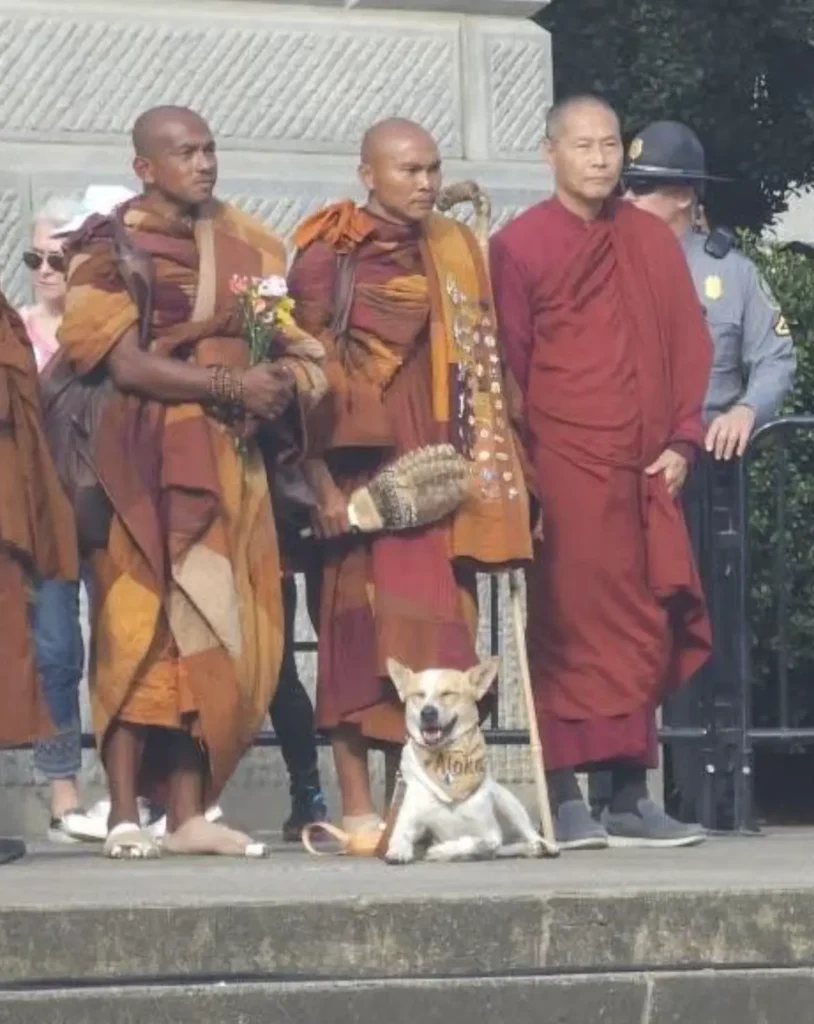
How You Can Honor Aloka’s Journey
For every Aloka, thousands wait
Aloka is one of the lucky ones. For every Aloka who finds a monk, there are millions of Indies on the streets of Delhi, Mumbai, and Bangalore who are shooed away. He is a living embodiment of the walk’s message, that peace does not announce itself loudly, but arrives through constancy, presence, and trust.
If this story touches you, don’t just “like” it, act on it. One of the kindest things you can do is adopt an Indie of your own.
- Don’t Shop, Adopt: The next time you want a dog, look at the street. That “mutt” has the same heart, the same resilience, and the same potential for loyalty as Aloka. Check out latest dog adoption updates on Reddit or social media feeds.
- Volunteer: Local shelters are always in need of walkers. You can have your own “Walk for Peace” with a shelter dog this weekend.
- Follow the Path: You can track Aloka’s live progress on his official Instagram @alokathepeacedog.
Aloka’s story did not begin with a name, a mission, or an audience but it began with survival. That it now unfolds on open roads, beside monks and among strangers who pause to watch, feels extraordinary. Yet the deeper truth is simpler and more challenging: what we call a miracle is often just potential finally met with trust. For every Aloka walking in the open, there are countless Indie dogs still navigating the margins, carrying the same quiet intelligence and devotion, waiting not for rescue alone, but for recognition.
Has an Indie dog shaped your life in unexpected ways? We’d love to hear your story, share it with us!
Get more dog stories in your inbox. Join Woofs & Words on LinkedIn.
Subscribe on LinkedIn