
Medically reviewed by Dr. Catherine Nicolaou, DVM.
Two of the dogs in Prime Minister Narendra Modi’s security ring are not German Shepherds or Belgian Malinois. They are Mudhol Hounds, a lean desi sighthound from a small town in Karnataka, and they are there on merit. In 2016 the Mudhol became the first Indian breed ever drafted into the Indian Army, and it has since earned a posting beside the country’s most protected man.
For a dog that once ran alongside trading caravans across the Deccan, that is quite a promotion. Here is the full story of India’s home-grown hunting hound: where it came from, what it is actually like to live with, and why it is finally getting the respect it spent a century waiting for.
Where the Mudhol Hound comes from
The breed is named after Mudhol, a town in the Bagalkot district of Karnataka, out on the dry Deccan plateau. Its modern story owes a lot to one man: Shrimant Rajesaheb Maloji Rao Ghorpade, who ruled the princely state of Mudhol until 1937. He watched the local Bedar hunters course game with their fast, rangy dogs and used careful breeding to bring the type back to its best.
On a visit to England in the early 1900s, the ruler of Mudhol gifted a pair to King George V, who is said to have given the breed its English name. That is also why it answers to so many: the Kennel Club of India registers it as the Caravan Hound, because the dogs travelled with trade caravans; local villagers call it Karwani; and the longer-coated, feathered variety is the Pashmi.
Built like a Saluki, bred for the Deccan
This is a classic sighthound, cut from the same cloth as the Saluki and the Afghan: tall and narrow, with a deep chest, a long muzzle, a slight Roman curve to the nose and a frame built for speed and stamina over open ground. Males stand around 68 to 72 cm. Most Mudhols carry a short, smooth coat, while the Pashmi variety adds light feathering on the ears, tail and legs. Colours run across fawn, cream, red, black and brindle.
Mudhol Hound facts at a glance
- Origin: Mudhol, Bagalkot district, Karnataka
- Also called: Caravan Hound, Karwani, Pashmi (the feathered variety)
- Type: sighthound, built for speed and stamina
- Height: males about 68–72 cm; females a little smaller (about 64–68 cm)
- Weight: roughly 22–28 kg, lean and deep-chested
- Lifespan: about 10–14 years
- Coat: usually short and smooth; the Pashmi is lightly feathered
- Temperament: loyal to its person, aloof with strangers, high prey drive
- Claim to fame: the first Indian breed inducted into the Indian Army (2016)
- Best suited to: active homes with space, not small flats
India’s first military dog
This is the part that put the Mudhol on the map. In February 2016 it became the first indigenous Indian breed taken into the Indian Army, after the Remount Veterinary Corps trialled it against the usual imported working dogs and found it sharp, hardy and cheap to keep in Indian conditions. Since then the Army, paramilitary forces and police have inducted dozens of them.
In 2022, two Mudhol pups from the Canine Research and Information Centre at Thimmapur, near Mudhol, joined the Special Protection Group that guards the Prime Minister. Modi himself name-checked India’s native breeds, the Mudhol among them, in a 2020 Mann Ki Baat broadcast, urging Indians to consider a desi dog over an imported one. For a breed that nearly faded out, official backing like this has been a lifeline.
A sighthound first, a soldier second
Do not let the military CV fool you into expecting a cuddly all-rounder. The Mudhol is a sighthound first: devoted to its own person, reserved bordering on suspicious with strangers, and independent enough to make obedience a negotiation rather than a given. That aloofness is exactly what makes it a sharp watchdog.
The prey drive is serious. Anything small and fast that moves, a cat, a squirrel, a chicken, will trip the chase instinct it was bred for, so a secure space and a solid recall matter. Give it real exercise, a long daily run or a chance to sprint, and it settles into a calm, clean, low-fuss housemate. Skimp on that, and you get a frustrated athlete bouncing off your walls.
Low-maintenance, until you skip the run
The good news is that this is a genuinely low-maintenance dog. The short coat barely sheds and needs little grooming, and as a desi breed it shrugs off the Indian heat that floors a Husky. It is hardy, with none of the long list of inherited problems that plague many imported pedigrees, but it is not bullet-proof: like any deep-chested sighthound it can bloat, so feed two smaller meals rather than one big bowl before a run, and with almost no body fat it feels the cold and wet far more than a thick-coated dog, so it wants shelter in a north-Indian winter or a monsoon downpour. What it really needs is space and exercise, which rules out a cramped flat with no daily outlet.
The price question, answered honestly
Search “Mudhol Hound price” and you will see ₹5,000 to ₹30,000 thrown around, more if a listing waves a “KCI pedigree” at you. We are not going to help you shop. A price tag is exactly how a hardy desi breed ends up mass-bred in backyard kennels, and how the dog that did not sell ends up dumped. Dog with Blog does not buy or sell dogs, and we would ask you not to either.
If it is specifically the Mudhol’s traits you want, the one defensible source is the government’s own Canine Research and Information Centre at Mudhol, not a marketplace listing where poor breeding hides behind a low number. But be honest about why. If you love the idea of a fast, loyal desi dog, an desi dog breed gives you the same heart, and there are sighthound mixes in shelters right now. Start with our adoption directory, not a breeder’s price list.
Whichever way a dog comes home, budget ₹3,000 to ₹8,000 a month to actually care for one: food, vaccinations and the occasional vet bill. That cost is real, and it never shows up in the “price”.
Where the Mudhol fits among India’s breeds
The Mudhol is Karnataka’s most celebrated dog, but it belongs to a wider family of Indian sighthounds and guardians, from the Rajapalayam and Kombai of Tamil Nadu to the Rampur Greyhound of the north. Our guide to India’s native dog breeds maps out the whole group.
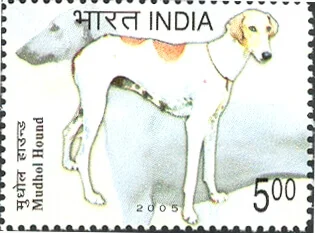
The Mudhol was also one of four native breeds India honoured on a set of 2005 postage stamps.
In 2005, @IndiaPostOffice released four commemorative postage stamps celebrating the canine heritage of the country – Himalayan Sheepdog, Rampur Greyhound, Mudhol Hound and Rajapalayam.
— Abhishek Joshi (@kaalicharan) July 17, 2020
It took a place in the Army and a posting beside the Prime Minister for India to notice the dog that had been running across the Deccan all along. The Mudhol did not change. The country’s taste finally did.
Mudhol Hound FAQs
Is the Mudhol Hound the same as the Caravan Hound? Yes. They are one breed with different names: the KCI registers it as the Caravan Hound, the INKC as the Mudhol Hound, and locals call it Karwani. The longer-coated Pashmi is its feathered variety.
Where can I get a Mudhol Hound, and what does one cost? Dog with Blog is adopt-don’t-shop, so the honest answer is to adopt first: start with our adoption directory, where desi dogs and sighthound mixes are waiting for homes. If you genuinely need the breed’s working traits, the government’s Canine Research and Information Centre at Mudhol is the only source worth trusting. Treat cheap online “Mudhol Hound price” listings as a red flag, not a bargain.
Get more dog stories in your inbox. Join Woofs & Words on LinkedIn.
Subscribe on LinkedIn