
Medically reviewed by Dr. Catherine Nicolaou, DVM.
Quick answer: The Rampur Greyhound is a tall Indian sighthound bred by the Nawabs of Rampur to hunt jackal and even tiger: lean, fast, and built for open country. Devoted but independent, it needs space and daily hard running, not a small flat. Once near extinction, it survives today in small numbers.
The Nawab of Rampur wanted a dog that could run down a leopard and still come back when called. In the early 1800s he got one. By crossing the desert-bred Tazi (the Central-Asian sighthound related to the Afghan Hound) with the English Greyhound, the rulers of Rampur built a sighthound fast enough to chase big cats across the northern plains and steady enough to live in a palace. They called it the Rampur Greyhound, and for a century it was the hunting dog of Indian royalty.
Then the maharajas lost their shikars, and the breed nearly went with them. This is the story of India’s fastest forgotten hound: how it was made, what it is like, and why it is only just clawing its way back from the edge.
Where the Rampur Greyhound comes from
The breed is the deliberate creation of one man: Nawab Ahmad Ali Khan Bahadur, a nineteenth-century ruler of Rampur State in what is now Uttar Pradesh. He took the Tazi, the tough Central Asian sighthound prized for hunting wolves but famously headstrong, and crossed it with the calmer, more trainable English Greyhound. The result was exactly what he was after: a hound with the speed and grit to bring down big game, and the temperament to listen to a handler.
Indian royalty took to it at once. Maharajas used the Rampur Greyhound to course jackals and wild boar, and to run down leopards, panthers and even tigers. It is reckoned among the fastest dogs alive, able to clear 40 miles an hour over open ground.
What a Rampur Greyhound looks like
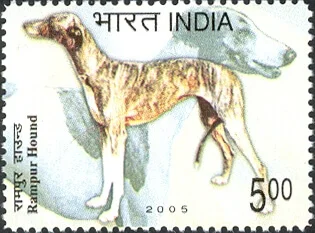
It is built like every great sighthound and then some: tall, around two feet at the shoulder, deep-chested, with long whip-thin legs, a narrow head and a tail like a stockwhip. Two details set it apart. Its ears are usually fine and half-folded, and its feet are slightly webbed with unusually flexible toes, which makes it surprisingly good at gripping and turning at speed. Coats come in a range, from mouse-grey and black to brindle and fawn.
Rampur Greyhound facts at a glance
- Origin: Rampur, Uttar Pradesh, North India
- Bred from: the Central-Asian Tazi (an Afghan Hound relative) crossed with the English Greyhound
- Type: sighthound, one of the fastest dogs in the world
- Height: males about 61–76 cm, females 56–61 cm at the shoulder
- Weight: about 23–32 kg
- Lifespan: about 10–12 years
- Coat: short and fine; grey, black, brindle or fawn
- Temperament: loyal to one person, reserved with strangers, sensitive
- Claim to fame: the hunting hound of Indian maharajas
- Status: rare, recovering from near-extinction
The dog that almost disappeared
The Rampur Greyhound’s fortunes were tied to a way of life that began unravelling in 1947. When the princely states were dissolved, and big-game hunting was first frowned upon and then outlawed outright by the Wildlife Protection Act of 1972, demand for a leopard-coursing hound collapsed. Breeding all but stopped, and by the late twentieth century the Rampur was teetering on the edge of extinction. A small band of enthusiasts and a slow revival of interest in indigenous breeds have started to pull the numbers back, but it remains a genuinely rare dog.
What the Rampur Greyhound is like to live with
Strip away the hunting CV and you find a quiet, sensitive, deeply loyal dog. It bonds hard with its person, stays aloof with strangers and dislikes rough handling, responding far better to calm, patient training than to force. Indoors it is a famous couch potato, content to fold itself into a corner and sleep.
The catch is the engine. This is a sprinter with a powerful prey drive, and it needs real room to open up, ideally a large, secure space to run flat out. Cooped up in a small flat with only short walks, a Rampur frets and fades. Give it the run it was built for and it becomes one of the easiest, gentlest housemates you could ask for.
Living with a Rampur Greyhound, and the price question
Care is light: a short coat that needs almost no grooming, a hardy constitution and good tolerance for Indian heat, though the lean build means it feels the cold and wants a warm bed. What it cannot do without is space and a daily sprint.
Because the breed is so rare, genuine Rampur Greyhounds are hard to find, and any cheap, easily-available litter deserves a hard second look. If you are drawn to a fast, gentle, loyal Indian dog, an desi dog (Indian pariah) from our adoption directory is the kinder place to start, and you will be giving a home rather than propping up a fragile market.
Where the Rampur fits among India’s breeds
The Rampur Greyhound is the north’s great sighthound, a cousin in spirit to the south’s Chippiparai and Kanni and the Deccan’s Mudhol Hound. Like them, it was honoured on an Indian postage stamp in 2005. Our guide to India’s native dog breeds places it among the rest.
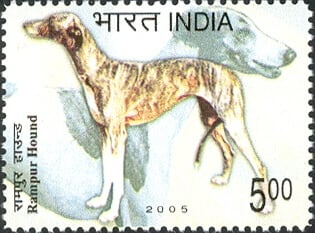
In 2005, @IndiaPostOffice released four commemorative postage stamps celebrating the canine heritage of the country – Himalayan Sheepdog, Rampur Greyhound, Mudhol Hound and Rajapalayam.
— Abhishek Joshi (@kaalicharan) July 17, 2020
A dog bred to outrun a tiger now spends its afternoons asleep on a sofa, waiting for India to remember it exists. The Rampur Greyhound never lost its speed. It lost its purpose, and is still looking for a new one.
Rampur Greyhound FAQs
Is the Rampur Greyhound a good pet? For a home with space, yes. It is gentle, quiet and loyal indoors, but a sensitive sighthound with a strong prey drive that needs room to sprint. It is not a small-flat dog.
How fast is a Rampur Greyhound? It is reputed to be among the fastest dogs in the world, able to run at over 40 miles an hour.
Why is the Rampur Greyhound so rare? It was bred for royal big-game hunting, which ended after 1947. Demand collapsed and the breed nearly went extinct; it is now slowly recovering.
What was the Rampur Greyhound bred from? A cross of the Central Asian Tazi and the English Greyhound, created by the Nawab of Rampur in the nineteenth century.
Is the Rampur Greyhound good with strangers and children? It is reserved with strangers and sensitive to rough handling, so it does best with calm, older children and early socialisation.
Get more dog stories in your inbox. Join Woofs & Words on LinkedIn.
Subscribe on LinkedIn