
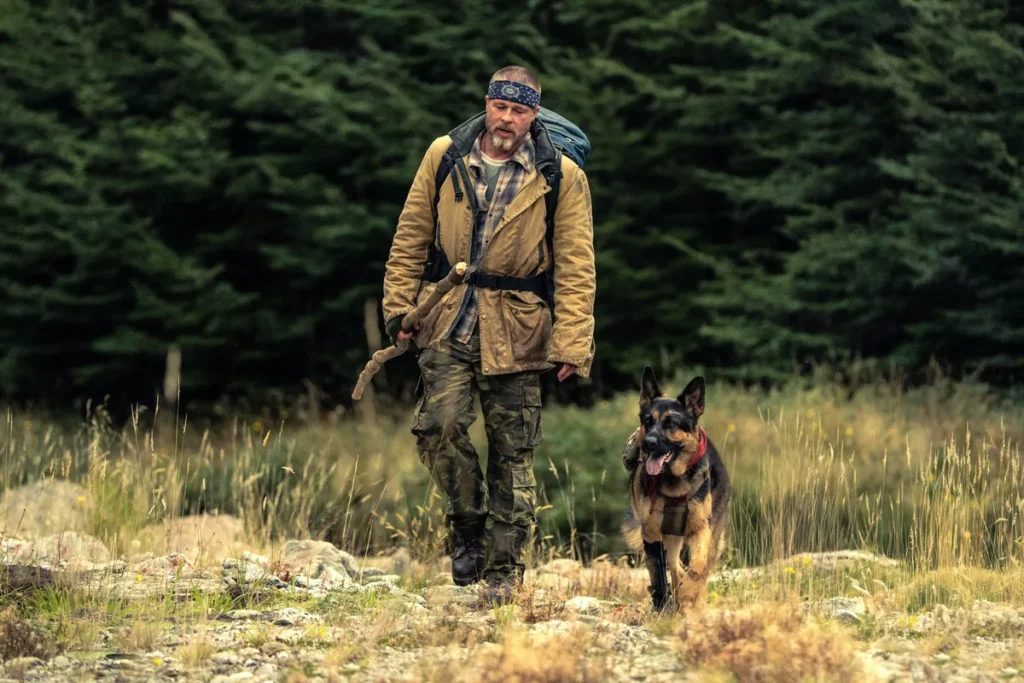
A German Shepherd with a prosthetic foreleg and a red scarf stands alone on a road in Alaska. That’s how Heart of the Beast opens, and it confirms what viewers may have been worried about: the dog lives.
There’s no sight sadder on the silver screen than a dog dying. Here’s remembering Daisy from John Wick. David Ayer seems to know it well, and he comforted many a viewer in his very first shot. The dog gets out of the woods, and an “A week earlier” title card then takes us through the events that unfolded over the past week.
The makers confirmed the dog lives well before release: producer Richard Raymond posted it on X in June, because they knew the question would keep dog people away. What happens to the humans is blurred out further down for anyone who hasn’t seen it.
Heart of the Beast (2026) at a glance
Director: David Ayer · Writer: Cameron Alexander · Producers: David Ayer, Brad Pitt, Damien Chazelle
Cast: Brad Pitt (James Belmont), J.K. Simmons (Watkins), Anna Lambe (Amber)
Odin’s breed: German Shepherd · Played by: Uber, a working dog from New Zealand, and his sons Seeka, Ryker and Hondo
True story? No. It’s an original screenplay, not based on a book or a real dog.
Runtime: 1h 41m · Certificate: UA16+ in India, PG-13 in the US
Release date in India: 25 September 2026, in cinemas, in English · OTT: no streaming date or Indian platform announced as of 4 October 2026.
Does the dog die? No. Odin survives, though he’s hurt more than once and other animals die on screen.
Is it sad? Yes. Keep tissues handy.
What happens in Heart of the Beast (no spoilers)
James Belmont (Brad Pitt) and Odin served together in Afghanistan. Odin came home missing a front leg, with a prosthetic in its place and metal where some of his teeth used to be, and both of them still wake up from the same war at night, a reminder that wars are never truly over and that PTSD hurts dogs too. On the way in they meet Watkins (J.K. Simmons), a man on a boat who warns them that weather is coming. Then James has a heart attack at the controls and the floatplane goes down, 58 miles from the nearest road.
This sets up man (and dog) against nature: a grizzly bear and a pack of grey wolves.
Who plays Odin? Uber, a dog too nice to be a police dog
Odin is played by a six-year-old German Shepherd called Uber, and his CV would put most actors to shame. He did two years of police training and washed out. Head trainer Andrew Simpson’s verdict: Uber was “too nice a dog to be a police dog.” So he went to work as the companion of a paramedic who flew rescue helicopters around Queenstown, which is where Simpson found him while auditioning dogs across New Zealand.
Simpson isn’t new to this (his credits include John Wick, Game of Thrones and The Revenant), and the dog unit was no small affair either. Four dogs played Odin, Uber and three of his sons, Seeka, Ryker and Hondo, each trained for particular jobs. A twelve-person crew looked after them: trainers, makeup, prosthetics and costume. A dog with battle scars and a war vest has continuity problems just like any human actor, and Ayer told one interviewer the dog would come in for hair and makeup and get a mic clipped on.
And the secret to getting a German Shepherd to look at Brad Pitt like that? Boiled chicken. According to Ayer, Pitt went to the kennel to bond with Uber and spent the shoot with his pockets full of it. Pitt says Uber “would do things that were just amazing, that were not in the script,” and that the close-ups moved him. We believe him.
That missing leg is movie work, by the way, part prosthetics team and part CGI, and the CGI is well done. So is the cinematography, which captures the great northern stretches of Alaska beautifully, even though none of it is Alaska. Ayer shot on New Zealand’s South Island, around Queenstown, Glenorchy, Lake Wakatipu, Milford Sound and Mt Aspiring National Park, and told a local paper you can’t tell the difference. We couldn’t.
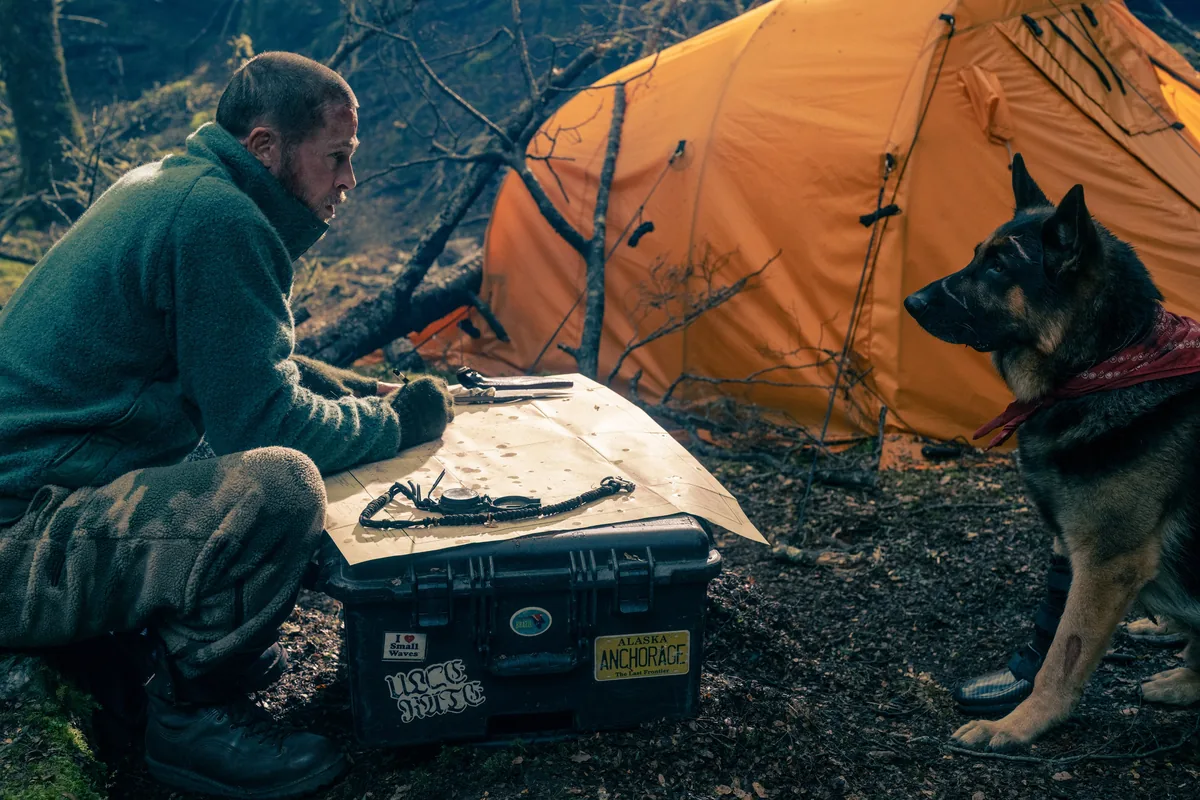
Odin’s metal teeth are the bit of the costume that’s closest to real life. Working dogs do get metal crowns, though not to bite harder. Veterinary dentist Dr John R. Lewis has written that a full metal crown goes on a canine tooth after it has broken and had root canal treatment, so that the same forces don’t break it again, and that the crowns hold up “even in those police dogs that test the crowns every day with bite work.” A dog’s own teeth are strong enough for the job. So if Odin has metal fangs, his real ones broke on duty.
Is Heart of the Beast a true story? No. Cameron Alexander wrote it as an original screenplay and James and Odin are fictional. If Odin has a real-life counterpart, it’s Lucca, the US Marine Corps German Shepherd who lost a leg to an IED in Afghanistan’s Helmand Province and retired to her former handler’s home in California.
What we liked, and what we didn’t
I watched it on 3 October, and it reminded me of The Grey and, to a degree, Finch. It gave me vibes from a lot of survival movies too, 127 Hours and Into the Wild among them.
The relationship between Pitt’s character and Odin is brilliant. The film is not heavy on dialogue, but it doesn’t need to be. And James is driven by one thing, giving his doggo a good life. A noble and rare life goal these days.
Anyone who has been fortunate enough to share a life with dogs knows the look Odin has, that of a dog who trusts you completely. A dog’s love doesn’t run out, and the movie echoes that, setting it against everything people have put him through.
And the dog? Uber is the star of the show, with more dignified expressions in his close-ups than many Tinseltown leads. Brad Pitt plays his reserved role really well. Uber would certainly be an early front-runner for the Palm Dog award.
Odin gets his own post-traumatic episode in the film, battlefield sound effects and all. It’s tempting to call that silly.
Silly it isn’t. Canine PTSD is a recognised condition in military working dogs. In 2011, Dr Walter Burghardt, who headed behavioural medicine at the US military’s working dog hospital at Lackland Air Force Base, estimated that more than 5% of the roughly 650 dogs then deployed by American combat forces were developing it, and that about half of those would have to be retired. Read the symptoms he listed and you could be reading Odin’s file: hypervigilance, avoiding places the dog was once comfortable in, sudden clinginess or aggression toward the handler, and a dog that once ignored gunfire now barking wildly at it.
The sound design may oversell it, but the condition underneath the scene is very real.
Not everything lands. The wolves and the grizzly bear that attack our leads are CGI predators, and they look somewhat odd standing next to Odin. Back in 1988, Jean-Jacques Annaud shot The Bear with a real trained Kodiak called Bart and kept the animatronics for the fight scenes. Perhaps this could have been done better.
Then there’s the tone. The movie doesn’t try to be overtly manipulative. Yes, there are set pieces and flashbacks, but they show the PTSD backstory and help drive the plot forward.
As for using dogs in combat, I know the great role canines have played in the war against terror, but I still feel animals shouldn’t be put in the way of danger for things they never had the free will to sign up for. While we’re at it, I hold the same view on space exploration, and on losing Laika too.
Is Heart of the Beast sad?
Yes, though maybe not the way you expect. The dog lives, but he doesn’t get off lightly. Wolves tear into Odin, a grizzly comes for him, and the river nearly takes him. For a long stretch you’re not sure he’ll make it, even if you already know he does. Other animals aren’t spared either: Odin catches a fish, and predators bring down a moose calf. And James’s arm snaps in the river, bone through skin, and gets reset on screen.
Keep tissues handy for the last act.
Heart of the Beast ending explained (spoilers)
James Belmont dies from the injuries he suffered in the wolf attack, a deep bite to the stomach that won’t stop bleeding. He never makes the last climb to the road, and passes on a rock under the northern lights with Odin beside him. In the morning Odin howls over him and leaves, reaches the road from the opening shot, and is found by a young woman named Amber, played by Anna Lambe. The dog lives. The man, however, meets a fatal fate.
The last few hours James and Odin spend together under the stars, and Odin’s howl when he realises his best friend is no longer there, absolutely destroyed me. The loss of human life is always tragic, but something about an innocent animal going through such profound grief just punches you in the gut.
Before he dies, James writes a letter and leaves it with Odin. Read it as a dog person and it’s a rehoming note, almost line for line. Odin is a trained special operations dog who needs a home. He has PTSD nightmares but settles if you speak to him calmly. His commands are listed on the back, and the finder should never use the bite command unless they’re in real danger. Buffalo jerky, scruff grabs and fetch are his favourite things, and whoever takes him on gets James’s bank accounts. Somewhere in the middle sits the line the film is named for:
“The heart of this beast is strong.”
A little further on comes the line the whole film turns on: “I’ve shown Odin war, and he’s shown me nothing but love and trust.” The film hints that Odin saved James in Afghanistan. Out here, it’s James’s turn to save Odin.
That’s a better handover than many dogs on our own adoption directory got. When we audited the directory in August, 206 listings had a story shorter than 40 words and no phone number or email at all. If you ever have to rehome a dog, write the letter James wrote, and our adoption guide covers the rest of what the next family needs to know.
Indian readers will know the shape of this ending from a much older story. At the end of the Mahabharata, Yudhishthira reaches the gates of heaven with a dog at his heels and refuses to go in without it. James, nearly at the road, spends what he has left making sure his dog goes on without him.
The film closes on text cards about retired military working dogs.
A decade ago, India was putting down its retired army dogs
Some will find the closing text cards about veteran dogs needing homes a bit preachy. We don’t, because in India that message has a history. Odin gets a retirement. Until recently, India’s army dogs weren’t promised one. In 2015 an RTI reply revealed the Indian Army was euthanising dogs at retirement, or when they were judged unfit for service for more than a month. After the story broke, the government told the Delhi High Court it would stop, and that the Army had already ended the practice except for terminally ill or badly injured animals.
Retired army dogs now go to the Canine Geriatric Centre at the Remount Veterinary Corps Centre and College in Meerut, and some are adopted out. On RVC Day, 25 December 2024, twelve of them were handed over to Asha schools and to individual families.
Others never reached retirement. Axel, a two-year-old Belgian Malinois, was shot in Jammu and Kashmir on 30 July 2022 after he found and went for an armed terrorist during a building search, and was mentioned in despatches. Zoom, another two-year-old Malinois, took two bullets in Anantnag that October and died of his injuries three days later in Srinagar. Kent, a nine-year-old Labrador, was shot while clearing a house in Rajouri and was honoured posthumously on Independence Day 2024. Indian units are working more with native breeds now, including the Mudhol Hound, and Mumbai’s 26/11 dog squad belongs to the same story. Superheroes sans capes, every one of them.
Before you go looking for your own Odin
Films sell dog breeds. In 2014, researchers led by Stefano Ghirlanda went through 87 dog movies against the American Kennel Club’s registry of more than 65 million dogs and found a single film could lift a breed’s popularity for up to ten years. After Lassie Come Home in 1943, Collie registrations rose 40% within two years. Our 777 Charlie review tracks the same effect closer home, where a film with an adopt-don’t-shop message sent people looking for Labradors.
Odin is a working dog with years of training behind him and a handler who built his life around him. A German Shepherd bought as a puppy on the strength of a movie is a large, high-energy, heavily coated dog who needs a job and a lot of your time.
When it goes wrong, those Shepherds end up on our adoption directory. Right now that includes Bagheera, a seven-year-old German Shepherd in Hyderabad, and over the years the directory has carried surrendered Shepherds and Shepherd crosses from Delhi, Patna, Kolkata and Wayanad. An adult dog who has been given up once is closer to Odin than any puppy will ever be. And if it’s the loyalty you fell for rather than the breed, most of the dogs on our adoption page are indies, built for an Indian summer in a way a double-coated Shepherd isn’t.
Where to watch Heart of the Beast in India, and how it’s doing
In cinemas, for now. Paramount released it in Indian theatres on 25 September 2026, in English, with a UA16+ certificate. As of 4 October no streaming date has been announced for India. In the US, Paramount’s films go to its own streamer, Paramount+, after the cinema run, but Paramount hasn’t said where the film will stream here, so any listing that puts it on Netflix or Prime Video is a guess.
It opened to $20.0 million in the US and $50.1 million worldwide. In India it had made ₹5.57 crore net by 2 October, by Bollywood Hungama’s count.
Our verdict: is Heart of the Beast worth watching?
Rating: 4 / 5
It isn’t an easy watch, and it isn’t meant to be. The film set out to get a visceral response, and it got one from me.
Recommended. This canine and man bond film takes the fight to the natural world, against a backdrop of war and PTSD. I wouldn’t recommend it for kids.
If the man-and-dog-against-the-wild part got to you, complement your watch list with Togo, a sled dog in Alaska and a true story, and Finch, where Tom Hanks builds a robot to look after his dog when he can’t. For the full list, including a table of which dog films let the dog live, start with our guide to the best dog movies. Hold on to that popcorn bowl and hug your dog.
Get more dog stories in your inbox: join Woofs & Words.
Get more dog stories in your inbox. Join Woofs & Words on LinkedIn.
Subscribe on LinkedIn