
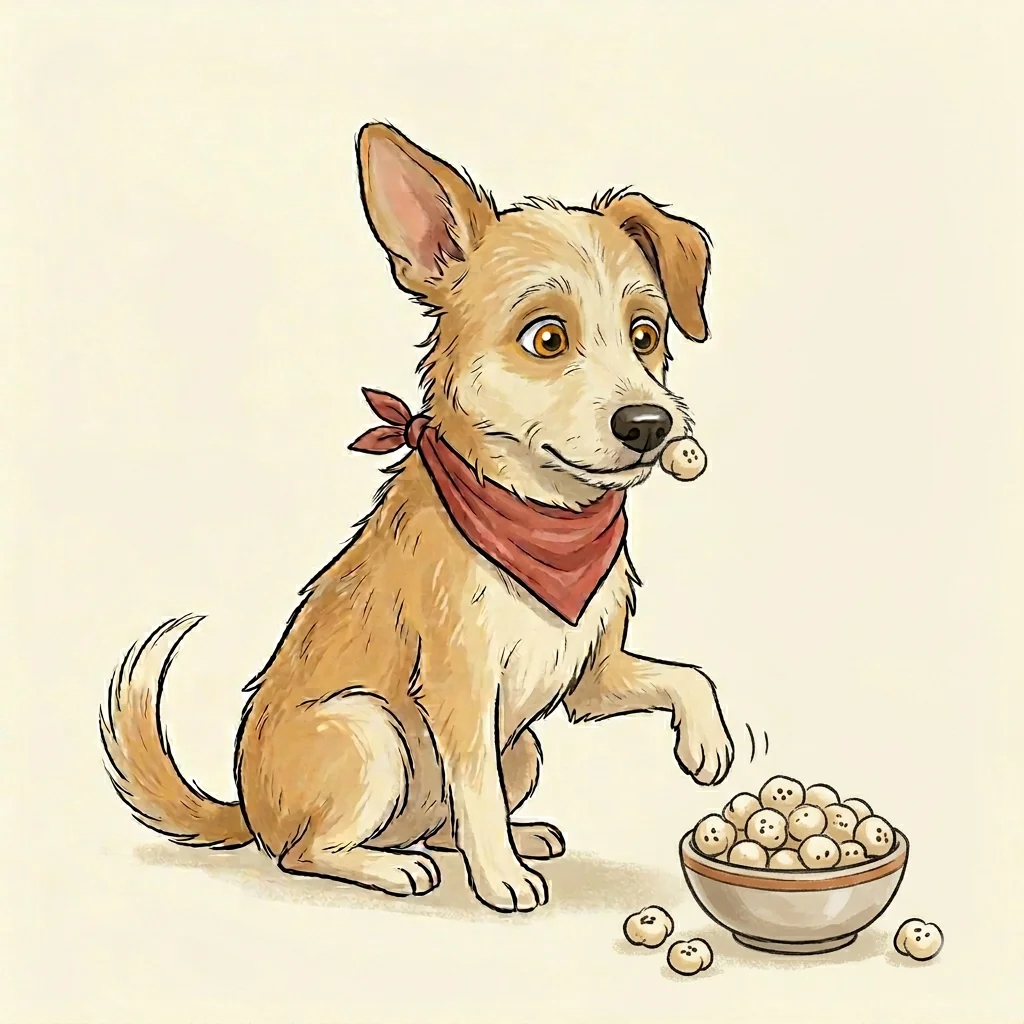

You are watching TV with a bowl of makhana. The dog is doing the thing where it stares at the bowl and then at your face, alternately, until you give in. One puff weighs almost nothing. It seems harmless.
It mostly is. But the reason people feed makhana to their dogs so freely is a mistake about arithmetic, and that mistake is worth clearing up before your dog puts on two kilos over a winter.
Is makhana safe for dogs?
Plain makhana is one of the safer Indian snacks to share. Lotus seeds contain no compound that is toxic to dogs, no pit, no skin to strip, and almost no fat. Dogs generally digest them without drama.
The seed is fine. The seasoning is the problem. Almost nobody eats plain makhana. It is roasted in ghee, salted, tossed in peri-peri or chaat masala or cheese powder, and sometimes caramelised. Those versions bring salt, fat, chilli and occasionally onion or garlic powder, which is where the actual risk lives. If the packet has a flavour name on the front, it is not for your dog.
Raw, unroasted lotus seeds are a different object. They are hard, dense and unpleasant to chew. A dog that bolts food can crack a tooth or swallow one whole. Roasted makhana is puffed and crumbles easily; that is the form to use.
Phosphorus is worth a mention if your dog has kidney disease. Makhana carries roughly 200 mg of phosphorus per 100 g, which is high for a snack. For a healthy dog this is irrelevant. For a dog on a renal diet, phosphorus is the whole point of the diet, and this snack undoes some of it. Ask your vet before making it a habit.
How much makhana can your dog have?
Counting grams is useless here, because nobody weighs makhana. So this table counts puffs. A plain roasted makhana weighs roughly 0.4 g, which works out to about 1.4 calories each.
| Dog’s weight | Daily calories | Treat ceiling (10%) | Makhana, as puffs |
|---|---|---|---|
| 5 kg (Pug, Shih Tzu) | ~375 kcal | 37 kcal | 10–12 puffs (~5 g) |
| 10 kg (Indie pup, Beagle) | ~630 kcal | 63 kcal | 20 puffs (~8 g) |
| 20 kg (Indie, Cocker) | ~1,060 kcal | 106 kcal | 35 puffs (~15 g) |
| 30 kg (Labrador) | ~1,435 kcal | 144 kcal | 50 puffs (~20 g) |
| 40 kg (GSD, Rottweiler) | ~1,780 kcal | 178 kcal | 60 puffs (~25 g) |
Daily calories assume a neutered adult dog at a healthy weight, calculated as 1.6 × 70 × (weight in kg)0.75. Portions are set at roughly half the treat ceiling, because makhana is almost never the only treat a dog gets in a day. Puff weight varies by grade; large “3-suta” makhana runs heavier.
Sixty puffs sounds generous until you notice that a standard 100 g retail packet holds around 250 of them. Half a packet is a Labrador’s entire treat budget for the day.
The claim to stop repeating: “makhana is a low-calorie snack”
It is not. At roughly 347 calories per 100 g, makhana is denser than paneer, denser than boiled chicken, and roughly level with many commercial biscuit treats. Popcorn, its closest textural cousin, is not far off either.
What confuses everybody is volume. A hundred grams of makhana is an enormous bowl. A hundred grams of paneer is a small cube. Your eye reads the bowl and concludes “light,” and then a dog gets fed by the handful all evening.
The honest framing is this: makhana is a low-calorie snack per bite and a high-calorie snack per gram. Feed it by the piece and it is one of the best treats on this list. Feed it by the handful and it is a weight problem with a health-food reputation.
Where makhana genuinely wins is fat. At about 0.1 g per 100 g it is effectively fat-free, which makes it a reasonable option for a dog recovering from pancreatitis or on a low-fat diet, unlike peanuts or ghee. Clear that with your vet first, but the nutritional argument is real.
Who should skip it
Overweight dogs. Not because makhana is uniquely bad, but because it is the treat people forget to count. If your dog is on a weight plan, makhana belongs inside the calorie budget or nowhere.
Diabetic dogs. Around 77 g of the 100 is carbohydrate, mostly starch, and roasting gelatinises it further. This is a fast-releasing carbohydrate wearing a health-food label.
Dogs with kidney disease. The phosphorus load, as above.
Puppies under four months and dogs that inhale their food. A whole puff can go down without chewing. Break it in half or skip it.
How to serve it
Dry-roast plain makhana in a pan without oil until it crisps, let it cool, and store it in an airtight jar separate from the family’s masala version. That separation is the entire trick, because the failure mode is not deliberate feeding; it is somebody absent-mindedly sharing from the wrong bowl.
Introduce it with two or three puffs and wait a day. Lotus seed is not a common allergen, but any new food deserves the same 24-hour gap.
If you use makhana for training, its size is a genuine advantage. It breaks into quarters, it is dry so it does not leave your pocket greasy, and a dog will work for it. Just count the pieces against the day’s ceiling like you would any other reward.
Questions people still ask
Can dogs eat roasted makhana with ghee and salt?
No, and it is the salt more than the ghee. A commercially seasoned 100 g packet can carry several hundred milligrams of sodium, and flavoured varieties often list garlic or onion powder, which are toxic to dogs in quantity. A tablespoon of ghee adds roughly 120 calories to the bowl on its own. If your makhana came flavoured, keep it for yourself and roast a plain batch for the dog.
Is makhana good for a dog’s joints or coat?
There is no dog-specific evidence for either claim. Makhana contains some magnesium, potassium and antioxidant compounds, and there is preliminary laboratory work on lotus seed extracts in other species, but nothing that supports feeding a dog makhana for joints or coat. Treat it as a low-fat snack, which is a defensible reason to feed it, and ignore the supplement-style claims.
How many makhana can a puppy have?
Fewer than the table suggests, and broken into pieces. Puppies need their calories from a complete growth diet, so treats of any kind should stay well under 10% of intake. Two or three broken puffs for a small puppy is plenty. Under four months, skip it entirely and use their own kibble as training rewards.
Related guides
Part of our human food for dogs guide. See also: can dogs eat peanuts, can dogs eat rice, can dogs eat roti and can dogs eat paneer. For the bigger picture, see our dog nutrition guide.
When in doubt about your dog and a new food, ask your vet. It is the cheapest insurance there is.
Sources: composition figures follow published values for dried lotus seed (Euryale ferox) and vary by grade and roasting method; Merck Veterinary Manual, nutritional requirements of small animals; ASPCA people foods to avoid.
Wondering about a different food?
🦴 Can my dog eat this?
Type a food to see if it is safe, needs caution, or is a hard no.
Get more dog stories in your inbox. Join Woofs & Words on LinkedIn.
Subscribe on LinkedIn
Solid recommendations! Definitely implementing these recommendations today.
Thanks for putting this together! Extremely well structured.