
Medically reviewed by Dr. Catherine Nicolaou, DVM.
On a moonless night in the Tamil Nadu countryside, the first thing you notice is the silence. Then a flash of white moving low and fast along the compound wall, and you understand why villagers call the Rajapalayam the ghost hound. This is a dog bred to chase wild boar alone through thick forest, to guard a household with its life, and to recognise exactly one person as its own.
The Rajapalayam is one of India’s oldest and most striking native breeds, and one of its most misunderstood. Here is the honest story: where it came from, what living with one actually demands, the health problem no seller will mention, and why “Rajapalayam price” is the wrong first question to ask.
Where the Rajapalayam comes from
The breed takes its name from Rajapalayam, a town in the Virudhunagar district of Tamil Nadu. It was developed under the Nayak rulers and the Polygars, the warrior-chieftains who held large estates across the south. They wanted a dog that could course wild boar and blackbuck over open country and stand guard at night, and the Rajapalayam did both.
By tradition the breed even went to war. Rajapalayams are said to have fought alongside Polygar forces against the British in the late 1700s, during the Carnatic and Polygar wars. Legend aside, the working role is well recorded: this was a hunter and a guardian, never an ornament.
What a Rajapalayam actually looks like
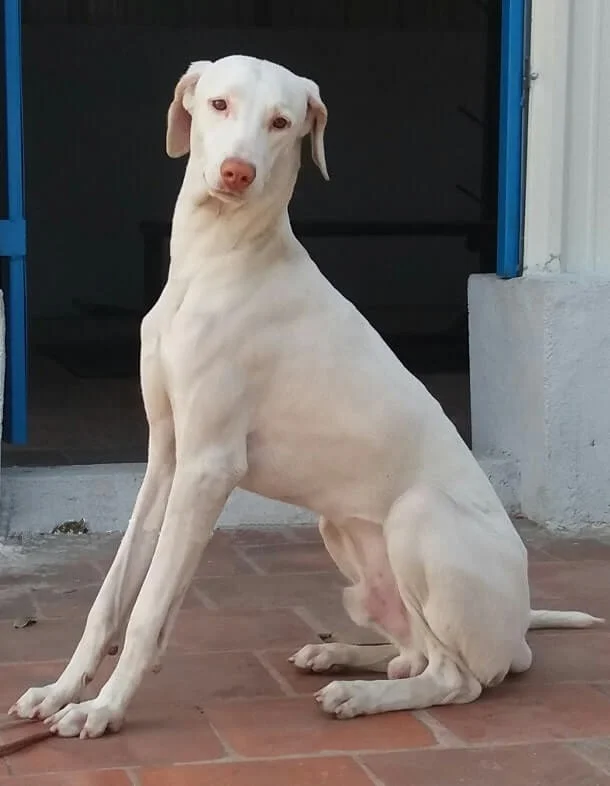
Picture a lean, athletic hound standing around 25 inches at the shoulder (older descriptions say up to 30, but most measured dogs fall short) and weighing about 22 to 32 kg. The classic coat is milk white, short and fine, usually with a pink, flesh-coloured nose and golden-to-brown eyes. At a flat-out run it uses a double-suspension gallop, the same airborne stride you see in a racing greyhound, where all four feet leave the ground twice in every cycle.
That ghost-white coat and the habit of patrolling silently after dark earned it the nickname Indian ghost hound. It is built for heat, not cold. The thin single coat suits the South Indian sun and does badly in a Himalayan winter or a chilly, air-conditioned flat.
Rajapalayam facts at a glance
- Origin: Rajapalayam, Virudhunagar district, Tamil Nadu
- Also called: Polygar Hound, Indian Ghost Hound
- Type: sighthound and guard dog; hunts by sight and by scent
- Height: males around 25 inches (63 cm), females about 23 inches (59 cm); older descriptions claim up to 30 inches, but measured dogs rarely reach it
- Weight: about 22–32 kg (males) and 20–25 kg (females); the 40 kg-plus figure often quoted is the exception, not the rule
- Lifespan: about 10–12 years
- Coat: short, fine and milk white; pink nose typical
- Temperament: intensely loyal to one family, aloof with strangers, strong prey drive
- Best suited to: hot climates, space to run and experienced owners, not apartments
- Watch for: congenital deafness linked to the white coat (ask for a BAER test)
A one-family dog with a hunter’s instincts
Rajapalayams bond hard and narrow. They attach to a single person or household and stay reserved, sometimes openly suspicious, with everyone else. That makes them superb guards and poor social butterflies. Early, patient socialisation matters more for this breed than for almost any other.
The prey drive is real. A dog built to chase and hold wild boar will watch the neighbourhood cats, chickens and smaller dogs the same way. They need secure space, a tall fence and daily hard exercise. Left bored and under-exercised, a Rajapalayam turns destructive and miserable, and so does everyone living with it.
The deafness problem no breeder should hide
This is the part that gets skipped on the sales call. The same genetics that produce the breed’s pure white coat are linked to congenital deafness. A real share of all-white puppies are born deaf in one or both ears, and dogs with blue eyes carry a higher risk of both deafness and vision problems.
The answer is not to avoid the breed, it is to test. A simple BAER hearing test on a puppy tells you what you are taking home before you fall in love with it. Responsible breeders test their litters and share the results without being asked. Like any big, fast breed it can develop hip dysplasia, so ask to see the parents’ hips; the better-documented breed problem, though, is mange, which clears up with prompt vet care. If a seller waves all of this away, walk away.
Can you keep a Rajapalayam as a pet, and what about the price?
Honest answer: only if your life fits the dog, not the other way round. A Rajapalayam needs warmth, space and a confident owner who can give it a job and firm, kind training. In a small city flat, alone for long hours, it is the wrong dog and an unhappy one.
On price, you will see all sorts of numbers online, but a healthy, hearing-tested Rajapalayam from someone who genuinely knows the breed is rare. The cheap “Rajapalayam puppies for sale” ads are exactly where deafness and careless breeding hide, so chasing a low price here usually buys a sick dog and a heartbreak. If what draws you is an Indian dog, loyal and suited to our climate, the kinder and easier route is to adopt an the indigenous Indian dog, who will love you just as fiercely for a fraction of the trouble.
How the Rajapalayam compares to other Indian hounds
The Rajapalayam is the most famous of Tamil Nadu’s native hounds, but not the only one. The Kombai is a darker, stockier boar-hunter; the Chippiparai is a fawn-to-grey sighthound built for speed; the Kanni is its black-and-tan cousin. All four were rare enough that the government set up a dedicated breeding unit in Saidapet, Chennai, in 1980–81 to keep them going. For the bigger picture, our guide to India’s native dog breeds covers the whole family.
India put the Rajapalayam on a postage stamp on 9 January 2005 and, by some reports, sends it to the Kashmir border as an army guard dog. The breed has earned its respect. It just hasn’t earned the right to be an impulse buy.
In 2005, @IndiaPostOffice released four commemorative postage stamps celebrating the canine heritage of the country – Himalayan Sheepdog, Rampur Greyhound, Mudhol Hound and Rajapalayam.
— Abhishek Joshi (@kaalicharan) July 17, 2020
Rajapalayam dog FAQs
Is the Rajapalayam a good family dog? For the right family, yes. It is devoted to the people it grows up with, but aloof and watchful with outsiders. It needs early socialisation, space and exercise, and it is not the best fit for tiny flats or homes with very young children and small pets.
Why are Rajapalayam dogs often deaf? The genetics behind the pure white coat are linked to the inner ear, so a share of all-white puppies are born deaf in one or both ears. A BAER hearing test before you bring a puppy home is the only reliable way to know.
How much does a Rajapalayam cost in India? There is no reliable market price. A well-bred, hearing-tested dog is rare, and cheap online listings usually mask deafness and poor breeding. Adopting an Indian dog is the safer and kinder choice.
Is the Rajapalayam suitable for apartments? Not really. It is a large, active, heat-loving hound that needs room to run and a securely fenced space. Flat life leaves it bored and frustrated.
What was the Rajapalayam bred for? Hunting wild boar and guarding the homes and estates of the Nayak rulers and Polygars of Tamil Nadu. Today it also serves the Indian Army as a guard dog.
Get more dog stories in your inbox. Join Woofs & Words on LinkedIn.
Subscribe on LinkedIn