
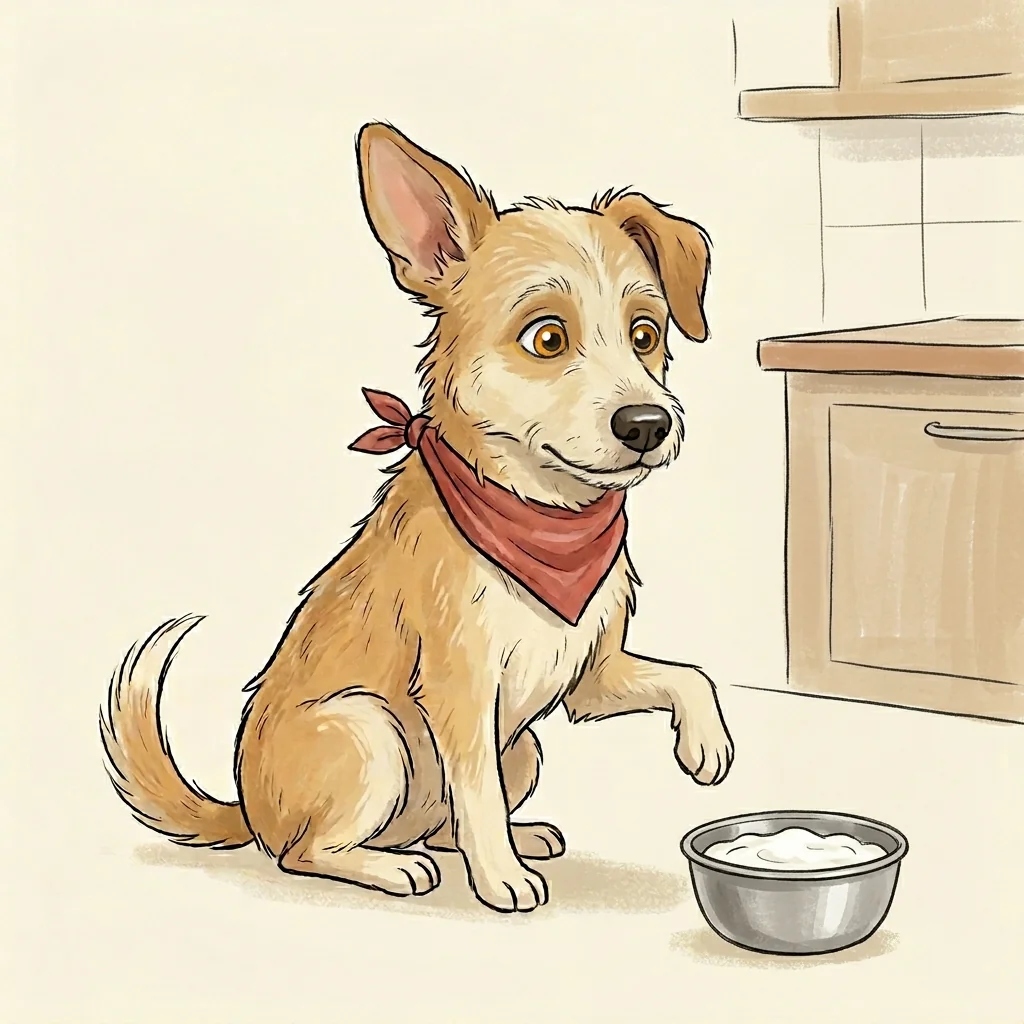

The dahi in your fridge was made by two bacterial strains: Lactobacillus delbrueckii subsp. bulgaricus and Streptococcus thermophilus. Neither one is what veterinary probiotic research has actually tested in dogs.
That does not make curd a bad treat. It makes it a food, not a medicine, and the difference matters when your dog has diarrhoea and someone tells you to reach for the dahi.
Is curd safe for dogs?
Plain, unsweetened, full-fat or low-fat curd is safe for the large majority of dogs. It is not on the ASPCA’s toxic list, and a spoonful mixed into food is one of the least risky human foods you can share.
Lactose is the real variable. Puppies produce plenty of lactase, the enzyme that splits lactose. Production drops sharply after weaning, which is why an adult dog that handled milk fine at eight weeks can be miserable on it at eight months. Curd helps here, because the fermentation bacteria consume some of the lactose before you ever open the pot. Plain dahi runs roughly 4 g of lactose per 100 g against about 4.8 g in the milk it came from. Less, but not none.
The dangerous curd is the flavoured kind. Sweetened fruit yoghurts carry added sugar you do not want, and a small but growing number of “no added sugar” or diet yoghurts use xylitol, which causes a rapid, life-threatening drop in blood glucose in dogs and can cause liver failure. Read the ingredients panel. If it lists xylitol or birch sugar, that pot is not a treat, it is a poison-control call.
How much curd can your dog have?
Treats of every kind should stay under 10% of a dog’s daily calories. One tablespoon below means about 15 g of plain whole-milk curd, roughly 9 calories.
| Your dog | Daily calories | 10% treat ceiling | Sensible curd portion |
|---|---|---|---|
| 5 kg (Shih Tzu, Pom) | ~375 kcal | 37 kcal | 2 tbsp (30 g, 1.2 g lactose) |
| 10 kg (Beagle, small Indie) | ~630 kcal | 63 kcal | 3 tbsp (45 g, 1.8 g lactose) |
| 20 kg (Indie, Cocker) | ~1,060 kcal | 106 kcal | 5 tbsp (75 g, 3.0 g lactose) |
| 30 kg (Labrador) | ~1,435 kcal | 144 kcal | 7 tbsp (105 g, 4.2 g lactose) |
| 40 kg (GSD, Rottweiler) | ~1,780 kcal | 178 kcal | 9 tbsp (135 g, 5.4 g lactose) |
Daily calories assume a neutered adult dog at a healthy weight, calculated as 1.6 × 70 × (weight in kg)0.75. Portions are set at roughly half the treat ceiling, because curd is almost never the only treat a dog gets in a day.
Watch the lactose column, not the calorie column. Curd is cheap in calories, which is exactly why people overshoot it: a “small bowl” for a human is a 150 g serving, and 150 g of dahi puts 6 g of lactose into a 5 kg dog that was built to handle a fraction of that. Start any dog at half the number in the table and see what the next day looks like.
The probiotic claim, and what dahi actually delivers
Curd gets recommended to dog owners as a gut remedy. The reasoning is not wrong, but it is much looser than the confidence behind it.
The strains are not canine strains. The bacteria that set dahi are dairy fermenters. The probiotics with actual controlled canine evidence behind them are specific, named organisms at specific doses, and they come in sachets from your vet rather than from a pot in the fridge. Feeding curd is not the same intervention.
The dose is unknown. A veterinary probiotic states its colony-forming units on the packet. Homemade dahi states nothing, and its bacterial count varies with the starter, the season and how long it sat out. You cannot dose what you cannot count.
What curd does do is deliver protein, calcium and a food most dogs find genuinely delicious, in a texture that is useful for hiding tablets and stretching a Kong. That is a good treat. It is not a treatment, and a dog with diarrhoea lasting more than 24 hours needs a vet, not a second bowl of dahi.
Who should skip curd
Lactose-intolerant dogs. Gas, bloating, loose stools or vomiting within a few hours of dairy is your answer. Some dogs simply cannot have it, and there is no benefit worth chasing through that.
Dogs with pancreatitis or a history of it. Full-fat curd is not high-fat by human standards, but for a dog recovering from pancreatitis every gram counts. Ask your vet, and if you get a yes, use low-fat.
Large-breed puppies. This one surprises people. Excess dietary calcium during growth is linked to developmental orthopaedic disease in large and giant breeds, and a good puppy food is already balanced for it. Adding daily curd on top is not a neutral act. Keep it occasional and small.
Dogs with a confirmed dairy allergy. Different from intolerance. Allergy shows up as itching, ear infections and skin trouble rather than gut upset, and it means no dairy at all.
How to serve curd
Plain, unsweetened, and cold. A spoon over kibble, nothing added. No sugar, no honey, no fruit, no jaggery.
Frozen into a Kong. Curd holds its shape well when frozen and turns a 30 g portion into twenty minutes of work. Mix in a little of the dog’s own kibble if you want to stretch it further.
As a pill vehicle. Thick curd wraps a tablet better than most foods and is less calorific than peanut butter or cheese.
Not as raita, lassi, chaas or shrikhand. Salt, sugar, chilli, jeera, onion and garlic all end up in these, and onion and garlic are genuinely toxic to dogs. Keep the dog’s curd out of the pot before you season it.
Questions people still ask
Can dogs eat curd every day?
A small daily spoon is fine for a dog that tolerates dairy well, provided it fits inside the 10% treat allowance and the rest of the diet is complete and balanced. Daily feeding is where portion creep happens, though, so measure it rather than eyeballing it. If your dog is a large-breed puppy, or on a therapeutic diet for kidney or pancreatic disease, daily curd is a question for your vet rather than a default.
Is Greek yoghurt or hung curd better for dogs?
For a lactose-sensitive dog, yes, and the reason is mechanical rather than magical. Straining removes whey, and lactose is dissolved in the whey, so hung curd and Greek yoghurt carry noticeably less lactose per spoon than the curd they were made from. They are also more concentrated in protein and calories, so the same volume is a bigger portion than it looks. Halve the spoon count in the table if you switch.
Can puppies eat curd?
In small amounts, once they are weaned and settled on solid food. Puppies actually digest lactose better than adult dogs do, so a teaspoon is unlikely to cause trouble. The real limit is that a growing puppy’s calories and calcium need to come from a complete growth food, and large-breed puppies in particular should not be getting extra calcium layered on top. One teaspoon, occasionally, is the sensible ceiling.
Related guides
Part of our human food for dogs guide. See also: can dogs eat curd rice, can dogs eat paneer, can dogs eat eggs and can dogs eat ghee. For the bigger picture, see our dog nutrition guide.
When in doubt about your dog and a new food, ask your vet. It is the cheapest insurance there is.
Sources: USDA FoodData Central, yogurt plain whole milk, Merck Veterinary Manual, nutritional requirements of small animals, ASPCA people foods to avoid.
Wondering about a different food?
🦴 Can my dog eat this?
Type a food to see if it is safe, needs caution, or is a hard no.
Get more dog stories in your inbox. Join Woofs & Words on LinkedIn.
Subscribe on LinkedIn