
Originally published November 2009. Refreshed and fact-checked August 2026 against the original 2008 reporting.
The Indian forests have changed a lot since the days of Mowgli, and the irony of this story is hard to shake. It reads like a real-life Jungle Book. Except this one happened in a village in Odisha in 2008, it made international wire news, and nobody involved got the ending they wanted.
Sloth bear Rani
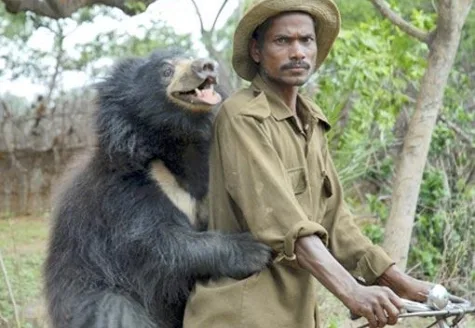
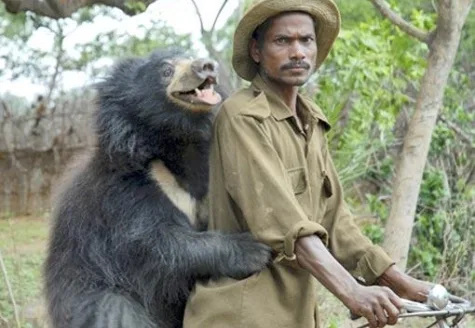
Ram Singh Munda, 35, a member of an indigenous tribe from Rutisila village under Ghatagaon block in Odisha’s Keonjhar district, 225 km north of state capital Bhubaneswar, found an abandoned sloth bear cub in the forest when she was about three days old. Left alone, she’d have died within a day or two. He carried her home, bottle-fed her, and the family named her Rani, which means Queen.
Munda was a widower raising his five-year-old daughter, Dulki, alone. Rani became the sibling Dulki didn’t have. The family shared their meals with her, Munda took her for rides on the back of his bicycle, and for close to eighteen months, nobody outside the village knew a sloth bear was living as part of a human family. No one used her for money. No one hurt her.
The chase, the jail, and the law that gave officials no room to bend
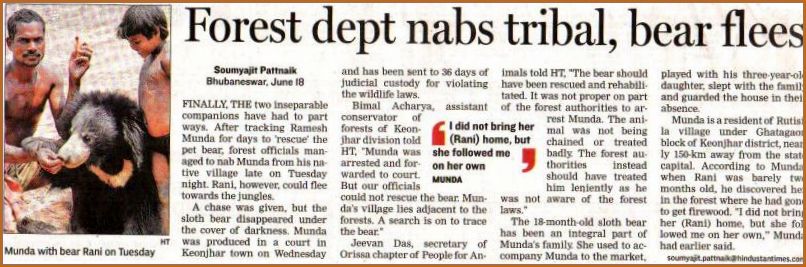
Word reached Odisha’s forest department in early June 2008: a tribal man in Ghatagaon was raising a sloth bear at home. Officials tracked Munda for over a week before they moved. When they finally closed in, Rani bolted into the forest. She was recaptured and taken to Nandankanan Zoological Park, and Munda was arrested around 16–17 June and jailed in Keonjhar, charged under Sections 9, 39(3), 40, and 42 of the Wildlife (Protection) Act, 1972, which govern hunting and possessing protected wildlife without the Chief Wildlife Warden’s written permission. Dulki, now motherless and fatherless for the duration of his custody, was sent to a state-run boarding school.
Legal commentators in Odisha argued at the time that the charges didn’t fit the facts: Munda had rescued a dying cub, not hunted or acquired a wild animal, and the Act’s own definitions left room for that distinction. It’s a fair argument, and it went nowhere. Reports at the time put his potential sentence at three to seven years plus a fine of up to ₹25,000 if convicted, though accounts of the exact ceiling varied. As of that July, the charges were still under investigation, with no fast resolution in sight.
Not everyone in the public conversation was on Munda’s side, either. Animal rights groups who mobilized behind him, including People for Animals Orissa and OIPA India, called the arrest heavy-handed cruelty toward a man who’d only ever shown the bear kindness. But Union Minister Maneka Gandhi, one of India’s most prominent animal-welfare voices, pushed back publicly at the time: the law required Munda to hand an orphaned protected species to police or forest officials, not raise her at home, whatever his reasons for keeping her.
Context that the story rarely gets told with: 2008–09 was also the tail end of India’s centuries-old “dancing bear” trade, where the Kalandar community kept sloth bears in captivity and forced them to perform on the street, using exactly the same claim Munda could make, that the bear was cared for, not exploited. Wildlife SOS surrendered India’s last known dancing bear that December, after rescuing 628 sloth bears from that trade. Forest officials in 2008 had almost no discretion to distinguish a genuine rescue from a cover story, because the cover story was the entire premise the dancing-bear trade ran on for decades. That doesn’t make what happened to Munda’s family fair. It explains why nobody in the system was willing to bend. It’s the same tension that runs through Shaktiman’s story eight years later: an animal caught between real affection and a system with almost no room for judgment calls.
What actually happened to Ram Singh Munda and Rani
Munda was released on bail on 23 June 2008. Four days later, he and Dulki made the 225 km trip to Nandankanan to see Rani for the first time since the arrest. Rani had reportedly refused food since arriving. When Munda reached her enclosure, she recognized him immediately, and staff let him inside for a 30-minute reunion. When it ended, Rani tried to follow him out and had to be held back. Munda volunteered on the spot to work at the zoo as her caretaker. The deputy director turned him down, citing legal restrictions on hiring him.
That’s where the public record runs out. A campaign blog that covered the case daily through June 2008 goes silent after the 26th, and no source, in 2008 or since, reports how Munda’s case was finally resolved or what became of Rani at Nandankanan. If you know more, and you grew up in Keonjhar, worked at the zoo, or followed the case through to a verdict, this comments section has stayed open on this story since 2009. Add what you know.
What makes sloth bears different from every other bear in India
Melursus ursinus is the only bear species found across most of the Indian subcontinent, and it’s built differently from the bears people picture. Sloth bears eat mostly termites, ants, and fruit, and they hunt insects by clamping onto a mound and vacuuming it out through a gap where their front teeth should be, a slurp you can hear from meters away. Poor eyesight makes them more likely than most bears to be startled at close range, which is part of why they have an outsized reputation for aggression toward people who stumble into one by accident, despite eating almost nothing that isn’t an insect.
India is home to an estimated 20,000 sloth bears, spread across roughly 174 protected areas in 19 states, Odisha among them. The IUCN lists the species as Vulnerable, with habitat loss, poaching, and human conflict as the main pressures. That population estimate is from a 2005 survey. There’s been no reliable full recount since, which tells you something about how much attention the species gets compared to India’s tigers and elephants. India’s wildlife and cruelty laws are stricter on paper than most people realize; we’ve broken down what they actually say in our guide to animal laws in India.
Dog with Blog exists because we believe India’s own animals, indie dogs, street-born, overlooked, deserve the same care as any imported breed. Rani’s story is a reminder that the instinct to take in something small and abandoned is the right one. Knowing when that animal needs a forest instead of a family is the harder part. If you want to see how that instinct plays out for India’s dogs specifically, our adoption directory is where it goes next.
Get more dog stories in your inbox. Join Woofs & Words on LinkedIn.
Subscribe on LinkedIn
Very nicely brought up!!
keep up the good job 🙂
Thanks Sunint!
Keep watching this space for more…
Very usfeul post. I thought to let you know that you website isn’t getting displayed properly on android browser on my pda.
Have a good time…sorry for typos
I loved reading this post,Abhishek! How did this thought come to you to write about animals, esp. dogs like this? My family loves all animals and I asked my husband also to read this post.
It was nice of Rama to take Rani home. It is typical of our people to put him behind bars. Hope he is able to visit Rani with his daughter, at least once in a while. Rani must be missing this family of hers.
Congratulation for the Award, this post of yours deserves it.
Thanks Sandhya!
Ever since I can remember…I’ve always loved dogs. Why I have loved them has a selfish rationality[I’ve yet to meet humans who can love to the decree of a dog henceforth the more humans I have met,the more I have come to fall in love with the canines] What goes on inside the head of a dog always perplexed me…what’s concealed underneath their barks always bamboozled the dim wit me:)
It was then that I pleaded my well versed dog to enlighten me and the human species with his point of view,the dog’s perspective of the world…as he sees it. With this ideation, Dog with the blog had its humble genesis.
I’m thankful to all of you wonderful readers,the animal lovers who have given the dog a chance to share his mind with you!
keep reading!
I hope your hubby likes it too:)
that was a lovely post
Thanks Sorcerer!
My heart goes out to the family and the bear. Such a sad state of affairs.
CONGRATS on the Blogadda pick.
Thanks Shail!
Touching post and hugging pix (literally). When miya (man) and bibi (bear) are razi, then kya karega kazi (interfering govt laws)?
woof woof:)
well said Sucharita:) If only the kaazi understands it in time!
Congrats on the spicy sat pick.
Too bad about Rani and Ram. Disgusting is a better word actually.
Thanks Ava!
I hope sanity marks a comeback after this prolonged a hiatus…
keep visiting!
Oh wow! That is heart-wrenching, just as you said.
Thanks K!
it’s a sad issue, animal rights and all.
very touchy one. speechless.
court should see and judge. if the bear goes freely to rama’s home, they must let him stay there.
Thanks Pramod!
Here’s hoping that the judiciary gives ‘humanity’ a chance.
Rama and Rani and Dulki are all part of a family. Where were the #*$!****** Govt. Officials when the Baby Bear got lost and followed Rama for shelter and security. Personally I believe the Media has got a role in all this. Why can’t the Media keep to the proper stories? Because of the Media’s irresponsibility disaster came into the lives of three LIVING CREATURES………….. who were living in harmony. Now the Law is Law. It is against the law to keep wlidlife as pets. It would have been better that Rama had come to know about the law and trained the poor animal to go back to the forest and to fend for itself. But as for Rama I think it was not possible because it required a lot of finances and support. In that case he could have taken the help of the officials!!!!!!!!!!! which I think in this country is quite unheard of as our officials are not trained themselves. As for the Law everybody knows that the ‘quote……Law is an ASS…….unquote’.
Truly said Deepa, if only the legislation had empathy for the emotional connect between Dulki & Rani, the tale wouldn’t have met such a fate.
As for media, you know the tides they turn to…they would follow the latest hairdo of the celebs, keep on with re-telecasts of apocalypse predictions but where averse from the land where a true story needs coverage…