
Medically reviewed by Dr. Catherine Nicolaou, DVM.
Quick answer: The Kombai is a native South Indian guard and boar-hunting dog from Tamil Nadu, red-brown with a black mask, built lean and hard. It bonds fiercely to its family and is sharp with strangers, so early socialisation and an experienced owner are essential. It’s a working breed, not an apartment pet.
When the Marudhu Pandiyar brothers raised their armies against the British in the 1790s, they did not field only soldiers. They fielded dogs: red-coated, black-masked Kombais trained to go for the hamstrings of enemy war horses. Centuries before that, the Marava kings of Tamil Nadu were already hunting wild boar with the same fearless hound.
The Kombai, also spelled Combai, is one of India’s oldest and most formidable native breeds: a guard dog with the heart of a warrior and a soft spot the size of Tamil Nadu for its own family. Here is the honest story, from its bloody history to the looks that get it called India’s Rhodesian Ridgeback, and what it truly takes to live with one.
Where the Kombai comes from
The breed is named after Kombai, a town in the Theni district of Tamil Nadu, and it is old. Records and local memory place it at least in the 15th century, and many believe the Marava kings were breeding it as a royal hunting dog as far back as the 9th. The Maravar, an ancient Tamil warrior community, shaped it to hunt wild boar, deer and bigger game through the southern forests.
Then it went to war. The zamindars of Kombai are said to have gifted these dogs to Hyder Ali and Tipu Sultan for their armies, and, by tradition, the Marudhu Pandiyar brothers of Sivagangai used Kombais against British troops during the Polygar wars. A hound bred to hold a charging boar was, it turned out, just as willing to face a soldier.
What a Kombai looks like
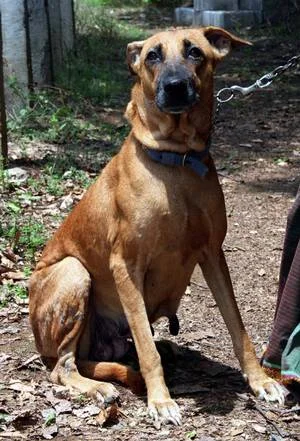
You will know a Kombai by its colour: a deep tan, red or reddish-brown coat with a striking black mask over the muzzle, which is why Tamil speakers call it Karumunji naai, the black-faced dog. The coat is short, dense and smooth. Some Kombais also carry a ridge of hair along the spine that grows against the lie of the rest of the coat, the very feature that makes the African Rhodesian Ridgeback famous, which is why the Kombai is sometimes called the Indian Ridgeback. It is a muscular, medium-large dog: males run about 25 to 32 kg and stand 22 to 24 inches, with a broad chest, strong jaws and dark, watchful eyes.
Kombai facts at a glance
- Origin: Kombai, Theni district, Tamil Nadu
- Also called: Combai, Polygar dog, Indian Ridgeback, Karumunji naai (the black-faced dog)
- Type: hunting and guard dog; a boar hound
- Coat: short and dense, tan to red-brown with a black mask
- Size: males roughly 25–35 kg and 22–24 inches at the shoulder; females a touch smaller, about 23–32 kg and 20–23 inches
- Lifespan: about 10–13 years
- Temperament: devoted to family, gentle with its own children, ferocious with strangers
- History: a Polygar-war dog, like its cousin the Rajapalayam
- Best suited to: experienced owners with space, not first-timers or flats
Gentle at home, ferocious at the gate
This is the contradiction that defines the Kombai. With its own people it is intensely loyal, affectionate and surprisingly gentle, tolerant enough to let the family’s children clamber all over it. With a stranger at the gate, the same dog becomes a serious deterrent: fast, fearless and very willing to act. That switch is not a flaw, it is the whole point of the breed.
It also means a Kombai is not a casual choice. It needs an experienced owner who can lead it calmly, early and steady socialisation, secure space and a real outlet for its energy and prey drive. Raised well, it is a magnificent guardian and companion. Raised carelessly, its courage curdles into a problem.
Kombai, Rajapalayam or Rhodesian Ridgeback?
People mix these up constantly. The Kombai and the Rajapalayam are both Tamil Nadu hunting-and-guard breeds that fought in the Polygar wars, but they look nothing alike: the Rajapalayam is milk white with a pink nose, the Kombai is red with a black mask. The Rhodesian Ridgeback shares the Kombai’s back-ridge and its boar-hunting job, but it is a separate African breed, larger and wheaten-coated. The Kombai is its own dog, older than the country that now claims it.
Living with a Kombai, and the price question
On care, the Kombai is refreshingly easy: a short coat that barely needs grooming, a hardy constitution with few inherited problems, and a body built for Indian heat. The hard part is not the dog’s upkeep, it is meeting its needs for space, exercise and firm, kind leadership. A bored Kombai in a small flat is trouble waiting to happen, for the dog and for everyone near it.
On price, treat cheap online listings with real suspicion, because careless breeding of a powerful guard dog is dangerous, not just sad. A well-bred Kombai is hard to find, and it is emphatically not a starter dog. If you love the loyalty and the desi heritage but are not set up for a working guardian, an India’s indie dogs from our adoption directory will give you the devotion without the liability.
Where the Kombai fits among India’s breeds
The Kombai is one of a proud line of Indian working dogs, alongside the Rajapalayam, the Chippiparai, the Kanni and the Mudhol Hound, most of them rarer than they should be. Our guide to India’s native dog breeds introduces the whole family.
India spent decades importing guard dogs while a braver, hardier one sat in the villages of Theni, asking only for a job and a family. The Kombai never stopped doing its work. We just stopped watching.
Kombai dog FAQs
Is the Kombai a good family dog? For an experienced owner, yes. It is fiercely loyal and gentle with its own family, children included, but ferocious with strangers. It needs socialisation, space and firm handling, and it is not a first dog or a flat dog.
Is the Kombai the same as the Indian Rhodesian Ridgeback? Not the same breed, but the Kombai shares the back-ridge and the boar-hunting role, so it is sometimes nicknamed the Indian Ridgeback. It is an older, separate Indian breed.
What is the difference between a Kombai and a Rajapalayam? Both are Tamil Nadu Polygar-war breeds, but the Kombai is red with a black mask, while the Rajapalayam is milk-white with a pink nose.
How big is a Kombai? Medium-large. Males weigh roughly 25 to 32 kg and stand 22 to 24 inches at the shoulder, with females a little smaller.
Where can I get a Kombai? It is a rare breed, best sourced from genuine breeders in Tamil Nadu rather than cheap online sellers. Adoption is always worth checking first.
Get more dog stories in your inbox. Join Woofs & Words on LinkedIn.
Subscribe on LinkedIn