
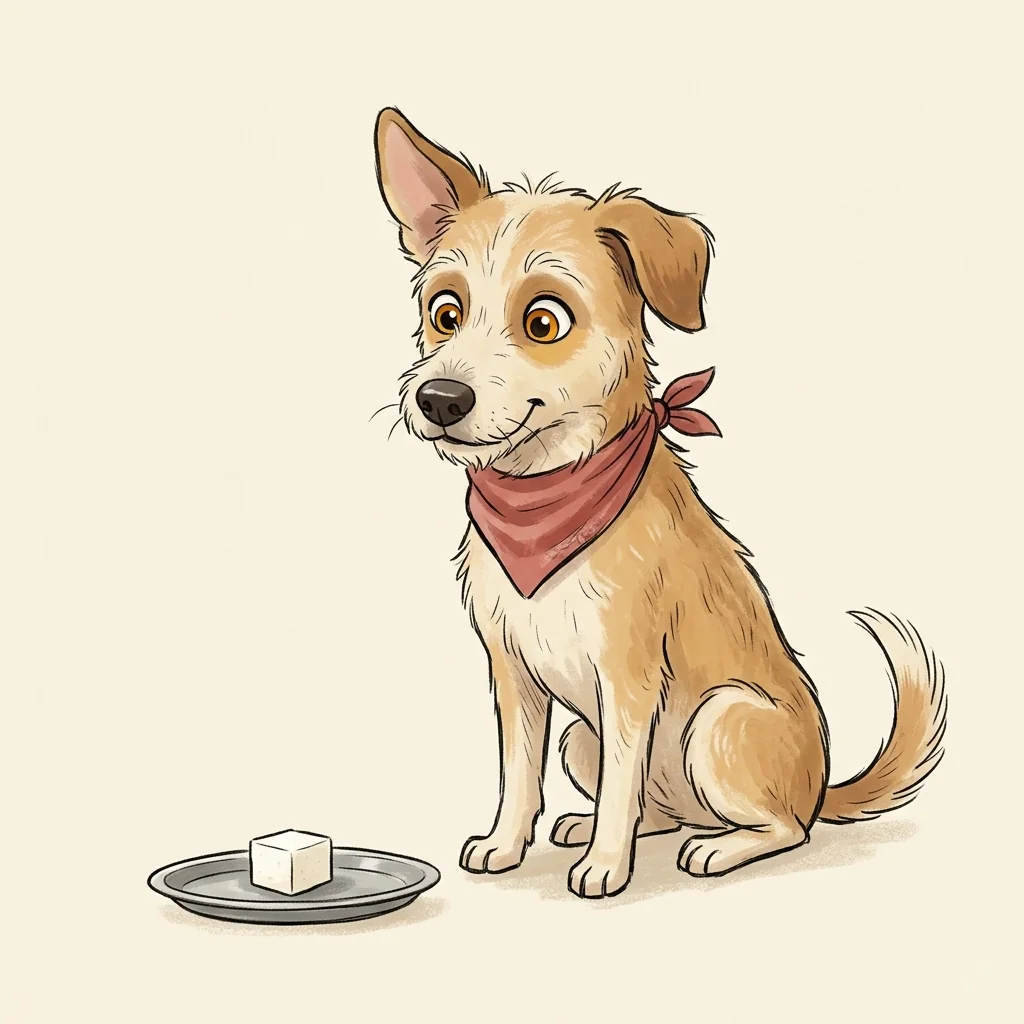

Aged cheddar has almost no lactose left in it. Paneer has roughly twenty times as much. Which is why the “cheese is fine for lactose-intolerant dogs” advice collapses on exactly the cheese Indian dogs actually get handed.
Paneer sits in a strange spot. It is the one dairy product most Indian households have in the fridge, it looks bland and harmless, and it is soft enough that people give it to puppies and senior dogs without a second thought. Two of those three things are fine.
Is paneer safe for dogs?
Plain paneer is not toxic. It contains nothing on the ASPCA’s list, and a dog that steals a raw cube off the chopping board is in no danger at all.
The problem is what paneer is made of by weight. Full-fat cow’s-milk paneer runs roughly 20 grams of fat and 18 grams of protein per 100 grams, at around 296 calories. Do the arithmetic and about 60% of those calories come from fat, not protein. Buffalo-milk paneer, which is what most Indian markets sell by default, is fattier still. High-fat treats are a recognised dietary trigger for acute pancreatitis in dogs, and the breeds with a known predisposition — Miniature Schnauzers, Yorkshire Terriers, Cocker Spaniels — have the least room for error.
Then there is what happens to paneer before it reaches the dog. Almost nobody eats paneer plain. It arrives as paneer butter masala, palak paneer, paneer tikka or a stuffed paratha, and every one of those carries salt, chilli, cream and usually onion and garlic. Onion and garlic damage canine red blood cells, and the signs — pale gums, weakness, dark urine — can take a day or more to show. The cube is innocent. The gravy is not.
How much paneer can your dog have?
Treats of every kind should stay under 10% of a dog’s daily calories. A cube below means a 2 cm piece of plain paneer, roughly 10 grams, 30 calories and 2 grams of fat.
| Your dog | Daily calories | 10% treat ceiling | Sensible paneer portion |
|---|---|---|---|
| 5 kg (Shih Tzu, Pom) | ~375 kcal | 37 kcal | ½ cube (6 g, 1.2 g fat) |
| 10 kg (Beagle, small Indie) | ~630 kcal | 63 kcal | 1 cube (10 g, 2.0 g fat) |
| 20 kg (Indie, Cocker) | ~1,060 kcal | 106 kcal | 1½ cubes (18 g, 3.6 g fat) |
| 30 kg (Labrador) | ~1,435 kcal | 144 kcal | 2½ cubes (25 g, 5.0 g fat) |
| 40 kg (GSD, Rottweiler) | ~1,780 kcal | 178 kcal | 3 cubes (30 g, 6.0 g fat) |
Daily calories assume a neutered adult dog at a healthy weight, calculated as 1.6 × 70 × (weight in kg)0.75. Portions are set at roughly half the treat ceiling, because paneer is almost never the only treat a dog gets in a day. Composition figures are for full-fat cow’s-milk paneer and vary with the milk used; buffalo-milk paneer is fattier.
Read the fat column. A 40 kg German Shepherd’s entire sensible portion is three small cubes, which most owners would not even register as a serving. The 100 gram block sitting in your fridge is more than three days of paneer for a Labrador, and about two and a half weeks for a Pomeranian.
The lactose-free cheese myth, and why paneer breaks it
Most adult dogs lose a good deal of their intestinal lactase after weaning, which is why milk causes gas and loose stools in so many of them. The standard workaround people repeat is that cheese is safe because cheese-making removes the lactose. That is true, and it is true for the wrong reason to help you here.
Lactose disappears from cheese during ageing, not during making. In a hard aged cheese, bacteria spend weeks to months fermenting the residual lactose into lactic acid, which is why mature cheddar comes in near 0.1 grams of lactose per 100 grams. Paneer is not aged at all. It is milk, acid, and a strainer, eaten the same week. It keeps something in the order of 2 grams of lactose per 100 grams — less than milk, because the whey is drained off, but roughly twenty times what an aged cheese carries.
So the rule inverts. If your dog reacts badly to milk, paneer is one of the worse dairy choices, not one of the safer ones. Plain curd is the better option for exactly the opposite reason: the culturing that turns milk into curd does consume lactose and supplies live bacteria that help digest what is left.
None of this makes paneer dangerous. It makes the common justification for feeding it wrong.
What actually goes wrong: salt, and fake paneer
Salt is the quiet one. Homemade paneer is unsalted. Commercial and restaurant paneer often is not, and a dog’s sodium requirement is a fraction of a human’s. Read the packet, and never feed paneer that has come out of a dish.
Analogue paneer is real and widespread. “Analogue” paneer replaces milk fat with cheap vegetable fat and bulks the block out with starch. It is a recurring subject of FSSAI enforcement and adulteration alerts across Indian markets, and it is not something you can reliably identify by looking at it. For a dog eating three cubes a week this is a small worry; if paneer is a regular part of your dog’s food, make it at home or buy from a brand you trust.
Milk protein allergy is a separate thing from lactose intolerance and gets confused with it constantly. Lactose intolerance produces gas, gurgling and loose stools. A dairy protein allergy shows up as itching, chronic ear infections and skin trouble, and it does not improve by switching to a lower-lactose dairy product. If your dog itches after dairy, the answer is not a different cheese.
Dogs with a history of pancreatitis, dogs on a prescribed low-fat diet, and overweight dogs should skip paneer entirely. There is nothing in it they cannot get from a leaner food.
How to serve paneer
Plain, homemade, unsalted, cut small. Boil milk, split it with lemon juice or vinegar, strain, press lightly. No salt at any stage. Cut into cubes smaller than you think, because the portions above are small.
As a training reward. This is the best use of paneer, and the reason is portion control rather than nutrition: it is soft, it smells strong, and a pea-sized piece works as well as a cube. A 6 gram portion goes a long way when it is broken into eight rewards.
To hide a tablet. Paneer moulds around a pill better than most foods and is less messy than cheese spread. Use it and count the calories.
Introduce it alone. Give a small piece on a day when nothing else is new, and look at the stool the next morning. That is the cheapest lactose test there is.
Skip fried paneer, paneer tikka, any gravy, malai paneer, and the stuffing from a paratha. Skip anything with onion, garlic or green chilli in it, which in practice means almost every paneer dish an Indian kitchen produces.
Questions people still ask
Can dogs eat paneer every day?
They can tolerate it, but it is a poor use of the daily treat allowance. Paneer is dense in fat and calories and thin in anything a complete dog food does not already supply. Twice a week is a sensible ceiling for most dogs, and if your dog is on any kind of weight-management plan, less than that. A large dog fed a couple of cubes daily is quietly adding around 400 calories a week that nothing in its diet accounts for.
Can puppies eat paneer?
In tiny amounts, once weaned and settled on solid food, and unsalted. Puppies generally retain more lactase than adult dogs do, so they often handle it better in the short term. The real issue is displacement: a growth food is formulated to a specific calcium, phosphorus and calorie balance, and treats crowding past 10% of intake begin to erode that. In large-breed puppies, whose skeletal development is genuinely sensitive to getting minerals wrong, that matters more than it does in a Pug.
Is paneer good for a dog’s bones?
Not usefully. Paneer carries roughly 200 mg of calcium per 100 grams, so a Labrador’s sensible 25 gram portion delivers about 50 mg — against a daily requirement in the region of 1,400 mg. It is a rounding error. Any complete commercial dog food already meets that requirement in a balanced ratio with phosphorus, and adding calcium on top of a complete food is more likely to unbalance it than to help. If you have a specific concern about your dog’s bones, that is a conversation with your vet, not a cheese purchase.
Related guides
Part of our human food for dogs guide. See also: can dogs eat curd, can dogs eat ghee, can dogs eat eggs and can dogs eat roti. For the bigger picture, see our dog nutrition guide.
When in doubt about your dog and a new food, ask your vet. It is the cheapest insurance there is.
Sources: USDA FoodData Central, fresh and aged cheeses, Merck Veterinary Manual, nutritional requirements of small animals, FSSAI, food adulteration standards and alerts, ASPCA people foods to avoid.
Wondering about a different food?
🦴 Can my dog eat this?
Type a food to see if it is safe, needs caution, or is a hard no.
Get more dog stories in your inbox. Join Woofs & Words on LinkedIn.
Subscribe on LinkedIn