

Kerala’s stray dog culling fight first made headlines in 2015, when the state moved to cull its street dogs. A decade later, the same fight is back before the Supreme Court. Updated for 2026 below.

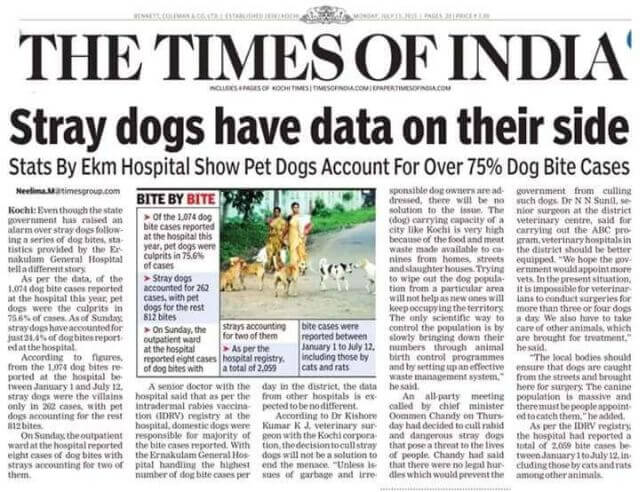
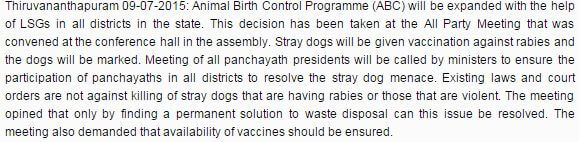
The Kerala State government’s decision to cull ‘rabid and dangerous stray dogs’ has triggered an online campaign with the hashtag ‘#BoycottKerala’. The Animal Welfare Board of India’s reported statement against the Kerala government decision called the culling decision ‘unconstitutional and barbaric’, and asked fellow campaigners to “hit Kerala where it hurts – their tourism”.
Kerala dog
Whilst this dog understands that hitting where it hurts the hardest – i.e. tourism would spell trouble for even the innocent but the failure of the state government, municipal boards, the animal welfare wings and the veterinary staff shouldn’t be borne by the dogs dubbing Kerala No country for dogs.
As it is with any voice raised for animal rights in India, the counterattacks from the know-it-all often snort:
‘In a nation where there is so much poverty, crime… why the concern for the plights of animals. Humans before animals…there have been thousands of cases of dog bites in Kerala… ’
To this public outcry within Kerala to cull stray dogs, perhaps they should see if the homeless are really at fault or if this incumbent fear and hatred has created monsters which were never there.
Not the Frankenstein’s monster, they are said to be.
This dog is not calling for a hate campaign against Kerala but against the atrocity that culling is. I’d spare you the graphic images of how the municipal board staff is treating the dogs but believe me that in no means is anything close to the ‘humane treatment’ as cited by the CM.
Furthermore, who watches the watchmen – would a society already on the cusp of hatred against the canine even check for who the ‘rabid’ is?
Animal rights laws in India
When dealing with stray dogs, the Prevention of Cruelty to Animals Act, 1960 and the ABC Rules hold the field over the provisions of the Kerala Municipality Act, 1994 and must be given the full effect. Any measures to undertake mass culling of stray dogs is unlawful.
On July 26, there are protests planned to be held in at least 10 Indian cities (Kolkata, Mumbai, Delhi, Ahmedabad, Goa, Indore and Bengaluru) and the foreign venues include Hyde Park in London, Chicago, Boston, New York, Houston, Seattle, Sao Paulo in Brazil, Berlin in Germany and Italy.
What the Supreme Court actually ordered in 2026
On 19 May 2026, a three-judge bench ordered every district in India to run at least one functioning ABC centre, told states to keep anti-rabies vaccine and immunoglobulin stocked in every government hospital, and set a deadline of 17 November 2026 to show their work. It did not order mass culling. The Court allowed euthanasia only for dogs that are rabid, incurably ill, or proven dangerous, and only with a vet’s sign-off. Catch, sterilise, vaccinate is still the law.
Now read Kerala’s own numbers
Kerala’s local bodies budgeted ₹47.6 crore in 2024–25 for sterilisation, vaccination and the “Rabies-Free Kerala” project. The state’s spend on animal rabies vaccine alone is up 958% in nine years, from ₹13.9 lakh to ₹1.47 crore (RTI data). What did the money build? Fifteen. That’s how many AWBI-approved ABC centres actually function, in a state of fourteen districts and lakhs of dogs. Over the same stretch, dog-bite cases rose more than 100% in seven years and rabies deaths tripled. The budget climbs; the graph moves the wrong way. The Court can order one ABC centre per district. Kerala was funded for far more and built fifteen. The order was never the missing piece. The money was.
The people doing the actual work
Here’s the part that should make you angry. The most effective sterilisation engine Kerala ever had was Kudumbashree, its women-led neighbourhood network, which ran ABC surgeries across the state for years, until a 2021 High Court order pulled them out of the work. The grassroots system that was actually catching, fixing and releasing dogs got switched off, and the gap it left is the one you now see at the school gate. The work didn’t stop everywhere. DAYA, a Kochi-based group registered with the Animal Welfare Board, has run sterilisation and mass anti-rabies immunisation for two decades; its early “rabies-free zone” drive in Muvattupuzha is the exact model the Court is now ordering, minus the press conference. Groups like this, and the volunteers who pay out of pocket to neuter a colony pup, were never the problem. They’re the unfunded version of the fix the state keeps saying it can’t afford. If you’re in Kerala and want to back one instead of arguing about it: find the rescue or ABC programme running in your district, or adopt a street dog instead of buying a breed.
If not for the plight of the mute, perhaps to remain in the good books of the traveller community, the lawmakers would reconsider this callous decision of theirs. Hope floats.
Where this stands in 2026
The fear this piece was written about never really went away. In 2025, after a run of dog-bite reports, the Supreme Court waded back into the stray-dog question, and Kerala became the test case for everything hard about it: too many dogs, too few working shelters, and a public mood swinging toward removal. Here is what the Court actually ruled, and why the money is the real story.
The law has changed less than the headlines suggest. India still runs on the Animal Birth Control framework: sterilise, vaccinate, return. Culling stays the exception, not the rule. For the plain-English version of what is and isn’t allowed, here are the animal-protection laws that govern strays and your rights.
Ten years on, the verdict on Kerala reads the same as it did then: the problem was never the dogs. It was a system that never funded the humane fix.
Get more dog stories in your inbox. Join Woofs & Words on LinkedIn.
Subscribe on LinkedIn