
For fifteen years the answer was obvious: cats owned the internet. Grumpy Cat, Nyan Cat, an endless scroll of aloof little emperors knocking things off tables. Then something shifted. The memes filled up with “very good boys,” the algorithm started coughing up dog content, and a fair question arrived — are cats or dogs actually more popular online now? We went looking for real numbers instead of vibes. The answer is more interesting than “dogs won.”
The 2026 answer, straight up
It depends on how you count — and that’s the honest truth. Dogs lead on the metrics of scale: more owners, more households, and the lion’s share of pet content on the big social platforms. But cats are not dethroned. They still pull far more readers on Wikipedia, they out-number dogs as pets across much of Europe, and “cat person” is still a whole personality online. Dogs win the feed; cats win the quiet corners. Nobody’s putting the crown down.
Before you pick a side: are you actually a cat or a dog person? Take the 2-minute quiz and find out what your answers say about you.
What’s in here
Are cats or dogs more popular on the internet?
On balance, in 2026, dogs edge it — but only on certain scoreboards. Dogs are the more-owned pet in the biggest content-producing markets (the US and India both skew heavily dog), and dog content dominates the recommendation-driven feeds of TikTok, Instagram Reels and YouTube Shorts. If “popular” means volume of people and volume of content, dogs are ahead.
But if “popular” means depth of curiosity, cats win: the Wikipedia “Cat” article is read far more than “Dog,” and cats out-number dogs as household pets across much of Europe. So the truthful answer to “who’s more popular online” is that the internet is split — dogs took the mass-market feed, cats kept the die-hards. Anyone selling you a clean “dogs won” or “cats won” is skipping half the data.
Cats vs dogs by the numbers (2026)
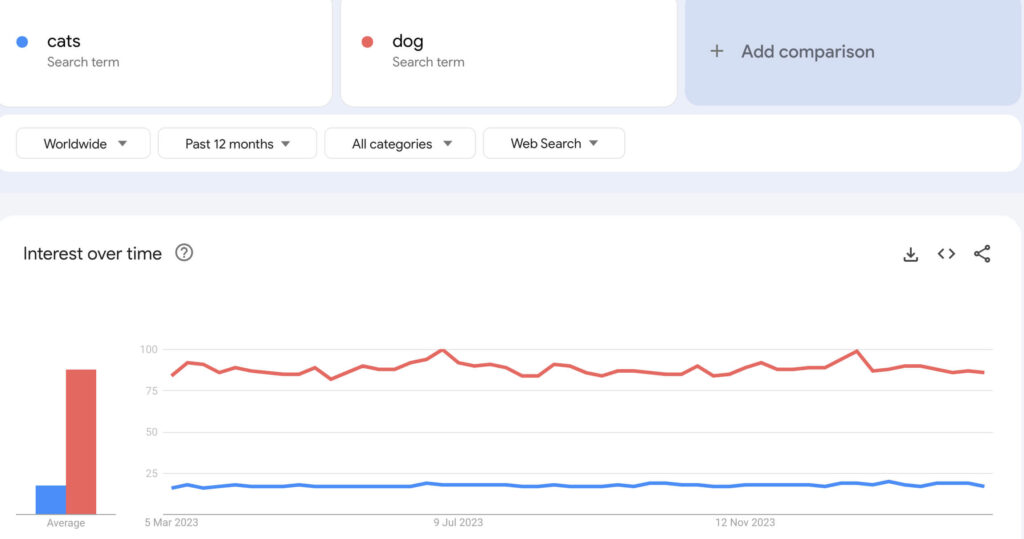
Here’s the current picture, with sources you can check — and only metrics that still actually exist (more on that below):
| Metric | Dogs | Cats | Who leads |
|---|---|---|---|
| Pets in the US | ~89.7 million | ~73.8 million | Dogs |
| US households owning | ~68 million | ~49 million | Dogs |
| Pets in India (2026 est.) | ~43.9 million | ~4.9 million | Dogs |
| Wikipedia article reads (12 mo) | ~2.2 million | ~3.2 million | Cats |
| Wikipedia language editions | 281 | 278 | Dogs |
| Pets in France | ~9.9 million | ~16.6 million | Cats |
Sources: AVMA U.S. Pet Ownership (2025 report) & APPA State of the Industry; TGM/Statista India pet data (2026); Wikimedia Pageviews and Wikipedia language-link counts (mid-2026); FACCO France pet population (2024). Figures are the best current estimates and move over time.
Notice the split right there in the table. Dogs sweep ownership. Cats take Wikipedia reading by a comfortable margin. And the old talking point that cats crush dogs on Wikipedia’s language reach? That’s flipped — the “Dog” article now runs in slightly more language editions than “Cat.” The scoreboard genuinely changed while everyone was arguing.
Why cats ruled the early internet
The cat era wasn’t an accident. The early web skewed toward a specific crowd — indoors, online a lot, wry sense of humour — and the cat was the perfect mascot for it: independent, a little chaotic, gloriously indifferent to your feelings. A cat knocking a glass off a table is the internet’s sense of humour. Cats also live where the cameras are (indoors, on the desk, on the keyboard), so they got filmed more in the webcam-and-laptop age. For a long stretch, “the internet is made of cats” was just true.
Why are dogs more popular than cats online now?
Two things changed. First, the internet got bigger and more global. Worldwide internet users passed 6 billion in 2026, and as the web expanded past its original niche it started to reflect the wider world — and most of the wider world is dog-leaning. Second, the platforms changed shape. Short-form video (TikTok, Reels, Shorts) rewards motion, reaction and story: a dog losing its mind over a tennis ball is built for that format in a way a cat’s five-second cameo isn’t. Dogs are expressive, trainable for the camera, and endlessly willing — which is catnip, so to speak, for an engagement-driven feed. Add in the pandemic adoption wave and a culture leaning hard into loyalty and goofy comfort, and dogs surged.
Where cats still win
Don’t write the obituary. Cats hold real ground in 2026:
- Wikipedia reading interest. The “Cat” article is read roughly 1.4–1.8× as often as “Dog.” When people want to actually learn about the animal, cats win the click.
- Europe. Cats out-number dogs as pets across much of the continent — France has about 16.6 million cats to 9.9 million dogs, and Germany is the largest cat market in Europe. “Dogs win online” is very much a US-and-Asia-flavoured claim.
- Meme longevity. The cat’s detached, deadpan energy still powers a huge share of reaction images. Dogs get the wholesome clips; cats still get the jokes.
Why the old “hashtag scoreboard” is broken (and most cat-vs-dog articles are now wrong)
Here’s the part almost every “cats vs dogs online” article gets wrong in 2026 — including, until this update, ours. For years these pieces “proved” a winner by comparing hashtag totals: #dog vs #cat post counts, TikTok hashtag view counts, Twitter “interested in” audiences. Those metrics no longer exist.
- TikTok removed view counts from hashtag pages (rolled out through early 2024), so “#DogsOfTikTok has X billion views” is a number you literally cannot look up anymore.
- Instagram gutted hashtags — capping usable tags and moving to a search-first model — so public post-count totals stopped being a stable, meaningful figure.
- X (Twitter) dismantled its public audience-insights tooling, so the old “291 million users interested in dogs” stat isn’t retrievable.
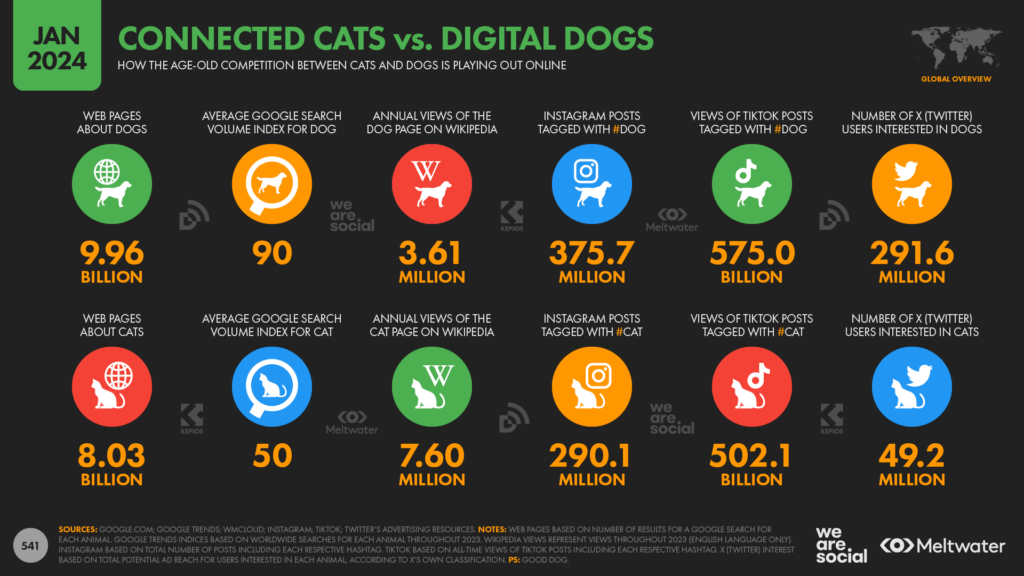
That’s why this update leans on things you can still verify — pet-ownership surveys, Wikipedia’s open pageview data — instead of screenshots of counters that platforms have since switched off. If a cat-vs-dog article is still quoting TikTok hashtag views in 2026, it’s quoting a ghost.
So, is the cat era over? Not even close. Dogs took the mass-market feed and the ownership numbers; cats kept the encyclopedia, the continent of Europe, and the reaction-image economy. Here at Dog with Blog we’re contractually obligated to root for the good boys — but the honest scoreboard is a draw with two different referees. And frankly, an internet with room for both is the better internet.
Settle it for yourself
Still not sure which team you’re really on? Take our cat-or-dog-person quiz, or read who actually loves you more — your cat or your dog. (We have opinions.) And if wrestling’s your thing, meet the WWE wrestlers who love their dogs.
Numbers here reflect the best publicly verifiable data as of July 2026 and will shift as new pet-ownership surveys land. Spotted a figure that’s moved? Tell us and we’ll update it.
Get more dog stories in your inbox. Join Woofs & Words on LinkedIn.
Subscribe on LinkedIn