
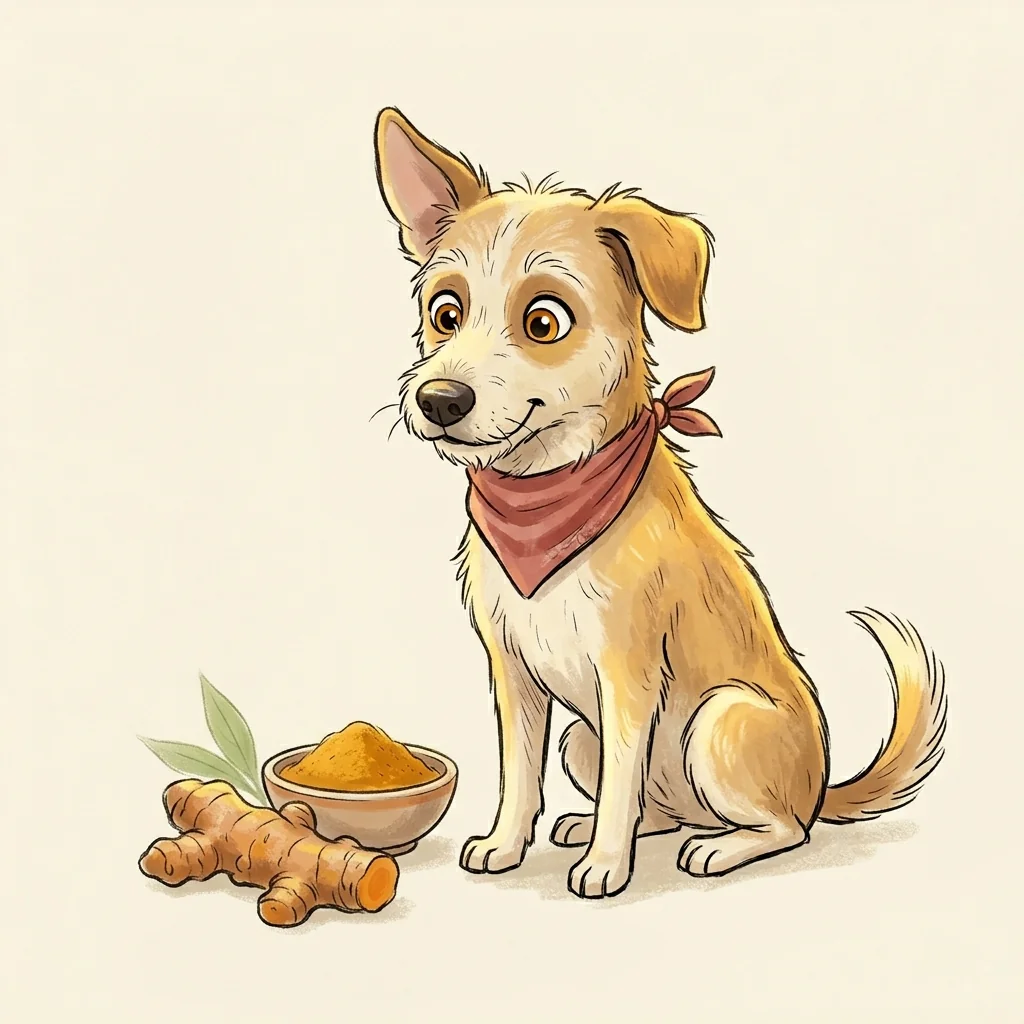

Your dog is stiff getting up in the morning, and someone in a Facebook group tells you to start golden paste. It is turmeric. It is in your kitchen. It cannot possibly hurt.
Mostly, it cannot. The question worth asking is whether it is doing anything at all.
Is turmeric safe for dogs?
Plain turmeric in small culinary amounts is safe for most healthy dogs. It has been fed to animals for a very long time, and a pinch stirred into food is unlikely to cause a problem.
It is not free of effects, though, and that is the point of using it. Curcumin has antiplatelet activity, so it should be stopped before any planned surgery and discussed with your vet if your dog is already on an NSAID like meloxicam or carprofen, or on any anticoagulant.
It stimulates bile flow. That makes it a bad idea for a dog with gallbladder disease or a suspected bile duct obstruction. This is not a theoretical caution; it is the standard contraindication.
Turmeric is high in oxalate. High-dose turmeric has been linked to oxalate nephropathy in human case reports. The extrapolation to dogs is not proven, but it is enough reason to be careful with dogs that form calcium oxalate stones, which disproportionately means Miniature Schnauzers, Shih Tzus, Lhasa Apsos, Yorkshire Terriers and Bichons.
The most common actual side effect is dull. Too much too fast causes loose stool, gas or nausea. Start smaller than you think you need to.
How much turmeric can your dog have?
Turmeric is not a calorie question, so this table is not about the treat budget. It is about how much active compound is actually in the spoon.
| Dog’s weight | Commonly cited daily dose | Weight of powder | Actual curcumin in it |
|---|---|---|---|
| 5 kg (Pug, Shih Tzu) | 1/8 tsp | ~0.4 g | ~12 mg |
| 10 kg (Indie pup, Beagle) | 1/4 tsp | ~0.75 g | ~23 mg |
| 20 kg (Indie, Cocker) | 1/2 tsp | ~1.5 g | ~45 mg |
| 30 kg (Labrador) | 3/4 tsp | ~2.2 g | ~66 mg |
| 40 kg (GSD, Rottweiler) | 1 tsp | ~3 g | ~90 mg |
The dose column reflects what is widely recommended online, roughly an eighth to a quarter teaspoon per 4.5 kg of body weight, split across meals. It is not an established veterinary dose and there is no consensus one. Curcumin content is estimated at 3% of powder by weight, which is typical but varies by source and age of the spice. Build up to these amounts over a week or two rather than starting at them.
Now read the last column again. The published trials that people cite when they recommend turmeric for arthritis used curcumin in the hundreds of milligrams to grams, in formulations engineered for absorption. A teaspoon of kitchen haldi is not in the same conversation.
The 3% problem: why kitchen haldi is not a joint supplement
Turmeric is a root. Curcuminoids are the part with the claimed anti-inflammatory activity, and they make up roughly 3% of the powder. So 97% of what you are stirring into the bowl is doing nothing for the joints.
Then absorption takes another cut. Curcumin is poorly soluble in water, badly absorbed from the gut, and rapidly metabolised and excreted. Very little of that 3% reaches the bloodstream. Fat helps, because curcumin is fat-soluble. Piperine, the active compound in black pepper, helps considerably more; the classic human pharmacokinetic work found piperine sharply increased curcumin bioavailability. That is the actual reason golden-paste recipes tell you to add pepper and oil, and it is a genuinely sound piece of folk pharmacology.
Even so, the canine evidence is thin. Studies of curcumin supplements for canine osteoarthritis have produced modest and inconsistent results, and the better ones do not show it matching an NSAID. Treat turmeric as a low-risk, low-cost, unproven adjunct. Do not treat it as a substitute for a drug that works.
If your dog’s stiffness matters enough that you are researching remedies, it matters enough for a vet to examine the joints.
Golden paste, and the three dogs who should not have it
Golden paste is turmeric simmered with water into a paste, with coconut or olive oil and a small amount of ground black pepper stirred in. The oil and pepper are there for absorption, and, as above, that part is well founded.
The dogs that should not get it: any dog on an NSAID or blood thinner without the vet knowing, any dog with gallbladder disease or a history of bile duct problems, and any dog that forms calcium oxalate stones. Add a fourth if your dog has surgery scheduled, in which case stop it and tell the surgeon.
Keep the paste refrigerated, make small batches, and throw it out after a couple of weeks. And expect stains, on your hands, the bowl, the floor and a white-coated dog’s muzzle.
How to use it, and when to stop
Start at a quarter of the amount in the table and build up over two weeks. Give it with food, always with some fat. Split the daily amount across meals rather than giving it all at once, which reduces the loose-stool problem more than anything else you can do.
Stop and reassess if the stool loosens and stays loose, your dog goes off food, you see any bruising or bleeding that is out of the ordinary, or you notice no change at all after six to eight weeks. That last one is not a failure; it is information.
Tell your vet you are giving it. Not because they will disapprove, but because curcumin interacts with real drugs, and a vet who does not know it is on board is working with an incomplete picture.
Questions people still ask
Can turmeric replace my dog’s arthritis medication?
No. This is the single most consequential mistake made with turmeric. Prescription NSAIDs for canine osteoarthritis are licensed because they demonstrably reduce pain; curcumin at kitchen doses has not shown anything close to that effect in dogs. Stopping a working painkiller to trial a spice leaves a dog in pain that it cannot tell you about, and untreated joint pain drives muscle loss, which makes the arthritis worse. If you want to reduce your dog’s NSAID dose, the conversation to have is with your vet, and it usually starts with weight loss and controlled exercise, both of which have far better evidence than turmeric.
Is turmeric good for a dog’s itchy skin?
There is no good evidence that it is, and itch has causes that respond to specific treatment. In India the leading candidates are fleas, environmental atopy, and secondary bacterial or yeast infection, and each has a different fix. A dog scratching itself raw needs a diagnosis, not a spice. Turmeric applied topically to broken skin is also a poor idea: it stains, it can irritate, and it makes the skin harder for your vet to assess.
Can dogs eat haldi doodh (turmeric milk)?
Better to skip it. Most adult dogs have reduced lactase activity, so a cup of milk tends to produce gas and loose stool, and haldi doodh is usually sweetened with sugar, jaggery or honey on top of that. If you want to give turmeric with fat for absorption, use a little coconut oil or a spoon of plain curd, which is lower in lactose than milk because the bacteria have already worked on it. The turmeric is the useful part; the milk is just calories and a stomach ache.
Related guides
Part of our human food for dogs guide. See also: can dogs eat garam masala, can dogs eat curd, can dogs eat ghee and can dogs eat amla. For the bigger picture, see our dog nutrition guide.
When in doubt about your dog and a new food, ask your vet. It is the cheapest insurance there is.
Sources: USDA FoodData Central for turmeric composition; Shoba et al., influence of piperine on the pharmacokinetics of curcumin; Merck Veterinary Manual, anti-inflammatory agents; Merck Veterinary Manual, osteoarthritis in dogs and cats.
Wondering about a different food?
🦴 Can my dog eat this?
Type a food to see if it is safe, needs caution, or is a hard no.
Get more dog stories in your inbox. Join Woofs & Words on LinkedIn.
Subscribe on LinkedIn