
For years, we’ve shared stories of dogs acting as “guardian angels”; pawing at a mole or refusing to leave a sick owner’s side. But in 2026, the science has finally caught up to the stories. Recent breakthroughs from the Penn Vet Working Dog Center have proven that dogs aren’t just reacting to our emotions; they are literal biological sensors capable of sniffing out “silent killers” like Hemangiosarcoma with 70% accuracy.
New Research: Dogs Detecting Canine Cancer (Hemangiosarcoma)
According to a landmark study led by Dr. Cynthia M. Otto and Clara Wilson (published January 2026), dogs are now being used to save other dogs.
-
The Disease: Hemangiosarcoma is a devastating blood-vessel cancer that often goes undetected until it’s too late.
-
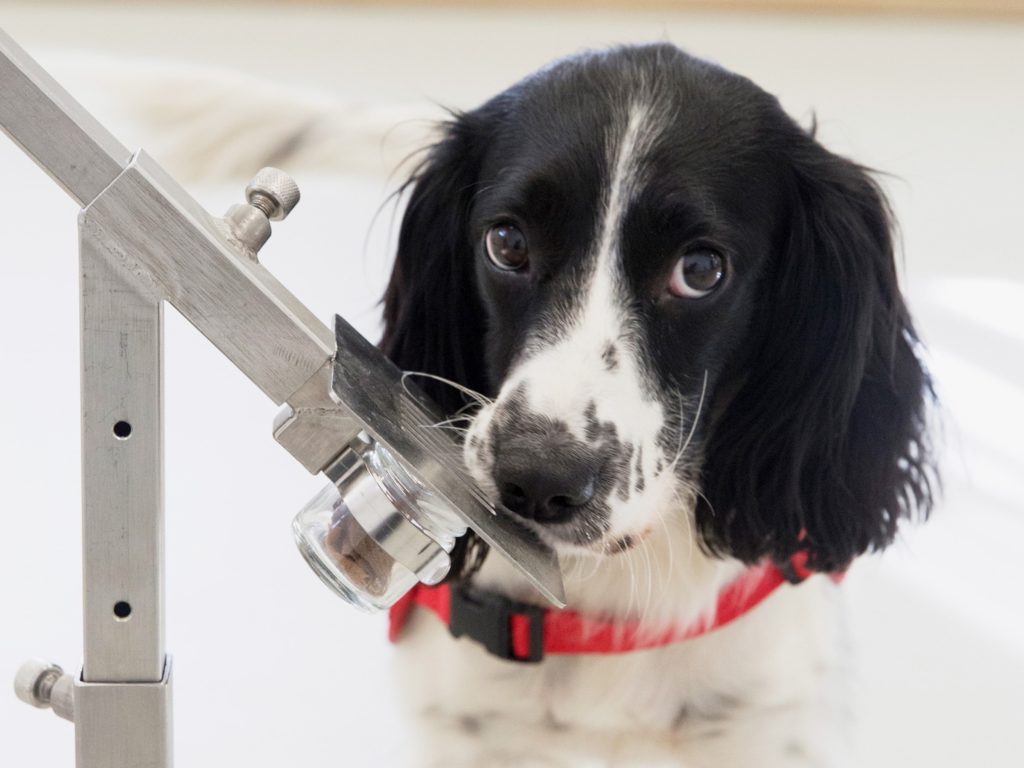
The Method: Using olfactometers (high-tech scent devices with infrared lasers), five bio-detection dogs were trained to identify the “signature scent” of this cancer in blood serum.
-
The Result: The dogs correctly identified the cancer samples 70% of the time.
Why this matters: This isn’t just about training dogs to work in clinics; it’s the “proof-of-concept” needed to develop electronic sensors that could eventually provide an annual screening test for your pet.
Medical detection dogs have truly evolved and they’re no longer just a quirky concept. These remarkable animals are now collaborating with researchers and healthcare professionals to identify diseases in their early stages. Exciting new findings from 2025 show that they can detect Parkinson’s, COVID-19, and various cancers long before any symptoms appear. At the University of Bristol, specially trained dogs achieved an impressive 98 percent accuracy in identifying Parkinson’s from skin swabs. In the UK, teams of Medical Detection Dogs are utilizing this extraordinary ability to spot COVID-19 in crowded public areas, playing a vital role in keeping communities safe.
Why Dogs Are So Good at This
The Science of VOCs: How the Sniff Works
It isn’t “intuition.” Every disease causes a metabolic shift in the body, releasing Volatile Organic Compounds (VOCs). These are tiny chemical molecules that evaporate into the breath, sweat, and blood. While humans have 5 million scent receptors, a dog has up to 300 million.
When a dog “smells” cancer, they are detecting a specific chemical “fingerprint” that is far too faint for any human-made machine to currently match in speed and portability.
Dogs have an astonishing sense of smell, equipped with over 300 million scent receptors. When diseases occur, they cause subtle chemical changes in the body, allowing dogs to identify conditions like Parkinson’s, COVID-19, breast and prostate cancer, malaria, fluctuations in diabetes, PTSD, stress disorders, and early signs of epilepsy. Researchers are now merging this natural gift with AI technology to boost detection speed and accuracy.
A dog’s sense of smell is about 1 million times greater than that of humans. With this precise sense of smell can dogs detect health problems in Humans?
Can dogs detect health problems in humans?
From detecting RDX to drugs, it’s simply amazing what they can do. In addition to smell, many dogs also have a strong “sixth sense”; they just notice things that we don’t. In multiple studies, dogs have been “intriguingly accurate” at detecting certain cancers by smelling breath or urine samples.
Research has shown that malignant tissues release chemicals that are different from normal tissue, and “it’s not surprising that dogs can recognize these differences.”
says Ted Gansler, MD, MBA, director of medical content for the American Cancer Society.
Dogs have also saved lives by early detection of health problems before they even occur. Dogs have also alerted humans to changes in their blood pressure or even let them know when a heart attack was imminent.
Amazing dog facts you need to know!
How do dogs detect human diseases?
Dogs’ sense of smell is way more advanced than the best of man-made machines. Consider this, a dog can detect substances at concentrations of one part per trillion—akin to locating a single drop of liquid in 20 Olympic-size swimming pools!
No wonder then that with training, these good boys sniff out drugs and bombs, trace suspects and even help find victims of earthquakes or other calamities. Dogs are being increasingly used to detect human diseases—from cancer to COVID-19, diabetes to malaria. All thanks to their sense of smell!
Dogs helping with disease detection in humans
Hospitals and public health initiatives are increasingly relying on detection dogs for swift and precise screenings. These dogs have tested thousands of people at airports, concerts, and hospitals, achieving accuracy levels that rival or even exceed traditional lab tests. They also visit elder care facilities and schools to help monitor health and well-being. Their contributions are already in line with World Health Organization standards for medical screening.
1. Malaria – Medical Detection Dogs, a UK based organisation showed how dogs could tell from sniffing someone’s socks whether they had malaria. The dogs could tell if the patient had malaria even if the patient showed no symptoms, now that’s a dogtor!

“Our previous work demonstrated that dogs can detect odours from humans with a malaria infection with extremely high accuracy—above the World Health Organization standards for a diagnostic.”
-Professor James Logan, Head of the Department of Disease Control at London School of Hygiene and Tropical Medicine (LHSTM).
Now this organisation is working with researchers to see if dogs can spot the dreaded COVID-19 virus too.
2. Diabetes – Alert dogs let their type 1 diabetic human companions know that their blood sugar levels are off before the person feels any symptoms or takes a blood test.
3. Prostate cancer – In 2015, Italian researchers announced that they had trained two German shepherds to detect chemicals linked to prostate cancer in urine samples.
4. Parkinson’s disease – Researchers are attempting to train dogs to detect Parkinson’s disease years before symptoms emerge.
5. Breast cancer – Canine cancer detection is being increasingly deployed at staging stage as a non-invasive and inexpensive way to detect the disease at an early stage. Dogs are helping to detect breast cancer, and melanoma by sniffing people’s skin, bodily fluids, or breath.

But you need not wait for experimental research, the greatest asset of a dog’s sixth sense is that he can smell a good person a mile away. In odd chances, if you look closely, you can also find a cat among them.
The other animal helping cancer science: it doesn’t sniff, it gets sick
A cat with feline leukemia is running an experiment no lab can order up on command: a healthy mammal catching a cancer-causing virus on its own, inside somebody’s living room. That’s the argument vet Julia Beatty and molecular biologist Thomas Tu made this year in Nature Reviews Cancer. Pet cats naturally pick up relatives of at least four viruses tied to human cancer. Feline leukemia virus causes lymphoma much the way its retrovirus cousins can in people. Feline immunodeficiency virus is a distant relation of HIV. Feline papillomaviruses are linked to skin cancers. And a domestic cat hepatitis B virus shares the human version’s genome structure, which matters because no lab animal fully reproduces how hepatitis B turns into liver cancer in humans, and roughly 15 to 20% of human cancers worldwide start with a virus.
Cats have done this kind of work before. In 1967, William Jarrett found that FeLV gives ordinary house cats cancer, the first proof that any mammal could catch cancer from a virus at all. That discovery sent virologist Robert Gallo hunting for a human equivalent, and he found one: HTLV-1, the first confirmed human cancer-causing retrovirus.
The Bengaluru dogs earlier on this page are proof of the same idea, just worked out with breath samples instead of blood tests. A dog living an ordinary life outside a lab handed researchers something a built experiment couldn’t. Read how a half-indie dog cleared that bar in a peer-reviewed trial.
Source: Beatty, J.A., Tu, T. “Cat viruses as windows into human oncogenesis.” Nature Reviews Cancer 26, 233-235 (2026). doi:10.1038/s41568-026-00909-z
Research suggests that people who live with dogs are more relaxed and far from anxiety and stress disorders. Thinking of adopting a dog?
Get more dog stories in your inbox. Join Woofs & Words on LinkedIn.
Subscribe on LinkedIn
Sinfully true! 😛
Wonderful photo!!!!!
Reblogged this on (: In Couch with Myself :).
I personally believe they can smell any sort of untoward danger/event 🙂
You are one smart lady 🙂