
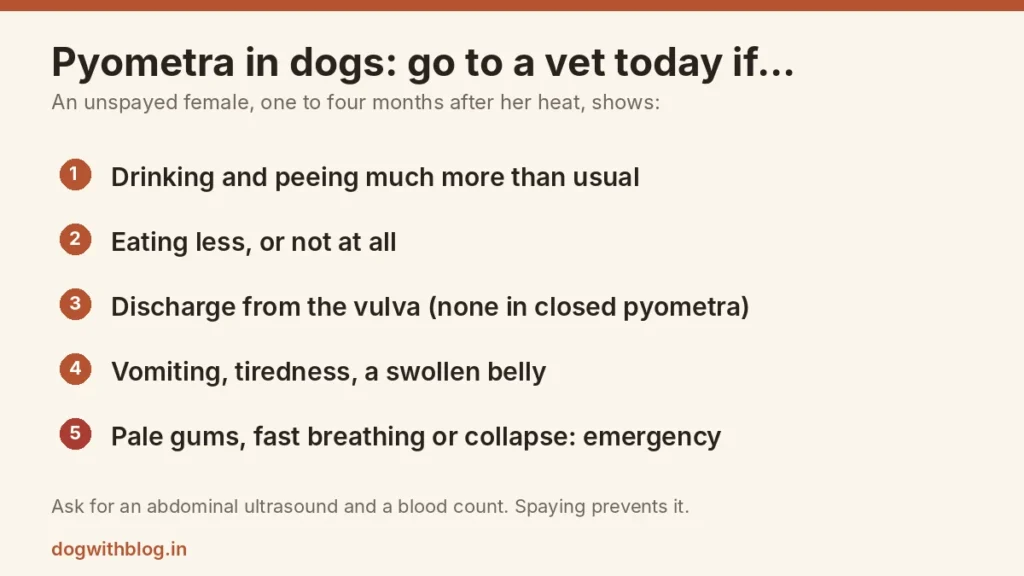
If your female dog isn’t spayed, came out of heat in the last two months, and is now drinking far more water than usual, eating less, or licking at a discharge under her tail, take her to a vet today and ask for an abdominal ultrasound. That is the classic picture of pyometra in dogs, an infection that fills the uterus with pus. Vets, including Cornell University’s canine health centre, treat it as an emergency because the infection can spread into the blood, and a uterus that can’t drain can burst.
It’s common. In Swedish insurance records of more than 260,000 female dogs, about one in five unspayed females had been diagnosed with pyometra by the age of ten. Older estimates, including Blue Cross’s in the UK, put it closer to one in four. India has no figure for how many pet dogs get it, only hospital data. At the veterinary college in Tirupati, 44 of the 211 female dogs brought to the gynaecology ward between March 2025 and 2026 had pyometra, and the Indian Spitz was the breed seen most.
What pyometra is, and why it follows a heat
After every heat, a dog’s body spends weeks under the hormone progesterone, whether or not she was mated. Progesterone thickens the lining of the uterus, fills its glands with fluid, keeps the cervix closed and damps down the local immune response. Over repeated cycles the lining can become cystic, and bacteria that reach it, most often E. coli, find a warm, wet place to grow. That is why pyometra is a disease of older, unspayed females: the average age at diagnosis in the Swedish data was seven, and in Indian hospital series cases peak between seven and ten.
Signs usually show four to eight weeks after a heat, though they can appear anywhere up to about four months later. So the question a vet will ask first is when she was last in season. Note the date every time, in your phone if nowhere else.
Open and closed pyometra
In open pyometra the cervix is open and pus drains out. You may see a creamy, bloody or pus-like discharge on her bedding or the fur around her tail, and she may still be eating. Most cases are open: 80 percent in one Andhra Pradesh series and two in three at IVRI, Izatnagar.
In closed pyometra nothing drains. There is no discharge to warn you, the belly swells, and the dog gets very sick quickly. Closed pyometra is the more dangerous form because the pressure builds inside a weakened uterus.
Symptoms of pyometra in dogs
- Discharge from the vulva, which can be missing altogether in closed cases
- Drinking and urinating much more than usual
- Tiredness, not wanting to get up or go for her walk
- Eating less or not at all
- Vomiting, sometimes diarrhoea
- A swollen or tender belly
- Fever, pale gums or fast breathing
Go straight to an emergency vet if she has stopped eating, is vomiting, has collapsed, has pale gums or is breathing fast, or if her belly is swelling with no discharge at all. In hospital studies about 60 percent of dogs with pyometra already meet the criteria for sepsis when they are diagnosed, which is why waiting a day to see if she perks up is the wrong call. Our list of animal helplines near you has emergency numbers by city.
How a vet diagnoses it, and what the tests cost in India
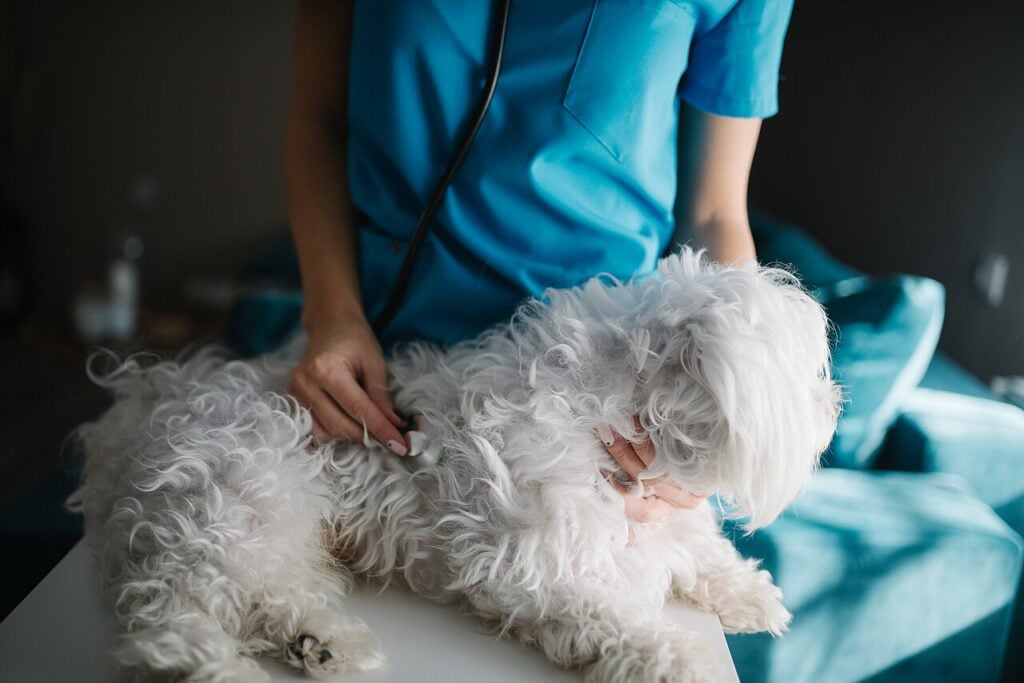
The vet will want to know when her last heat was, then examine her and usually run three things: an ultrasound, which shows an enlarged, fluid-filled uterus and rules out pregnancy, a complete blood count, which usually shows a high white cell count, and a kidney panel, because the toxins strain the kidneys. Those are the same tests used in the Indian hospital studies, and your vet may add X-rays or more blood work.
At government veterinary institutions they are cheap. ICAR-IVRI at Izatnagar in Uttar Pradesh charges ₹250 for an ultrasound, ₹300 for a blood count and ₹300 for a kidney panel for a pet, plus tax, on fees in force since June 2024. The Bihar Animal Sciences University hospital in Patna charges ₹500 for an ultrasound and ₹300 for a blood count. Private clinics charge more.
Treatment: surgery is the standard
The treatment almost every vet recommends is surgery to remove the infected uterus and the ovaries, after the dog has been stabilised with intravenous fluids and antibiotics. It’s a harder operation than a routine spay because the uterus is swollen and fragile, and antibiotics usually continue for about two weeks afterwards. Once the uterus and ovaries are fully removed, pyometra does not come back. The rare exception, a stump pyometra, happens when a piece of tissue is left behind.
Surgery works, and timing matters. In a Swedish study of 356 dogs, 1 percent of the dogs operated on died after surgery. Most of the deaths in that study, 32 of 36, were dogs put to sleep without treatment. At a veterinary college hospital in Gannavaram, Andhra Pradesh, 14 of 75 dogs with pyometra died: five after surgery and nine during the illness, including dogs too sick to be operated on. The study doesn’t say why the numbers were so much worse there, and we won’t guess, but a dog that reaches the table early has the better odds everywhere.
Can pyometra be treated with medicine instead?
Sometimes, for a young dog who is meant for breeding, is not septic and has an open cervix. Hormonal treatment with prostaglandins, cabergoline or anti-progesterone drugs can clear the infection in most such dogs, but it takes about 48 hours to show improvement, it’s risky in closed pyometra, and the infection often comes back. Across studies, an average of 29 percent of dogs relapsed, in one Swedish series 43 percent, usually at a later heat.
The drug European vets prefer, aglepristone, is not listed as marketed in India. Indian vets who try medical treatment have used cloprostenol, cabergoline, methylergometrine and mifepristone in published trials. For an older dog or a pet who will never be bred, vets generally recommend surgery.
What pyometra surgery costs in India
We couldn’t find a single Indian clinic that publishes a price for pyometra surgery, so we won’t invent one. What is published: IVRI charges ₹500 for a spay operation and BASU in Patna ₹2,500. A private clinic charges ₹6,000 to ₹15,000 for a routine spay and a multispecialty hospital ₹8,000 to ₹20,000 or more, according to an April 2026 price guide from the clinic chain Vetic. Emergency pyometra surgery costs more than a routine spay because it adds intravenous fluids, a hospital stay, antibiotics and a harder operation. Ask your vet for an estimate before surgery, and ask what the hospital stay adds.
How to prevent pyometra
Spaying prevents it. Remove the uterus and ovaries and there is nothing for the infection to grow in, apart from a rare “stump pyometra” when tissue is left behind. When to spay depends on your dog’s size and health, so decide that with your vet, but the idea that a female should have one litter first is a myth, and Indian vet clinics that write about spaying, such as Dr Paws in Bengaluru and Hyderabad, list it as one.
Two hormone shots raise the risk. Oestrogen injections given to end an unplanned mating are discouraged because of it: in one 1985 study, two of eight dogs given an oestradiol injection after heat developed pyometra. Progestin drugs used to suppress heat, such as medroxyprogesterone acetate, are linked to the same uterine changes that lead to pyometra. If your vet suggests either, ask about spaying instead.
Community dogs and pyometra
Street dogs are meant to be sterilised under the Animal Birth Control Rules, 2023, which local bodies run. Females who miss the programme stay intact and at risk, and the person most likely to notice is whoever feeds her. If a female you feed is drinking from every puddle, has stopped eating or has a swollen belly a month or two after she was in heat, call your city’s animal helpline or a local rescue.
Pyometra in cats
Cats get it too, less often: about 2 percent of unspayed females are diagnosed by the age of 13, and most cases are in cats over five. The danger is that cats wash. Discharge is missing or licked away in up to 40 percent of cases, so a female cat who is quiet, off her food and drinking more needs the same ultrasound.
This guide is general information for dog owners in India. It does not replace an examination by your vet.
Get more dog stories in your inbox. Join Woofs & Words on LinkedIn.
Subscribe on LinkedIn