
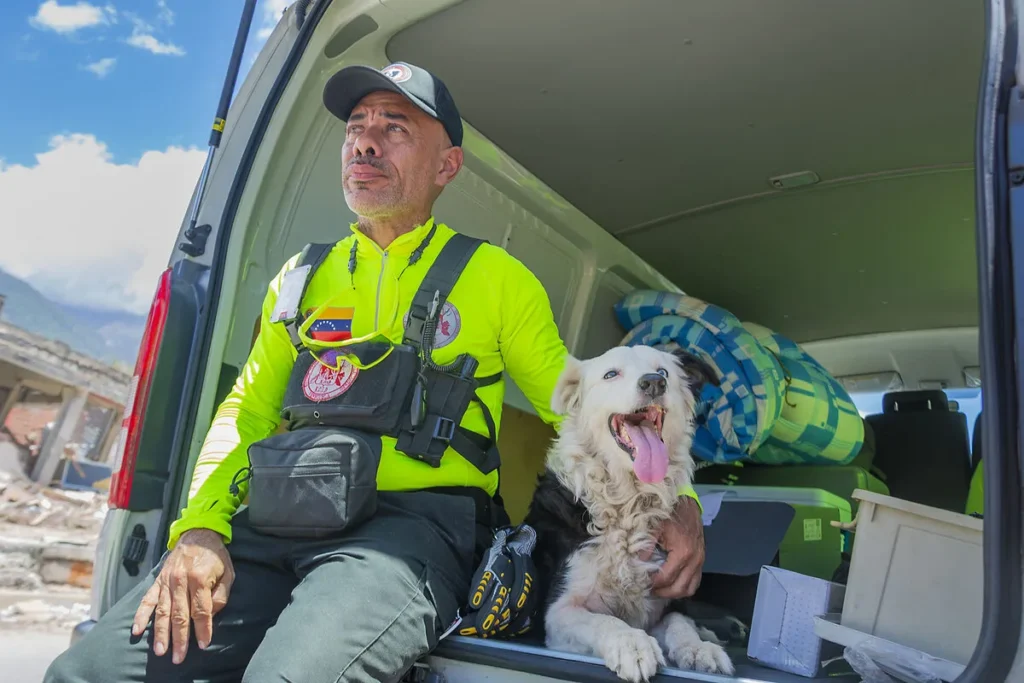
Nine years ago, someone in Caracas decided a Border Collie puppy with one blue eye and one brown eye wasn’t worth keeping, and handed him over to animal control. He landed at a shelter run by APROA, the city’s animal welfare association, and then with a man named Jorge Beens, who trains dogs to find people trapped under collapsed buildings. On his first day at Beens’ place, the puppy knocked over an entire basin of water. That accident is the entire reason his name is Tsunami. Nine years later, that same rescue dog spent six days climbing through what two earthquakes left of a Venezuelan coastal town and came out having found at least 26 people still alive. Last weekend, the city of Maracaibo cast him in bronze.
Staying quiet is the actual skill
Beens has run a canine disaster-response unit out of Caracas for roughly 15 years, working landslides, gas explosions and building collapses long before this year’s earthquakes made his dog famous. He calls what he builds with a working dog “a marriage.” It takes years to build a trust that has to survive chaos, noise and the dog’s own exhaustion. The training itself sounds almost too simple to explain a 26-person career. Hide a volunteer in a debris pile with Tsunami’s favourite toy. Reward him for two things at once: pushing past every distracting scent in a collapsed building, and staying completely silent until he’s certain, then barking exactly once to mark the spot.
That silence is the part that actually saves lives. A search dog who barks at every hint of human scent sends a rescue crew digging into the wrong pile for the two or three hours they don’t have. It’s also a demand that wears on the dog: after 9/11, handlers working Ground Zero reportedly had to hide in the rubble themselves and stage fake finds once their search dogs went too many days without a real one, just to keep them from giving up. Tsunami was certified for landslide search and rescue in 2022, one of only a handful of dogs in Venezuela to hold it, and by 2023 he and Beens’ team were in Turkey and Syria, working the rubble left by that February’s earthquakes.
Forty minutes into the worst week of the year
On 24 June 2026, two earthquakes measuring 7.2 and 7.5 hit northern Venezuela and killed nearly 4,500 people, gutting the coastal town of La Guaira along with it. Tsunami’s unit deployed within hours. Beens says his dog found his first survivor 40 minutes after the ground stopped moving, and kept working for six straight days until the mission ended, locating at least 26 people alive in what was left of the buildings. Across his whole career, Beens’ team credits him with more than 350 people found or otherwise helped. Landslides, floods, gas explosions, two countries’ worth of earthquake rubble. The June mission was the one that finally caught up with him. By the time it ended, Tsunami needed an IV drip and a stretch of medical observation before anyone let him go home. He was luckier than some: DWB wrote in 2016 about Dayko, the Ecuadorian rescue dog who died of a heart attack after days of this exact kind of work in extreme heat, following that year’s earthquake.
Three medals that aren’t handed to pets
On 20 September, Maracaibo’s mayor, Giancarlo Di Martino, unveiled a bronze statue of Tsunami in Vereda del Lago park, its plaque reading “Guardián de la esperanza” — Guardian of Hope. Alongside it, the city gave him three honours normally reserved for its own emergency workers: the Honor Button of Merit, the Medal of Valor, and the fire department’s own service insignia.
“A true hero,” Di Martino called him.
Tsunami’s own unit, K-SAR ECID, put his retirement plainly:
“He retires at the top of his game, proving his courage and giving everything in the field.”
At nine, he’s done with rubble. What’s next, per the group, is visiting schools and communities across Venezuela with the dog-training nonprofit Perros Extremos. He’s an ambassador now, not a responder.
What this actually proves
None of it happened because someone checked Tsunami’s bloodline. He got certified for the hardest job a working dog can hold because he passed a test that has nothing to do with pedigree: could he stay on a scent through every distraction a collapsed building throws at him, and trust a stranger enough to work for a toy instead of running. That’s a temperament question, not a breeding one. It’s also the same question every Indian shelter is quietly answering every day, for dogs who will never get a bronze statue or even a second look at an adoption drive.
We’ve written before about Frida, the Mexican Navy dog who pulled 12 people from Mexico City’s rubble in 2017 and was credited with more than 50 rescues by the time she died in 2022 — proof this kind of work has been happening quietly for years, long before a statue made it a headline.
Tsunami gets to spend his retirement visiting schoolchildren instead of collapsed buildings. Most dogs who start exactly where he started don’t get either one.
Sources: Wikipedia, The Christian Science Monitor, Dexerto. Related on DWB: heroes looking after dogs after disasters · Patron, Ukraine’s mine-sniffing hero · more dogs with jobs. Photo: Rhonny Zamora/Special to The Christian Science Monitor.
Get more dog stories in your inbox. Join Woofs & Words on LinkedIn.
Subscribe on LinkedIn