
Medically reviewed by Dr. Catherine Nicolaou, DVM.
Quick answer: The Bully Kutta, also called the Indian Mastiff or Alangu, is a giant guard and hunting dog from the Punjab and Sindh regions, descended from the war mastiffs Mughal armies brought to the subcontinent. Powerful, dominant and wary of strangers, it needs an experienced handler and is not a pet for most homes. In India today it is more often found in illegal dogfighting rings than in loving homes.
It is worth a contrast. Where the Bully Kutta was shaped by breeders for war and guarding, the indie dogs of India were shaped by the land itself, which is why they are far easier to keep as family pets.
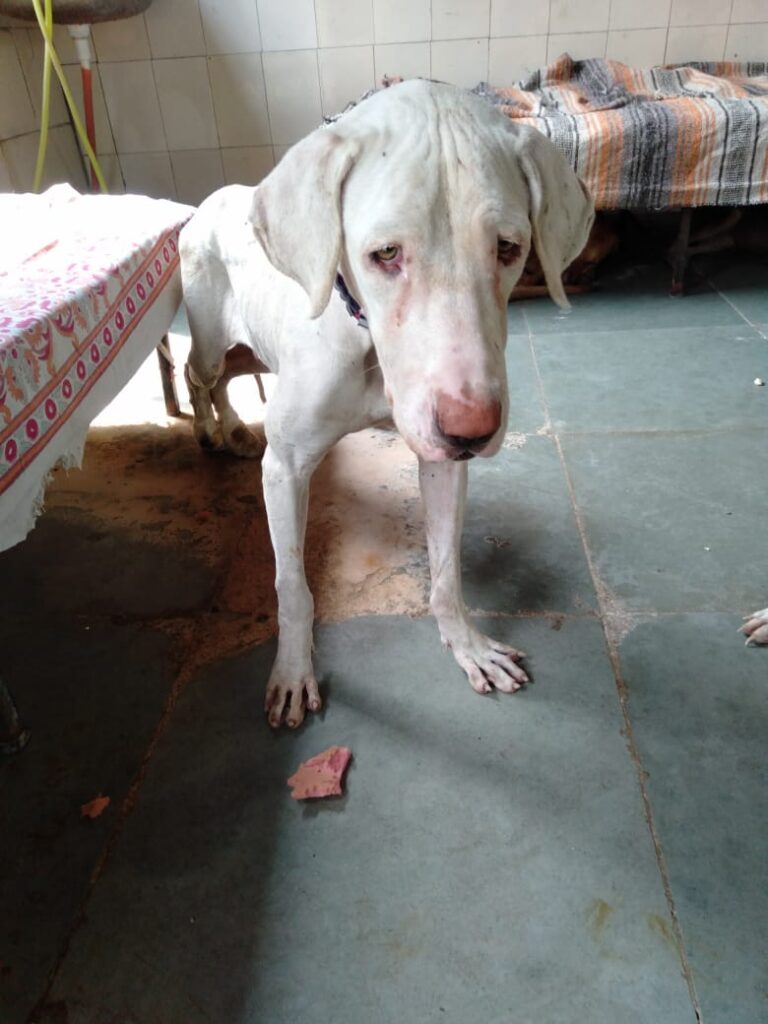
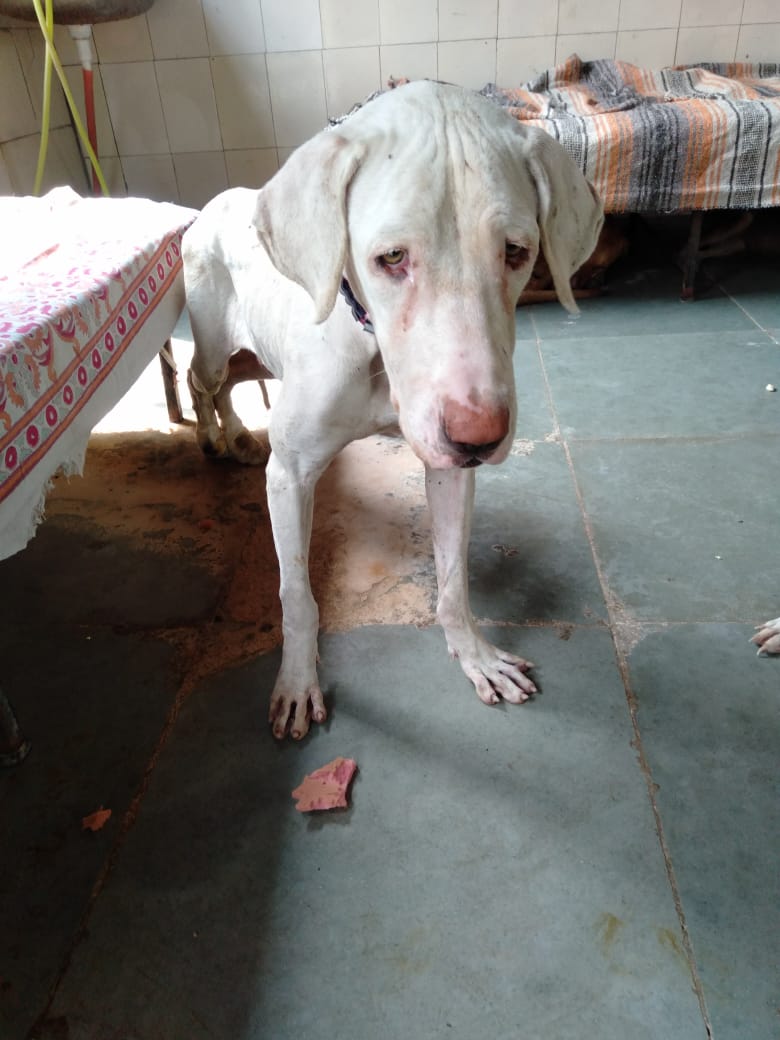
A white dog stands on a shelter floor in Delhi, too weak to walk. Her name is Lily, a 16-month-old Pakistani Bully Kutta who arrived at the Sanjay Gandhi shelter starved to the bone. Weeks of care got her back on her feet. Lily is the Bully Kutta most Indians never see: not the snarling giant of the breeder’s reel, but a young dog discarded the moment she stopped being useful.
That gap between the myth and the animal is the whole story of this breed. So let’s tell it straight.
What the Bully Kutta actually is
The Bully Kutta is a large molosser-type guardian native to the Indian subcontinent, built over centuries in the Punjab and Sindh regions. Historians trace its line to the Alaunt, an extinct war-dog type brought in by invaders and traders and refined during the Mughal era into a dog suited to India’s heat and hard work. The emperor Akbar is recorded as keeping Bully Kuttas for hunting, and an “Indian Mastiff” was shown as far away as the Second International Dog Show in London in 1864.
The name itself gives the game away. “Bully Kutta” is often mistranslated as “bully dog,” but it comes from the Punjabi bohli, meaning heavily wrinkled, and kutta, meaning dog. It means “the heavily wrinkled dog,” not “the bully.” This has nothing to do with the American Bully, a modern American breed it is constantly confused with online.
The name tangle: Bully Kutta, Indian Mastiff, Sindhi, Alangu
Few Indian breeds carry as many names, and the confusion is worth clearing up because it changes what you’re actually buying or adopting:
- Bully Kutta / Indian Mastiff / Sindh(i) Mastiff / Indo-Pakistani Mastiff — the same giant guardian of the Punjab and Sindh plains.
- Alangu — a South Indian mastiff-type from Tamil Nadu, depicted in carvings at the Darasuram temple near Thanjavur. Many treat it as the same dog; others classify the Alangu separately, as a leaner, non-molosser type. In the market the Alangu sells for far less (roughly ₹7,000–₹9,000) than a Bully Kutta.
- Kumaon Mastiff — a distinct, rarer Himalayan mastiff often lumped in with the group but genuinely its own breed.
None of these is recognised by the Kennel Club of India or the FCI. There is no breed standard, no registry, no health screening. What passes for a “pedigree” Bully Kutta is whatever a breeder says it is.
Bully Kutta facts at a glance
- Also called: Indian Mastiff, Sindhi Mastiff, Indo-Pakistani Mastiff, Alangu, Indian Bully
- Origin: Punjab and Sindh regions of the Indian subcontinent
- Type: giant molosser guard and hunting dog
- Height: roughly 76–89 cm (30–35 in) at the shoulder, sometimes taller
- Weight: around 68–90 kg for males; females a little less
- Lifespan: about 8–10 years
- Coat: short, usually white, fawn, brindle or patched
- Temperament: dominant, alert, fiercely protective, wary of strangers and other animals
- Best suited to: only very experienced owners with space, a working purpose and time; never first-timers, apartments or homes with small children or other pets
- Recognition: none (no KCI/FCI standard)
What a Bully Kutta looks like
This is a genuinely giant dog: tall, deep-chested and heavy-boned, with loose skin around a broad head, a long muzzle, pendulous lips and the folds that give the breed its name. Ears are usually cropped by breeders, a painful and needless practice we do not endorse. Coats run short and are easy to groom, most often white, sometimes fawn, brindle or patched. Everything about the build says the same thing: this animal was made to overpower.
Living with a Bully Kutta: the honest version
Bully Kuttas are described, accurately, as intelligent, alert and dominant, and as dogs that should only be handled by people experienced with large, powerful guarding breeds. Bred to protect their territory and pack at all costs, they can be intensely aggressive toward strangers and other animals. This is not a temperament you train out; it is what the breed was built for.
For the overwhelming majority of Indian households, that makes the Bully Kutta the wrong dog. It needs space, an experienced hand, early and relentless socialisation, and a job. Get any of that wrong and you have an 80-kilo animal you cannot control, in a country with almost no infrastructure for rehoming dogs like Lily. This is exactly how so many end up chained on terraces, dumped at shelters, or worse.
The hard truth: dogfighting and the law
There is no gentle way to say this. In India, the Bully Kutta is one of the breeds most exploited in illegal dogfighting. Investigations by welfare groups have documented Bully Kuttas, pit bulls and mastiffs being mangled and killed in organised fights across Haryana, Punjab, Uttar Pradesh, Maharashtra and Rajasthan. Inciting animals to fight has been illegal in India since the Prevention of Cruelty to Animals Act, 1960, yet the rings continue, and dogs are bred, drugged and discarded to feed them.
The law is finally moving. A 2024 central government advisory recommended banning the breeding and sale of around two dozen “ferocious” breeds, the Bully Kutta among them, and through 2025 and 2026 several states and union territories have acted on it: Chandigarh has restricted aggressive fighting breeds, Jharkhand has banned pit bulls, Rottweilers and other foreign attack breeds, and Goa has been finalising similar rules. Enforcement is uneven and parts of the advisory have been challenged in court, so the picture varies by city. PETA India and other groups continue to push for a nationwide prohibition on breeding dogs deliberately made for fighting.
Our position is simple: the cruelty is the breeding-for-aggression and the fighting, not the individual dog. Lily did nothing wrong. The dogs are victims of the trade, not its villains.
While native breeds earn medals, the Bully Kutta pays a different price
Here is the contrast worth sitting with. Over the last few years the Indian Army has been inducting native breeds under the Aatmanirbhar Bharat push: the Mudhol Hound first, in 2017, for border surveillance and IED detection, followed by the Rampur Hound, Chippiparai, Kombai and Rajapalayam, with Himalayan breeds like the Bakharwal, Gaddi and Bhutia now being evaluated for high-altitude work. India’s indigenous dogs are being recognised, trained and honoured.
The Bully Kutta sits outside that story. Its strength was never channelled into service; it was channelled into the pit. Same country, same era, two completely different fates for two kinds of native power.
Bully Kutta health (vet-reviewed)
Like most giant molossers, the Bully Kutta’s size is also its medical burden. Owners and rescuers should watch for:
- Joint disease — hip and elbow dysplasia are common in fast-growing giant breeds and worsened by overfeeding puppies for “size.”
- Bloat (gastric dilatation-volvulus) — a life-threatening emergency in deep-chested dogs; feed smaller meals and avoid hard exercise right after eating.
- Heat intolerance — a heavy dog struggles badly in the Indian plains; heatstroke is a real summer risk.
- Eye and skin issues — the loose facial skin can lead to entropion (in-rolling eyelids) and skin-fold infections.
- Heart conditions and shorter lifespan — giant breeds typically live only 8–10 years.
None of this is a substitute for veterinary care. Any lameness, a bloated or painful abdomen, laboured breathing or eye trouble is a same-day vet visit, not a wait-and-watch.
Price in India, and why adoption is the better route
A Bully Kutta puppy in India typically runs from ₹15,000–₹20,000 for “basic” litters up to ₹50,000, and ₹1,00,000 or more for dogs sold on supposed show or fighting lineage. The Alangu type sells for far less. But every rupee spent on a breeder feeds a trade with no health screening, no standard and, too often, links to the fighting world.
There is another way in. Dogs like Lily land in shelters across India every month, most of them young, most of them failed by a first owner who wanted a “powerful” dog and could not cope. If you genuinely have the experience, space and time for a giant guardian, adopt one who is already here and already out of options. Meet dogs looking for homes near you.
Bully Kutta vs the dogs it’s confused with
- Bully Kutta vs American Bully — no relation. The American Bully is a modern, stocky companion breed from the United States; the Bully Kutta is a giant Indian guardian. The shared word “bully” is a coincidence of translation.
- Bully Kutta vs Alangu — often treated as one; the Alangu is the leaner South Indian type, usually cheaper and less molosser-heavy.
- Bully Kutta vs Kumaon Mastiff — a genuinely separate, rarer Himalayan mastiff.
Bully Kutta FAQs
Is the Bully Kutta banned in India? Not nationally, as of 2026. A 2024 central advisory recommended banning it along with other fighting breeds, and some states and UTs (such as Chandigarh and Jharkhand) have acted, but rules and enforcement vary by city and parts of the advisory are being contested in court.
How much does a Bully Kutta cost in India? Roughly ₹15,000 to ₹50,000 for most puppies, and up to ₹1,00,000 or more for so-called show or fighting lineage. Adoption costs a fraction of that and saves a dog already in need.
Is the Bully Kutta a good family dog? For almost everyone, no. It is a dominant giant guardian bred to be wary and protective, unsuited to first-time owners, apartments, or homes with young children or other pets.
Is the Bully Kutta the same as an American Bully or a pit bull? No. It is a large native Indian mastiff, unrelated to the American Bully or the American Pit Bull Terrier despite the shared “bully” label.
Adopt, don’t shop. For the full picture of the country’s desi dogs, see our guide to India’s native dog breeds.
Get more dog stories in your inbox. Join Woofs & Words on LinkedIn.
Subscribe on LinkedIn