
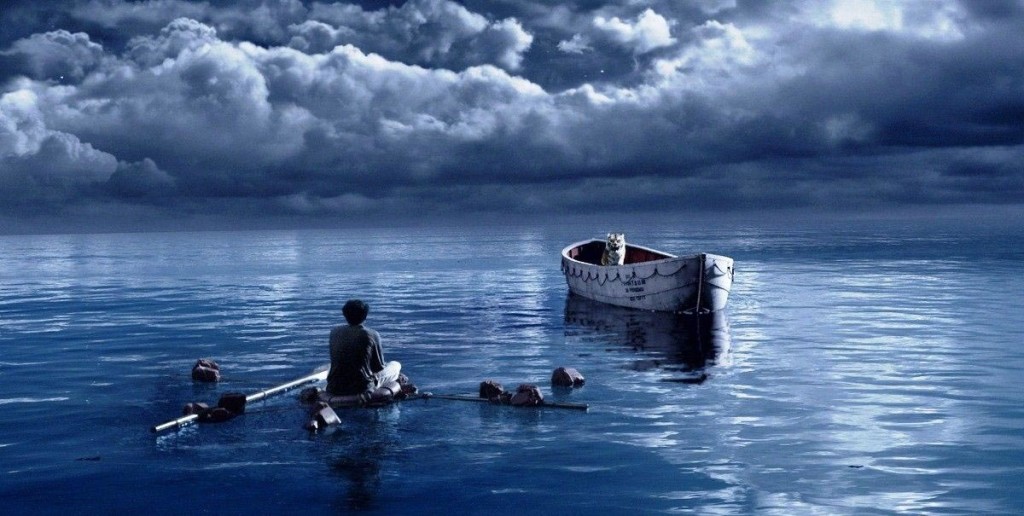
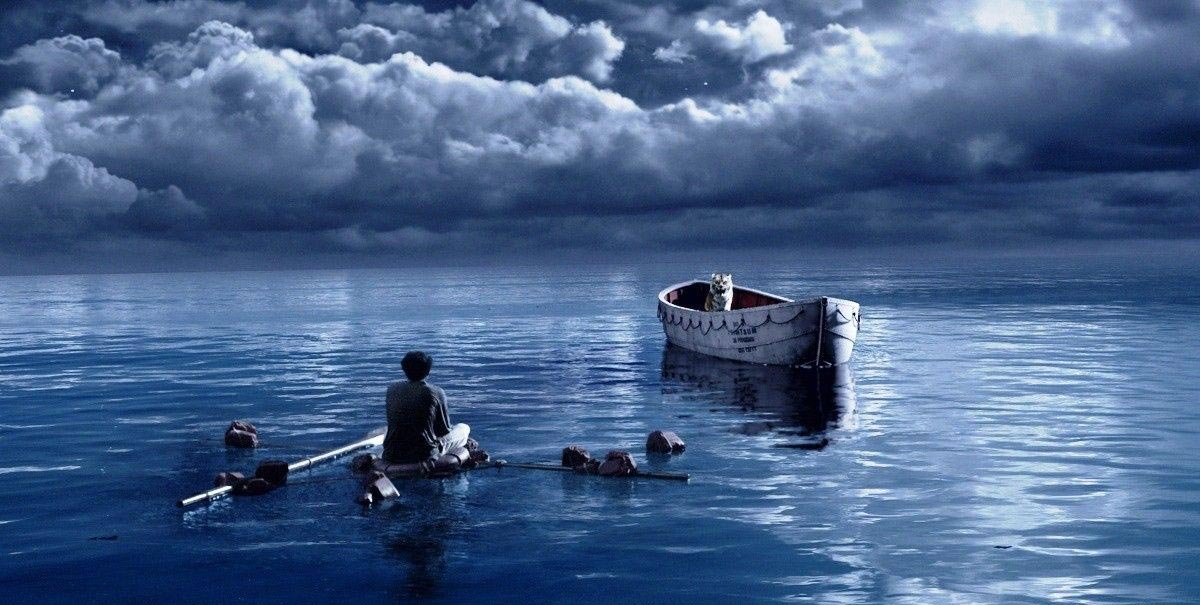
Watching Life of Pi (2012) as a dog lover, I see a movie about a boy and a 450-pound Bengal tiger learning the impossible language of trust — a
story that hits anyone who has ever shared a quiet moment with an animal. Below is everything you’ll want to know: the plot, the ending explained, the real story behind the tiger named Richard Parker, where to watch the film in India today, and my review.
I remember slam books from my school years. Brightly colored, artistically carved into the shape of a heart or an animated character. Although different from one another in colour and contour, they always had a recurring question. “If you were stranded on an island, who would you want with you?”
I wonder if any kid ever scribbled ‘tiger’ in the space provided.
Fernfly gifted me Yann Martel’s bestseller Life of Pi in 2004. Reading it was a study in faith. Back then, I wasn’t affirmative whether we needed zoos in our world. All that Martel needed was a paragraph to shake my beliefs, consider this extract:
But I don’t insist. I don’t mean to defend zoos. Close them all down if you want (and let us hope that what wildlife remains can survive in what is left of the natural world). I know zoos are no longer in people’s good graces. Religion faces the same problem. Certain illusions about freedom plague them both.
Yann Martel, Life of Pi
I was sold.
Life of Pi movie review
When Fernfly gifted me Yann Martel’s novel in 2004, I wasn’t sure a story this internal — a boy, a tiger, an ocean — could survive the jump to
film. Ang Lee made me wrong, beautifully.
Few films in recent memory have used visual effects with as much restraint. The water sequences move between tranquil azure stillness and tempestuous
violence; the rendering of Richard Parker — his eyes, his weight, his breath — remains a high-water mark in VFX. Pi’s voyage feels less like spectacle and more like prayer.
The film’s strongest scenes are the small ones. The meerkat island. The storm Pi calls a visit from God. The first time Richard Parker accepts
food without lunging. The last time he doesn’t look back.
My one regret is what got cut from the book: Pi’s temporary blindness, and a chance encounter with another survivor whose ending is more
terrible than any storm. These are losses, but the film earns them.
My rating: 4 / 5. Watch it on the biggest screen you can find, with the lights off and the dog asleep at your feet.
Life of Pi Plot Summary (No Major Spoilers)
Piscine “Pi” Patel grows up in 1970s Pondicherry, the son of a zookeeper. When India’s political turmoil forces the family to migrate to Canada,
they board a Japanese freighter — the Tsimtsum — with their animals.
The ship sinks in a Pacific storm. Pi survives on a 26-foot lifeboat with four passengers he didn’t choose: an injured zebra, an orangutan,
a hyena, and a 450-pound Royal Bengal tiger named Richard Parker.
What follows is 227 days adrift — a survival story that is also a meditation on faith, instinct, and what we choose to believe about the
world. Pi must keep himself alive, and somehow keep the tiger alive too, because Richard Parker’s hunger is the only thing keeping Pi’s mind sharp.
Life of Pi (2012) — Quick Facts
- Director: Ang Lee
- Based on: Yann Martel’s 2001 novel Life of Pi
- Lead cast: Suraj Sharma, Irrfan Khan, Tabu, Adil Hussain
- Setting: Pondicherry (India) → Pacific Ocean → Mexico
- Original language: English, with Tamil and French dialogue
- Runtime: 127 minutes
- Awards: 4 Academy Awards including Best Director
- Rating (Dog with Blog): 4 out of 5
Ever since its movie adaptation was announced, I was skeptical if such a tale could be put on celluloid. Director Ang Lee brilliantly brings to screen this powerful story of hope in sheer cinematic excellence, a visual delight in every frame!
In a politically unstable India of 1970s, Pi Patel’s zoo keeper family decides to migrate to Canada. However as fate would have it, the ship bows down to the mighty waters of Pacific ocean and when the surf settles, only a 26-foot lifeboat and five survivors are left in its wake. Pi himself, an injured zebra, an orangutan, a hyena and a 450 pound Royal Bengal tiger named Richard Parker (on the name of its captor). The dynamics of the predator prey relation comes to picture in the survivor story that spans 227 grueling days. But wait, it’s not the story where David beats Goliath.
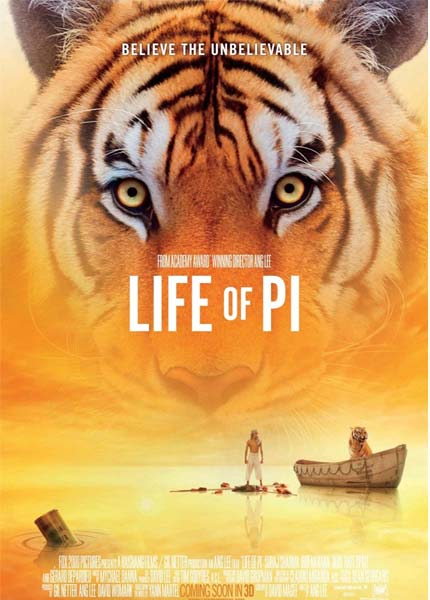
A lyrical odyssey of an angry ocean, The Life of Pi visits a familiar set piece; lead character marooned in open waters – Cast Away, Robinson Crusoe, Gulliver’s travels among others albeit with an imagery never seen before and a story webbed with mysticism. Stranded in a boat, a boy and a tiger not only have to define their spaces but co-exist.
Few films in recent memory have harnessed visual effects with as much vision and finesse as “Life of Pi.” Ang Lee and his team elevated digital artistry to new heights, blending breathtaking CGI with practical sets to immerse audiences in Pi’s surreal odyssey across the Pacific. The water sequences—ranging from tranquil azure stillness to tempestuous waves were achieved through a seamless fusion of real water tanks, green screen work, and digital environments, making each frame both convincing and poetic.
The rendering of Richard Parker, the Bengal tiger, stands as a watershed moment in VFX history: his movements, emotion-filled eyes, and presence blur the line between reality and animation. Coupled with the vivid, painterly cinematography and a richly textured sound design, the film becomes an all-sensory experience that lingers long after the credits roll.
See also: Movies that animal lovers should watch
Unlike run-of-the-mill Hollywood productions that deploy 3D vaguely, Life of Pi uses technology to bring forth the story and not to subdue it. So there are scenes where in you taste the saline waters, feel the thundering lights and above all the majestic presence of the big cat. The sequence featuring floating island of meerkats in particular is as visually stunning as anything I have ever seen.
As a dog lover, I was especially moved by Pi’s profound bond with Richard Parker, the Bengal tiger. Their delicate dance of trust, fear, and companionship on that tiny lifeboat reminds me of the unspoken understanding we share with our canine companions. “Life of Pi” isn’t just a tale of survival but a meditation on empathy, animal instincts, and the ways creatures shape our stories. The movie offers a gentle reminder: every animal, whether a playful pup or a majestic tiger, invites us to look beyond ourselves and discover new forms of courage and compassion.
Life of Pi Ending Explained
When Pi finally washes ashore in Mexico, Richard Parker disappears into the jungle without looking back. It is the film’s most-discussed scene —
and the first half of its real ending.
In a Mexican hospital, Japanese insurance investigators come to interview Pi about the shipwreck. They don’t believe the story with the animals.
So Pi tells them a second version — a darker, human story in which the zebra is a sailor, the orangutan is his mother, the hyena is the ship’s
cook, and Richard Parker is Pi himself.
Pi then asks the investigators: “Which story do you prefer?” They choose the one with the tiger. Pi smiles and says,
“And so it goes with God.”
The ending is not asking which story is true. It is asking which story you choose to live with and what that choice says about your faith,
your grief, and your need for meaning. Ang Lee leaves the answer to you.
The tiger walking away without a backward glance is the moment Pi grieves not just for an animal, but for the part of himself that survived only
because it became something wild.
This dog gives the movie a 4/5 rating with the only regret being omission of some critical consequences of the novel like the temporary blinding of Pi and the chance encounter with another survivor (who met a tragic end facing Richard Parker’s wrath).
The bottom line, watch it while the academy rolls the red carpet for Ang Lee.
Who Is Richard Parker? The Real Story Behind the Tiger
In the film, Richard Parker is a Royal Bengal tiger named — by clerical error — after the hunter who captured him. In real life, the name
“Richard Parker” carries a much darker history that Yann Martel chose on purpose.
The 1884 Mignonette Shipwreck
In 1884, a 17-year-old English sailor named Richard Parker was aboard the yacht Mignonette when it sank in the South Atlantic. Four men
survived on a lifeboat. After 19 days adrift, the three older sailors killed and ate the young Parker to survive. The case — R v Dudley and
Stephens — became one of the most famous in English legal history and established that necessity is no defence to murder.
Edgar Allan Poe had also written a fictional character named Richard Parker who is cannibalised at sea in his 1838 novella
The Narrative of Arthur Gordon Pym of Nantucket — 46 years before the real shipwreck.
Yann Martel pulled the name from both. The tiger named Richard Parker is therefore a quiet, deliberate signal from the very first page: this
is a story about survival, about what one being does to another to live, and about which version of that truth we are willing to tell out loud.
Why a Bengal Tiger Works as a Co-Survivor
As a dog lover, I find this part of the film unforgettable. Pi cannot befriend Richard Parker — a Bengal tiger is not a dog, and the film
respects that. What Pi builds instead is something rarer: a working relationship between two animals who recognise each other’s right to
live.
This is closer to how rescuers describe their first weeks with a feral street dog than to any Hollywood “boy and his pet” trope. There is no
domestication arc. There is mutual wariness, then a fragile rhythm, then the brutal honesty of the tiger walking into the jungle as if Pi had
been weather. For anyone who has ever loved an animal, that final scene is the most accurate thing the film does.
Where to Watch Life of Pi in India (May 2026)
Life of Pi is owned by Disney (via the 20th Century Fox acquisition). In India, the film is currently available to stream on:
- JioHotstar / Disney+ Hotstar — included with subscription
- Apple TV / Google Play Movies — available to rent or buy
- Amazon Prime Video — available to rent in some regions
Streaming rights change frequently. Always check the platform directly before subscribing.
Watching the film in 4K HDR on a large screen is worth it — the floating island of meerkats and the bioluminescent whale sequence were designed
for that resolution.
लाइफ ऑफ पाई (2012): फिल्म की कहानी
लाइफ ऑफ पाई एंग ली द्वारा निर्देशित 2012 की हॉलीवुड फिल्म है, जो यान मार्टेल के 2001 के उपन्यास पर आधारित है। कहानी पाई पटेल नाम
के एक भारतीय लड़के की है, जिसका जहाज प्रशांत महासागर में डूब जाता है। पाई एक लाइफबोट में बचता है — साथ में रिचर्ड पार्कर नाम का 450 पाउंड
का रॉयल बंगाल टाइगर। 227 दिनों की इस यात्रा में पाई को टाइगर के साथ रहना सीखना पड़ता है। फिल्म आस्था, अस्तित्व और हम कौनसी कहानी पर
विश्वास करना चुनते हैं — इस सवाल पर एक खूबसूरत ध्यान है। फिल्म ने चार ऑस्कर जीते।
Frequently Asked Questions
Is Life of Pi a Hollywood movie?
Yes. Life of Pi (2012) is a Hollywood production by Fox 2000 Pictures, directed by Taiwanese filmmaker Ang Lee. It was filmed primarily in
Taiwan and India and released in English.
What is the original language of Life of Pi?
English. The film also includes Tamil dialogue (Pi’s family in Pondicherry speaks both Tamil and English) and brief French dialogue.
Where is Life of Pi set?
The film opens in 1970s Pondicherry, India, moves to the Pacific Ocean after the Tsimtsum sinks, and ends in Mexico, where Pi washes ashore.
The frame story is set in present-day Montreal, Canada.
Who is Richard Parker named after?
The Bengal tiger is named after a real 17-year-old sailor killed and eaten by fellow castaways on the yacht Mignonette in 1884 — and after
a fictional character with the same fate in Edgar Allan Poe’s 1838 novella. Yann Martel chose the name deliberately to foreshadow the
novel’s darker reading.
Is Life of Pi based on a true story?
No. The film is based on Yann Martel’s 2001 novel, which is fiction. Martel drew inspiration from real shipwreck survival accounts and the
work of Brazilian author Moacyr Scliar.
What does the ending of Life of Pi mean?
Pi tells investigators two versions of his survival — one with animals, one with humans — and asks which they prefer. The film does not say
which is true. The choice between the two stories is the film’s question about faith: which story do you choose to live with?
Why does Richard Parker leave without looking back?
The tiger walks into the jungle without acknowledging Pi because, to Richard Parker, Pi was never a companion — only weather. The scene is
Pi grieving for the wild part of himself that survived the ocean and cannot follow him into ordinary life.
Where can I watch Life of Pi in India?
As of May 2026, Life of Pi is available on JioHotstar / Disney+ Hotstar in India, and to rent on Apple TV and Google Play Movies. Streaming
rights change — check the platform directly before subscribing.
One last thought. Richard Parker was fiction, a tiger built to carry a boy’s grief across the Pacific. The animals who actually need us aren’t fictional, and they’re far closer than a lifeboat. If the film left you thinking about the bond between people and animals, meet the dogs and cats looking for a home in India right now, or read a true story of one such bond.
Get more dog stories in your inbox. Join Woofs & Words on LinkedIn.
Subscribe on LinkedIn
Agree completely! Loved it, and how!! 🙂
I think I need to read it again — I remember the temporary blindness…but not the “chance encounter with another survivor” 😀
There is an instance of temporary blindness,visit the fine print once again. You would love it! 🙂
Sold me the book, (and the movie) now I have to read it first !
Do let me know how you find it:)
Ah! The sheer poetry of a review, loved the detail with which you have captured the essence of both, the book as well as the movie adaptation. Imari is right, I am also sold:)
Thanks Vijyeta:)
I will, oh, I will! First the book, and then the movie. This week itself.
Good choice, girl:) You are not going to regret it! *wags his tail*
Charming… the movie as well as your piece on it.
Keep writing.
Thanks Shakti:)
Super review! I loved the movie too, needless to say Richard Parker. 😀