
On 7 August 2026, every state chief secretary in India owed a court a piece of paper. The Supreme Court’s May judgment had given them eight weeks to fence schools, colleges and hospitals against street dogs, and the first compliance affidavits were due in their High Courts that Friday.
That same Friday, a Hindi film opened with two Indian street dogs in the lead roles.
Coincidence, obviously. Amit Rai has been making this film for years and nobody builds a release calendar around affidavit deadlines. It still tells you what sort of week the country was having when Ohh My Dog turned up.
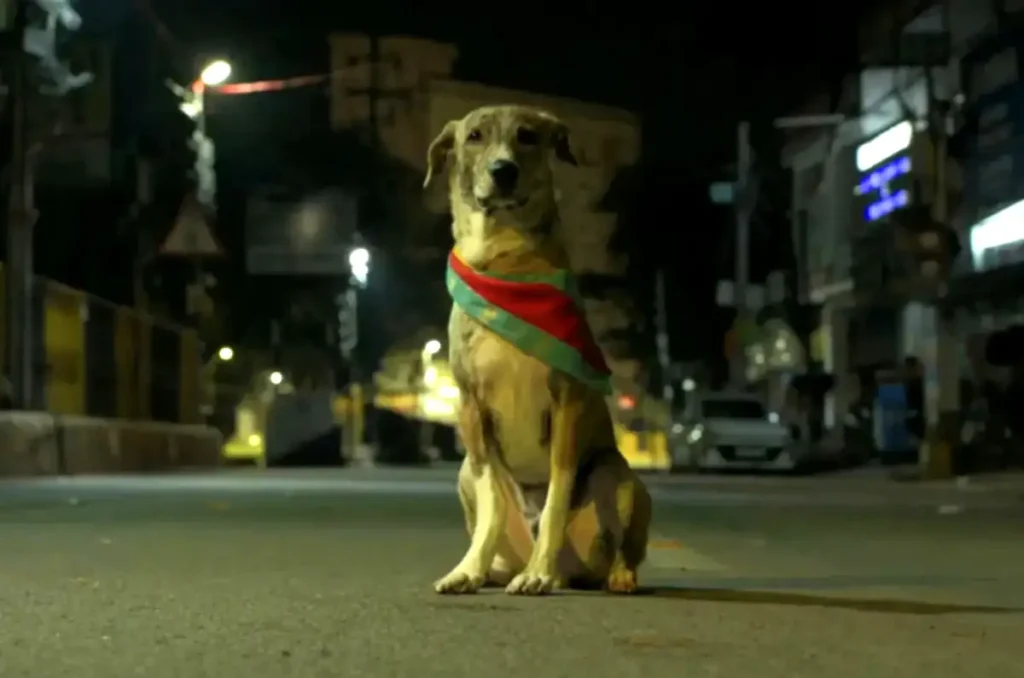
Rai’s follow-up to OMG 2 arrived with almost no noise around it. Its leads are indies called Bruno and Oscar, two separate dogs, and neither is a Labrador in a scrappy wig. They look like the dog asleep under the auto-rickshaw at the end of your street. That is why I bought a ticket.
Director: Amit Rai (OMG 2, Road to Sangam). Cast: Pankaj Tripathi, Maahi Rai, Pawan Malhotra, Rajesh Kumar, Geeta Agrawal Sharma, Sulakhyana Baruah, Nikhil Kumar, Jitendra Joshi, plus two real dogs: Oscar (the director’s own family pet, playing Momo) and Bruno (playing Oscar). Runtime: around two hours twenty; listings vary between 141 and 150 minutes. Language: Hindi. Certificate: UA, and earn it: despite the premise this turns into a fairly grim crime drama, not a soft family film. Where: in cinemas; no OTT date announced.
Does a dog die? Neither lead dog dies, and nothing happens to either of them on camera. But the film opens on the funeral of Senapati, a decorated police dog who is Momo and Oscar’s mother. She is already dead when the scene begins, so you see the grief and not the death. If you’re deciding whether to bring a child, that is the scene to know about.
The first thing I did, before booking, was check whether the dogs make it out alive. It is the question every dog person asks before walking into a film like this, and it is the reason it sits in the facts box at the top of this piece rather than buried in a spoiler.
Jump to: the story · who Bruno and Oscar are · the White God scene · where it argues against itself · too many gods · in its defence · the box office · what cruelty costs in India · the verdict
What happens in Ohh My Dog, and how the two halves fit together
It opens at a funeral. Senapati, a police service dog, is being buried with honours, and her handler Rajale (Jitendra Joshi) carries a particular kind of guilt: she was taken from her litter when she was inducted into service. His senior officer offers the standard consolation, that her bloodline is destined for greatness.
Two of that litter are Momo and Oscar. From there the film splits into two stories that run side by side and never touch.
In Assam, a boy called Apu wakes up, plays with his dog Momo, and by the end of that morning Momo is gone. The local SHO tells Apu’s mother the thing he won’t say to Apu: dogs are being lifted in numbers and sold for meat, and the odds here are bad. Apu is eleven, very good with a phone, and completely unwilling to accept any of it.
With his tuition teacher in tow he starts investigating faster than the policemen assigned to help. The name is Ray’s, from Pather Panchali, and there is a large Satyajit Ray poster on the wall at home, in case the Feluda parallel needed underlining on top of the name.
In Patna, the arrangement flips. Prince, a young labourer on a construction site, disappears, and his adopted street dog Oscar goes looking. Not a boy searching for his dog. A dog searching for his man.
What each track is really about, tap to reveal:
Pankaj Tripathi plays the schoolteacher in the Patna half, the one adult who takes a poor family’s missing son seriously when nobody official will. He asked for the part himself. Rai’s account of that conversation is that he told Tripathi he was too big a star for the film, and Tripathi answered, “Keep those things aside, I’m taking it up because I like this role.”
Tripathi has two rescued dogs at home, Prince and Genie, with their names painted outside the house, so you can see why the script found him. He’s excellent, and barely used, which is its own kind of statement: Rai builds the film around an eleven-year-old and a dog rather than around his biggest name, and that sounds reckless right up until you watch it work.
Pawan Malhotra arrives late, in the Assam track, as the only figure of authority in this film who isn’t bought. He is mercurial with it, and not a clean hero, which is what makes him worth watching rather than merely worth trusting. His scenes with Apu are the best exchanges in the picture. Writing a flawed adult who takes an eleven-year-old seriously is much harder than writing a heroic one, and it is where this film is most alive.
Mangesh Dhakde’s score is doing more than you’ll notice on a first watch. It carries the long stretches where the only character on screen is a dog and there’s no dialogue available to explain what he wants, which is most of the Patna track’s second half and all of the best of it. Aman Pant’s songs are restrained by current Hindi-film standards. “Suno na” is the one that stops the film dead, in a good way.
Who Bruno and Oscar actually are
They’re pariah-type Indian street dogs. Not a breed dog dressed down for the part, and not a Golden Retriever with mud rubbed on it. They look like the dogs you walk past outside a construction site without looking at.
The poster credits them by name, ahead of the crowd: Introducing Bruno, Oscar and 250 Heroes. Bruno plays Oscar, the dog who does the searching, and is the trained professional of the pair. Oscar plays Momo, and is Amit Rai’s own family pet, which the director has said himself in interviews.
In Hindi, kutta is still an insult more often than it’s a noun. A film that spends two and a half hours asking a multiplex to root for a kutta doing the job a hero usually does is arguing with that word every single time somebody claps.
Compare what Indian cinema normally reaches for: a Labrador in 777 Charlie, a husky-adjacent silhouette in the 2022 Tamil Oh My Dog. Recognisable shapes, imported breeds, dogs an audience has already been taught to read as valuable. Bruno and Oscar are neither, and nobody has tidied them up to make them easier to love.
Now watch Oscar, in the smaller role, in close-up. His face carries confusion, then panic, then something that reads unmistakably as grief, in shots held long enough that an editor has nowhere to hide a bad take. That’s not a training-montage reel cut together to look coherent. Getting a dog to hit a mark, hold an expression and register as one specific character rather than a generic frightened animal takes a director who understands the animal as well as he understands the actor. I’ve sat through performances from people with ten years of screen credits who can’t summon that on cue.
Rai won’t take the credit. Asked how hard it was to get the dog to act, he said he didn’t want to claim it, that he thinks the dog did it himself, and that all he did was speak into his ear: “Son, do this. Show your anger, show your love, show your fear.” He reckons the dog worked through the navarasas on screen.
It’s a lovely thing to say and I don’t quite believe it. Dogs don’t produce grief on a mark, take after take, because somebody whispered nicely at them. Somebody built enormous trust with that animal over a long time and then protected it under pressure, and the modesty is hiding the actual craft.
The White God sequence, and the whistle it got
Late in the Patna track, Oscar calls for backup, and roughly 250 dogs answer.
The image is lifted, openly, from White God, the 2014 Hungarian film in which Kornel Mundruczo put 250 real shelter dogs on screen and rehomed every one of them after the shoot. I reviewed that film on this site years ago and did not expect to see its central idea turn up again in a Hindi multiplex with an interval in the middle of it.
The borrowed image isn’t the only Hungarian thing here either: Rai shot the film with the Hungarian cinematographer Mate Herbai. Mundruczo staged his version as art-house horror. Rai stages the same image as mass entertainment. Same bet underneath, though: that real dogs, in numbers, land harder than any amount of CGI or one immaculate purebred.
In my screening it drew a whistle. Not applause, a whistle, the particular sound a Hindi film crowd makes when it approves of something. It went to two hundred and fifty street dogs, not to Pankaj Tripathi.
Where the film argues against itself
Ohh My Dog is a film about indies, made by people who obviously love them, and both of its heroes have owners. Momo belongs to Apu. Oscar belongs to Prince. The emotional engine is never “a street dog matters.” It’s “this street dog is somebody’s.” Every beat built to move you is a beat about a broken household.
The genuinely ownerless dog, the one lying outside your gate right now with no name and nobody to file a complaint for him, turns up in this film as scenery. Two hundred and fifty of him, in one sequence, and not one of them gets a name.
I don’t think that’s cynicism. It’s the compromise nearly every mainstream animal film makes, because ownership is the fastest route to audience sympathy and a director has 150 minutes to move a crowd, not a lifetime to change how they see a street. But a film this deliberate about its politics should have caught it. Ohh My Dog spends its whole runtime insisting a life isn’t worth less because nobody’s watching, then only lets us grieve for the dogs somebody was watching.
To be fair to the film, it knows exactly what it is doing with people. Apu gets a police officer on the case because his family is comfortable enough to be taken seriously. Prince’s family, living on a construction site, get nobody at all except a schoolteacher who volunteers. That asymmetry is deliberate and the film is very good on it, which is what makes it strange that the same lens never swings round to the animals. It sees clearly that a poor man goes unlooked-for. What it never quite sees is that an unowned dog does too.
It goes further than ownership, and this is the bit that genuinely surprised me. The film gives its street dogs a bloodline. Momo and Oscar aren’t strays who turn out to be extraordinary. They’re the children of a decorated police dog, and the opening scene has a senior officer say out loud that their mother’s line is destined for greatness. That is pedigree logic. It’s the exact reasoning the breeding industry sells with, transplanted onto indies and played as inspiration.
An indie’s whole case is that she owes her intelligence to nobody’s breeding programme. A film built to make that case handed its heroes a lineage anyway, because a lineage is easier to write than an accident.
A smaller irony sits next to that one. Apu is played by the director’s son, Maahi Rai, and Momo by the director’s own dog, so a film arguing against the privileges of pedigree ended up casting half its leads out of a single household. I’d hold that against it harder if the boy weren’t so good.
One more, and the word is the film’s rather than mine. The Assam dog-meat trade gets pinned on a tribe. That framing does a great deal of work for very little screen time: it hands the audience somebody to hold responsible, and then never asks who is buying, who is paying, or why a trade this organised needs a border at all. A film this careful about how the word kutta gets used could have been as careful with this one. It doesn’t dwell on it. It doesn’t examine it either.
It also runs long. Two and a half hours, and the search sequences start repeating themselves. The dog-searching stretch in Chillar Party is a fraction of the length and still lands harder, which is worth remembering every time this one stops to explain something the dogs have already made obvious.
Too many gods for one dog movie
Dogs have real standing in Hindu tradition, from Bhairava’s mount to Yudhishthira refusing heaven without his. Rai reaches for exactly that when he’s asked where the idea came from: in a world of co-existence, he says, a Dharmaraj Yudhishthir cannot go to heaven without his dog, and so a dog ought to be given a story the way a human is. It’s a real tradition, honestly held, and he draws on the whole of it at once.
A character says the thesis out loud: “Ek kutte ki wajah se Mahabharata shuru aur khatam hui thi.” Because of a dog, the Mahabharata began and ended. Apu’s teacher is named Krishna. Someone mistakenly calls Apu “Arjuna.” Bhairava’s iconography turns up on screen rather than only in the marketing, Hanuman ji gets an appearance, and all of this sits on top of two missing-persons plots and a trafficking reveal the script was already carrying.
Overcooked, and I don’t think that’s a controversial reading. A screenplay confident enough to pick one god and stay with him would have been the tighter film.
I’m not going to make a bigger complaint of it than it deserves. If reaching for Krishna, Arjuna, Hanuman and Bhairava all at once is what nudges a Friday-night multiplex toward a little more patience with the dog outside its own gate, I’ll take that trade.
In defence of a dog who does too much
The obvious objection is the premise. A dog who tracks a scent across a district, out-thinks trained officers, effectively solves a kidnapping.
Fair, taken alone. Selective, taken in context. Hindi cinema puts out three films a year in which a man takes on forty armed goons bare-handed and flips a truck with one shoulder, and nobody demands physics on the way out. Two street dogs tracking a scent and reading a room faster than a bought daroga is one of the milder things this industry has asked anyone to swallow in 2026.
What the film is actually built on supports the generous read. Rai says the seed wasn’t a news story or a cause. A friend told him about a man who had kept his dog’s ashes at home for more than a year and could not bring himself to immerse them. That is the whole film in one image, and it explains the excess: somebody who starts from a man who cannot let go of an urn is not going to make a restrained picture.
He says the rest of it plainly too. “There is an unspoken bond between us and dogs. Only those who have a dog truly understand it.” Then the sharper version: “If anyone thinks that they are raising a dog, please do not live in that ego, because the truth is that the dog raises you.”
That isn’t studio-issued talking-point language, and it tracks with who turned up to an early Delhi screening. Maneka Gandhi, India’s most prominent animal-welfare politician and not a soft audience for this genre, called it one of the best films she’d ever seen, and said it takes a sharp eye to notice what happens to animals roz ke roz and then actually put it on a screen.
What Ohh My Dog’s first week actually did
Friday looked like a write-off on paper: about ₹90 lakh net across 844 shows, 20% occupancy. Then it started working. Saturday took ₹1.10 crore from 721 shows at 29%. Sunday took ₹1.20 crore from 749 shows at 35%, the best day of its run. Per show that’s roughly ₹10,700 on Friday against ₹16,000 on Sunday, a 50% climb in two days, which is what word of mouth looks like on a spreadsheet.
I saw the same thing in the room. My Saturday show ran about half full against Friday’s national 20%, and the applause came more than once.
None of which makes it a hit. Then Monday, and the floor gave way: ₹25 lakh, a 79% drop, 11% occupancy. It never came back. Week one closed on Thursday at ₹4.25 crore net from 4,895 shows, and week two opens against Awarapan 2 and Batwara 1947 over the Independence Day weekend.
The trade has already filed it as a flop. Against what, nobody says. No producer has published a budget for this film, and the figures being quoted run from ₹8 crore to ₹25 crore depending on which aggregator you read.
A film that cast two Indian street dogs as its leads, and built its climax around 250 more, deserved a longer run than it got.
What it costs to hurt a dog in India
That affidavit deadline wasn’t a one-off. It was the end of a year that has gone badly for street dogs, and I have covered most of it here as it happened.
On 11 August 2025, after a child died of rabies, a Supreme Court bench ordered Delhi-NCR authorities to pick up every street dog and move them into shelters. There are no shelters for that many dogs. The backlash was immediate, and eleven days later a three-judge bench reversed the core of it, restoring sterilise, vaccinate and release.
In November the court ordered dogs cleared from schools, hospitals, railway stations and bus stands nationwide, and pushed public feeding into designated municipal zones. The 19 May 2026 judgment upheld all of it, gave institutions eight weeks to fence themselves, and ordered a functioning ABC centre in every district. Whether that money ever reaches a dog is a separate question, and I have done those sums.
Now hold all of that against the other half of the law, the half nobody legislates in a hurry.
Watch the traffickers in this film and ask what happens to them if they are caught for the dogs. Under Section 11 of the Prevention of Cruelty to Animals Act, a first offence carries a fine of ten to fifty rupees. Fifty. Do it again within three years and it is twenty-five to a hundred, or three months inside. Those figures were written in 1960 and have never once been revised. A draft amendment from 2022 would raise them to fifty or seventy-five thousand with real prison time, and as of a written reply in Parliament this February it is still “under examination” and has never been tabled.
So the state can order a million dogs relocated and every school in the country fenced inside eight weeks, and in sixty-six years it has not found the time to raise the price of hurting one of them. Fifty rupees is less than the ticket you bought to watch a film about a dog.
Nobody involved in making Ohh My Dog has claimed it is a response to any of this, and I’m not claiming it either. But that is the room it’s playing in, and it is why the casting choice at its centre carries more weight than it would in almost any other year.
The verdict on Ohh My Dog
Dog With Blog’s rating: 3.5 out of 5.
Ohh My Dog is the first mainstream Hindi film to hand two Indian street dogs the lead roles, and to direct them well enough that a multiplex whistles for them. Also half an hour too long, one god too many, and a script that keeps explaining what the dogs have already made obvious. A fabulous film with its flaws that we would still put a kid in front of.
In that room, the audience that mattered wasn’t grading the pacing. Kids clapped, more than once, watching Momo and Oscar do what dogs in Hindi cinema are almost never allowed to do, which is solve the thing instead of standing next to the man who solves it.
Somewhere in one of those rooms, a child watched a dog exactly like the one outside her building crack a case wide open, and walked out having quietly revised what that dog is worth. That’s a slow way to change a country. It’s also the only way it has ever happened here.
If Bruno or Oscar made you want a dog like them, you don’t have to wait for a sequel. They’re exactly what an Indian street dog looks like: smart, scrappy, loyal past the point of sense. There are thousands like them in shelters and on streets across India right now.
If this one lands for you, the next place to go is dog films based on real-life stories, where the dog on screen was somebody’s dog first.
Get more dog stories in your inbox. Join Woofs & Words on LinkedIn.
Subscribe on LinkedIn