
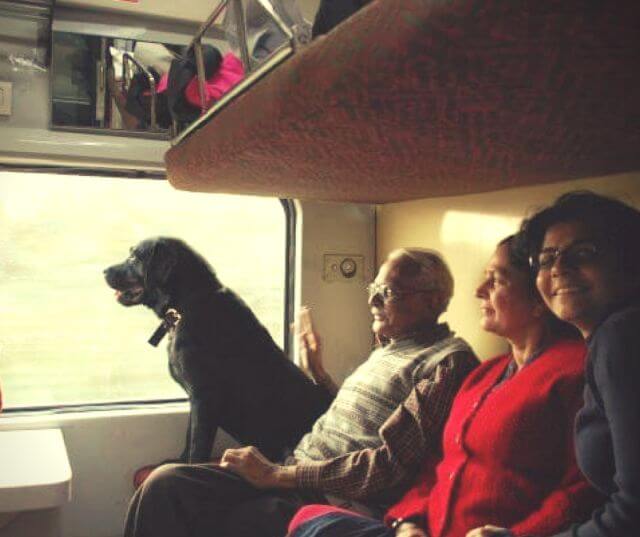
Indian Railways charges your dog as though it weighs 60 kg, whatever it actually weighs. Most pet parents have no idea which counter sells the ticket, let alone how the fare is worked out.
I’ve moved dogs across this country by train, shipped one to Dubai on Emirates, and made every mistake you’re about to avoid. Here’s the full playbook for how to travel with your dog in India: trains, flights, and the road in between, updated for what actually works in 2026.
India’s pet travel infrastructure has changed quietly. By early 2025, nearly one in three properties on MakeMyTrip accepted pets, with bookings for pet-friendly stays up 43 percent year on year. Two domestic airlines now fly dogs in the cabin. The question is no longer whether you can bring a dog on a trip in India. It is how to do it without the headache.
Rules verified against Air India, Akasa Air, IndiGo, SpiceJet, IRCTC and destination-government sources in July 2026. Pet policies and import rules change without much notice — confirm with the airline, the parcel office or your destination’s agriculture ministry before you book.
Can you take a dog on a train or flight in India?
Yes to both. On Indian Railways, your dog travels with you if you book a full First AC coupe, or in the brake van if you don’t. In the air, Air India and Akasa Air now take dogs up to 10 kg in the cabin; IndiGo does not carry pets at all, in the cabin or the hold. The details, fees, and paperwork are below.
Taking your dog on an Indian train
Option 1: First AC coupe (the right way)
Your dog rides with you, but only if the entire coupe (2 berths) or cabin (4 berths) is yours. Fellow passengers in a shared compartment can object, and the dog gets moved to the luggage car.
- Book First AC and choose coupe or cabin. Book in even numbers (2 or 4) so no stranger shares the space.
- Request the coupe in writing. Apply to the Chief Reservation Officer at the main reservation office 1–2 days before travel, with your PNR, contact details, and the dog’s vaccination/health certificate. Online booking now exists and is official, but it is phased by station rather than by route, and eligibility is checked against your PNR. Look for TRAINS → “Dogs/Cats Booking” on IRCTC, which hands off to the railway parcel booking system. It has been live at some stations since late 2025. If the option does not appear for your PNR, the counter is still your route.
- Get the dog’s ticket at the parcel counter on travel day. It’s issued only after the reservation chart is prepared, roughly 4 hours before departure. Reach the station 2–3 hours early with the dog.
- Pay the charge. This is where almost every article gets it wrong, including an earlier version of this one. The fare is not based on what your dog weighs. It is luggage Scale ‘L’ freight calculated on distance, applied to a fixed notional weight — 60 kg for a 1AC coupe or cabin, and a lower slab for the dog box — with a minimum freight of ₹30 plus 5% GST. A Chihuahua and a Rottweiler in the same coupe cost the same. Ask the parcel clerk to show you the Scale L slab for your distance rather than trusting a figure you read online. One warning the counter will not give you: this freight is non-refundable, even if your train is cancelled or runs late.
Option 2: The brake van (avoid if you can)
The dog travels in a cage in the brake van as booked luggage. You feed and check on him at station stops. It’s legal, it’s cheap, and it’s lonely, hot, and loud. Use it only when First AC isn’t available on your route.
One real exception, and it is not the one people assume: a dog large enough to need a berth cannot travel in 2AC, 3AC, Sleeper or General. But a puppy or kitten small enough to stay in a carrying basket may be booked into any class on payment of the usual charges. The animal has to remain in the basket — it does not get a berth or a seat, and this is enforced. Anything bigger, in any of those classes, means a penalty plus the risk of being offloaded mid-journey.
The Vande Bharat Sleeper changes this, on the rakes that have it. Indian Railways has begun fitting dedicated ventilated pet boxes into Vande Bharat Sleeper coaches, positioned at either end near the locomotive, with holders for food and water. Booking is offline only: a confirmed ticket, then the parcel office at your boarding station at least three hours before departure with a vet fitness certificate and vaccination records. Waitlisted and RAC tickets do not qualify. The facility drew a fair amount of criticism online when it appeared, on the grounds that a box is still a box. Note this applies to the Sleeper variant, not Vande Bharat chair car or Shatabdi, and it is going in rake by rake rather than everywhere at once, so confirm before you plan around it.
On long routes, know your station stops in advance. That’s your dog’s bathroom schedule. And watch the clock; the train won’t.
Flying with your dog: Indian airline pet policies (2026)
| Airline | In-cabin? | Limits | Notice | Notes |
|---|---|---|---|---|
| Air India (“Paws on Board”) | Yes | 10 kg incl. soft carrier, economy | 48 hours | 80+ domestic & international sectors, max 2 pets in cabin per flight |
| Akasa Air (“Pets on Akasa”) | Yes | 10 kg cabin · 32 kg check-in · 100 kg cargo | 24 hours | Cats & dogs 3+ months; vet certificate issued within 72 hrs of travel; cabin crate max 19″ × 12.6″ × 10″ |
| IndiGo | No | Does not carry pets at all | – | Its own CarGo guidelines state it does not carry livestock. Trained service dogs for sensory-impaired passengers are the only exception, free, in cabin, 48 hrs notice |
| SpiceJet | No | Cargo hold only, domestic routes | Contact cargo desk | Not offered internationally. Aircraft restrictions circulate online but are not published by the airline — confirm directly |
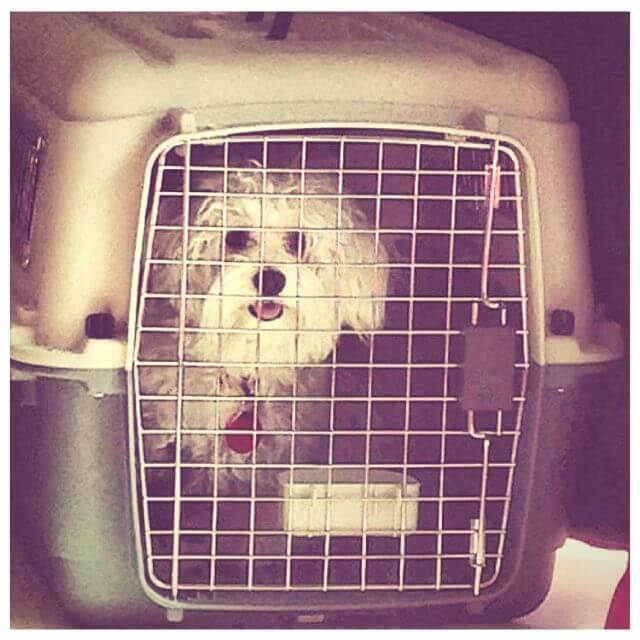
Ready to be shipped on Emirates from Mumbai to Dubai.
What it costs, on Air India: ₹7,500 for the cabin on domestic routes, and ₹16,000 if the dog travels as checked baggage. The soft carrier for the cabin has to fit 17 x 10 x 9 inches with no wheels, the dog must be at least eight weeks old, and you report three hours before departure. Worth knowing before you plan an international leg: Air India does not take pets in the cabin to or from the USA, Canada, Australia or the UK, and flat-faced breeds are barred from the hold entirely. Akasa allows three pets per flight in total and is domestic only, and both airlines take pet bookings by phone or email rather than online.
Three rules from experience:
- Cabin beats cargo, every time. If your dog fits the weight limit, pay for the cabin.
- Book direct flights. Every layover is a fresh chance for things to go wrong in a cargo hold.
- Crate-train weeks before, not the night before. The airline-approved crate should smell like home by departure day.
Don’t feed a full meal within 3–4 hours of the flight. Make sure water is accessible. And if your dog flies cargo, your calm at check-in is the last thing he reads from you; make it count.
Taking your dog abroad from India
Planning to travel with your dog beyond India? International is where paperwork outweighs the dog. The pattern for 2026: microchip first, rabies records always, and a health certificate with a short validity window.
| Destination | What India’s status actually means | Quarantine |
|---|---|---|
| EU / UK | India is an unlisted country, so a microchip and certificate are not enough. You need a rabies titre test (blood drawn at least 30 days after vaccination, result ≥0.5 IU/ml, at an approved lab) and then a 3-month wait before the certificate is issued. Certificate itself is valid 10 days to the border check. | None if fully compliant. Up to 4 months if not. |
| USA | India is on the CDC’s high-risk for dog rabies list. Dog must be 6 months+, microchipped before vaccination, with a titre from a CDC-approved lab and a booked appointment at a CDC-registered facility at your arrival airport. No direct domestic connection first. | None with a valid titre. 28 days without one. |
| Japan | India is a non-designated region: two rabies vaccinations, titre at a MAFF-designated lab, then a 180-day wait from the blood draw, plus advance notice to Animal Quarantine Service at least 40 days out. | Under 12 hours if compliant. Up to 180 days if not. |
| Australia | You cannot fly a dog from India to Australia. India is not an approved country. The dog must first live in an approved country for at least 180 days and be prepared there. | 30 days minimum, always — even fully compliant. |
| Singapore | India sits in Schedule III. Import licence, titre taken at least 90 days before export, core vaccinations, and a quarantine slot booked in advance. | 30 days minimum, mandatory — not conditional on compliance. |
Two practical facts worth more than the whole table. There is no CDC-approved or EU-designated rabies titre laboratory in India, so blood samples have to be shipped abroad, which adds weeks and its own permit problem. And every one of these clocks runs from the date the blood is drawn, not the date of vaccination. Start four to six months out, not four weeks.
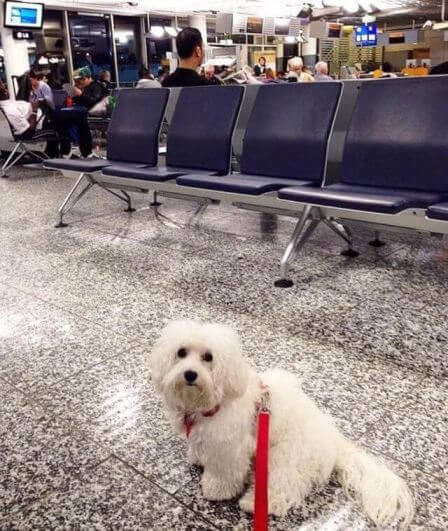
Miss Malti at Frankfurt Airport, Germany.
The order that matters: microchip (ISO 11784/11785) first → rabies vaccination after the chip → titre test at a lab your destination recognises → wait out that country’s clock, which runs from the blood draw and ranges from about a month to 180 days → vet health certificate inside its short validity window → IATA-compliant crate. Carry paper copies even where digital documents are accepted. Insurance covering quarantine and vet bills abroad is sensible, though no country requires it.
Bringing a dog into India is more restricted than most people expect. You need an ISO microchip, an official health certificate from the country of origin, and rabies vaccination given more than a month but less than a year before you fly. Critically, you also need an advance No Objection Certificate from the Animal Quarantine and Certification Service, applied for at least seven working days ahead — airlines will not board the dog without it. Import as accompanied baggage is capped at two pets per passenger and is meant for people transferring residence after at least two years abroad; anyone else needs a DGFT import authorisation. Expect an examination at the port of entry, and be prepared for a short quarantine at the officer’s discretion. Confirm the current position with your AQCS station before booking anything.
If your trip is for treatment rather than leisure, our guide to pet medical tourism covers travelling for specialised veterinary care.
How to travel with your dog by car
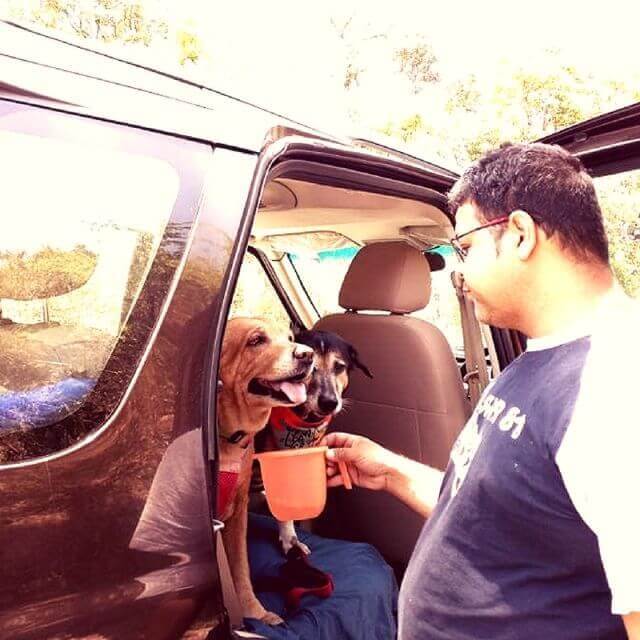
Make frequent stops, especially early in the trip. Picture courtesy: Geetalima
- Back seat, always, harnessed to the seatbelt or crated. An unrestrained dog becomes a projectile under emergency braking.
- Exercise him before departure and skip meals in motion; snack at pit stops instead. Motion sickness is half prevention.
- Non-slip bedding, familiar toy, ventilation cracked open before you shut the last door.
- Frequent stops early in the trip build confidence faster than any calming spray.
- Never leave your dog in a parked car. Cabin temperatures in Indian summers kill in minutes.
- Dog on medication, or living with kidney disease, diabetes, or another condition — plan for more frequent stops and easier access to water than you would for a healthy dog.
Before you travel with your dog for the first time, get a vet check: respiration, motion sickness, and anxiety issues show up on the road, not in the living room. Don’t jump straight from the living room to a ten-hour drive, either. Run two or three short trips first, a drive to the park, a night at a friend’s, and watch him. A dog who drools, whines the whole way, or won’t settle on a twenty-minute ride is telling you something before you’ve booked anything bigger. If the anxiety doesn’t ease with practice, talk to your vet: a short course of anti-anxiety medication is a real option for a dog who has to travel, and for one who genuinely can’t handle it, a trusted sitter or boarding beats dragging him along.
Where you can actually stay with a dog in India
A street dog sleeps at the entrance of the Taj Mahal Palace in Mumbai, and the staff will tell you he has been there since he was a puppy. Book a room at that same hotel with your own dog and the FAQ stops you dead: “No, pets are not permitted.” Taj Lake Palace in Udaipur says the same thing at slightly greater length. So the hotel that feeds a street dog at its door will not let you bring yours through it.
That pattern repeats across the industry, which is why booking a stay here is harder than it should be. No Indian hotel chain publishes a single guest pet policy. Not Taj, not ITC, not Lemon Tree. What you get instead is a per-property patchwork, and the prices inside one brand vary more than the prices between brands.
Lemon Tree has a reputation in Indian pet circles as the chain that welcomes dogs, which makes it the clearest case. The word “pet” does not appear anywhere in Lemon Tree’s terms and conditions. No fee, no weight cap, no breed rule, no limit on numbers, nothing about whether your dog can be left alone in a room, at any property. What the chain has instead is a rescue programme: street dogs adopted as staff, called K9 ambassadors, across the 110-plus hotels its own homepage claims. The programme is real and worth admiring, and it will not get your dog through the door.
What the chains actually charge
Every figure below came off the hotel’s own website or policy document on 4 September 2026. The basis column matters as much as the fee, because the same number means very different things per pet and per room.
| Property | Pets? | Fee | Basis | Weight cap |
|---|---|---|---|---|
| ITC Mughal, Agra | Yes | No fee at all | – | Not stated |
| Hyatt Regency Dehradun | Yes | ₹1,500 + taxes (includes pet bed, bowl and food) | Per night | 22 kg one pet, 35 kg two |
| Vivanta (per property) | Yes | ₹1,500 + taxes | Per pet, per day | Not stated |
| ITC Grand Chola, Chennai | Yes | ₹1,750++ | Per room, per night | 25 kg, max 2 |
| Sheraton Grand Chennai | Yes, one room type | ₹2,000 + taxes | Per pet, per night | 15 kg, max 3 |
| The Westin Sohna | Yes, selected villas | ₹2,000 | Per villa, no time unit published | Not stated |
| IHCL SeleQtions | Yes, chain-wide | ₹2,000 or ₹3,000, plus ₹3,500 refundable deposit | Per pet, per night | 30 kg, max 2 |
| ITC Rajputana, Jaipur | Dogs only | ₹2,500++ | Per room, per night | 25 kg |
| Taj Theog, Shimla | Yes | ₹5,000 + taxes | Per night | Under 15 lb (about 7 kg), 1 pet, breed list applies |
| Grand Hyatt Mumbai | Yes | ₹5,000 + taxes | Per pet, per night | 15 kg, 1 pet |
| ITC Grand Goa | Yes | ₹5,000++ | Per room, per night | 25 kg |
| ITC Grand Bharat, Gurugram | Yes | ₹5,900 incl. taxes | Per pet, per night | Not stated |
| Radisson (“Rad Pets”) | Yes | Not published | Per pet, per night | 25 kg |
| Oberoi and Trident | No | – | – | – |
| Roseate, India | No | – | – | – |
| Taj Mahal Palace and Taj Lake Palace | No | – | – | – |
| ITC Gardenia, Royal Bengal, Kohenur | No | – | – | – |
Look at ITC on its own. Nothing at Agra, ₹1,750 a room at Chennai, ₹5,000 a room at Goa, and ₹5,900 per dog at Grand Bharat, which means two dogs there cost ₹11,800 a night against ₹5,000 for the same two dogs in Goa. Three other ITC flagships refuse pets outright. Nothing about your dog changed between those properties.
The same holds inside Hyatt, where Dehradun asks ₹1,500 and throws in a bed, a bowl and food for the stay, while Grand Hyatt Mumbai asks ₹5,000 per dog and states that pets should not be left unattended at any point. And it holds inside IHCL, where Vivanta charges ₹1,500 a day, SeleQtions runs a proper chain-wide programme, and the two most famous Taj addresses in the country say no. One warning on the SeleQtions number: three versions of its pet policy sit live on official IHCL domains right now. One reads ₹2,000 a night throughout, one reads ₹3,000 throughout, and the third says ₹3,000 in the policy and ₹2,000 in its own FAQ. Budget for ₹3,000 and get the figure confirmed before you arrive.
Pet permission in India usually attaches to a room category rather than to the hotel. Sheraton Grand Chennai takes dogs in its Sea View With Garden rooms and nowhere else. The Westin Sohna says pets are welcome “in selective room categories”. Tijara Fort-Palace near Alwar allows them in the Tope Mahal and Deewar Mahal wings only. A booking site will happily sell you a room at a pet-friendly hotel that is not a pet-friendly room.
Which is why the aggregator listings are close to useless here. Marriott’s own page for The Westin Sohna has been carrying “Maximum Pet Weight: 0.0kgs” since at least July, a database default that now repeats itself in the auto-generated FAQ underneath. If the brand’s own page cannot keep the number straight, a site scraping it will not either.
So book direct, then email the property and get four things confirmed in writing before you pay:
- What is the fee charged against? Per pet per night, per room per night, or flat for the stay. On the numbers above, that distinction is worth thousands.
- What is the weight ceiling? Most Indian properties sit between 15 and 25 kg, which rules out a great many entirely ordinary dogs, indies included.
- Can the dog be left alone in the room? If the answer is no, your whole trip gets built around your dog.
- Which areas are off limits? Restaurants, pool and gym are excluded almost everywhere, even at the most welcoming properties.
What a property lists as pet-friendly and what the front desk allows on arrival are not always the same conversation. If a hotel will not put the fee in an email, you have learned what check-in is going to be like.
Policies checked against each hotel’s own website and policy documents on 4 September 2026. Indian hotels change these without notice and rarely date the page, so confirm before you book. If you have stayed somewhere with your dog and the desk did not match the website, tell us which property and what they charged and we will verify it and update this guide.
Before you go
Put your number on the collar. If he’s staying back, sort boarding before you book flights. Pack his treats, a spill-proof water bottle instead of a bowl (a bowl sloshes over in a moving car and eats up carrier space), any medication or preventives he’s on, a basic pet first-aid kit, and waste bags.
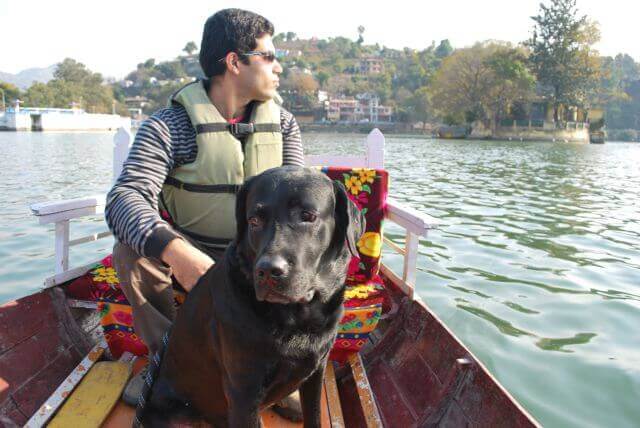
“People in India are not hostile towards dogs as the general perception might be. People have been welcoming in giving our dog boat rides and even letting him in their restaurants. However, be sure that your dog does not dirty their premises and is well behaved.”
~ Neha Bhardwaj, avid traveler
Be careful, be safe, and have fun.
Travelling with a dog you adopted? They make the best co-passengers. Find yours here.
Get more guides like this in your inbox: Join the Pack
FAQ
Can I take my dog on a train in India?
Yes. Book the entire First AC coupe or cabin, then get the dog’s ticket at the parcel counter about 2–3 hours before departure (it’s issued after the chart is prepared). The brake van is the fallback option.
How much does a dog ticket cost on Indian Railways?
It is not priced on your dog’s weight. It is luggage Scale ‘L’ freight based on distance, charged against a fixed notional weight (60 kg for a 1AC coupe), with ₹30 minimum freight plus 5% GST. Ask the parcel clerk for the slab covering your route. The freight is non-refundable even if the train is cancelled.
Which Indian airlines allow dogs in the cabin in 2026?
Air India (Paws on Board) and Akasa Air, both up to 10 kg including the carrier, with advance notice. Those are the only two. IndiGo carries no pets at all, SpiceJet takes them in the hold on domestic routes only, and Air India Express does not permit them onboard.
Can I bring my dog to India from abroad?
Yes, with an ISO microchip, valid rabies certificate, and import licence where applicable. Dogs from high-risk countries may need rabies titer tests.
Get more dog stories in your inbox. Join Woofs & Words on LinkedIn.
Subscribe on LinkedIn
can you suggest domestic flights that allow pets in cabin.
I haven’t personally flown a pet in India but a friend of mine has used Jet Airways twice and was appreciative of the same. I’d however suggest to go through a detailed discussion with customer service staff of respective flight carrier for their policies and wherever possible, try to fly your pet in cabin.
Hello Abhishek,
I have Indian Pariah dog, a female.
I wish to transport her by flight.
I checked on airline website that it requires a crate which should be IATA approved.
Can you guide me as to where I can get the crate? I have checked online, and the prices vary from 1500 to 10000. I stay in Delhi.
It will be very helpful if you provide your contact number as it help me in planning her journey.
Thanks and regards,
Ashutosh
Hi Ashutosh, unfortunately, I can’t help you with the price front. All I can recommend is to go after a quality product. IATA approval is not only mandatory for the flier but also good for your dog.
I am currently traveling and not in India.
You can reach out via our contact page: https://dogwithblog.in/contact-us/