
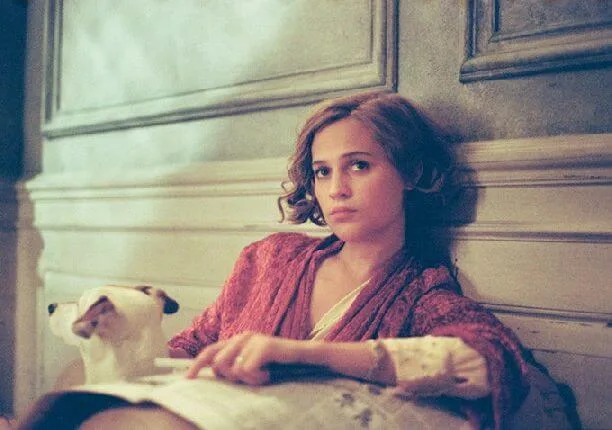
As leaf with tree, I belong to thee… Alicia Vikander brings real empathy to her portrayal of Gerda.
The Danish Girl (2015) isn’t really a dog movie but it makes so much sense when seen from the eyes of Havappe (Pixie), the dog who plays a silent spectator to an otherwise poignant story. Inspired by the lives of Danish artists Einar Wegener and Gerda Wegener, The Danish Girl follows Einar’s self-discovery, in a clockwork script, as Lili Elbe, the woman.
The Danish Girl Review
When we are first introduced to the painter duo, everything looks perfect, at least on the surface. Artists, romantics, friends; the couple are everything to one other and Copenhagen never looked any better, not to forget the cute little dog referred earlier. However, in a heart-wrenching process, Einar discovers that he is a woman in soul and with Gerda’s support, attempts the first-ever male to female gender reassignment surgery.
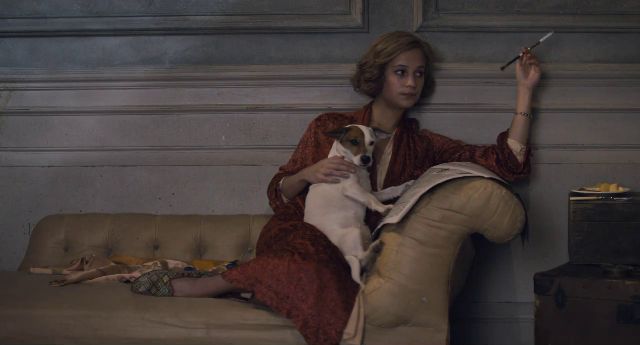
The movie may be all about a man finding out his true female side but I believe it is more about Gerda — the woman, the wife, the lover, the best friend who stays by his side despite knowing what it would mean for them as a couple, and her. To this dog, she is the true hero of this film. Alicia Vikander shines through every frame as Gerda Wegener. To see the love of her life fade away with each passing day into a distant image or rather a different person, how it must be like to support someone who is erasing himself from your life, and letting you know the same? Where you’d expect anguish, anger and apathy, Gerda gives you amiability, adaptability and ambivalence. Such strange passion, loyalty and love…
Havappe never gets a line, a name check from the humans, or a moment where the camera asks us to notice him noticing. That’s exactly why he works. A dog in a film like this isn’t there to react. He’s there to prove nothing has changed on the surface while everything underneath has. The scarf is still warm, the walks still happen, the dog still waits by the door. Grief and transformation are loud in every human scene in this film. The one character who can’t perform anything for anyone is the one who shows you what staying actually costs.
“I have a habit of falling in love with souls who have yet to be at peace with their bodies, their minds, their weaknesses. I try to build them, to find the parts of them that are missing in me. I end up with holes in my chest.”
—Farah Gobdon
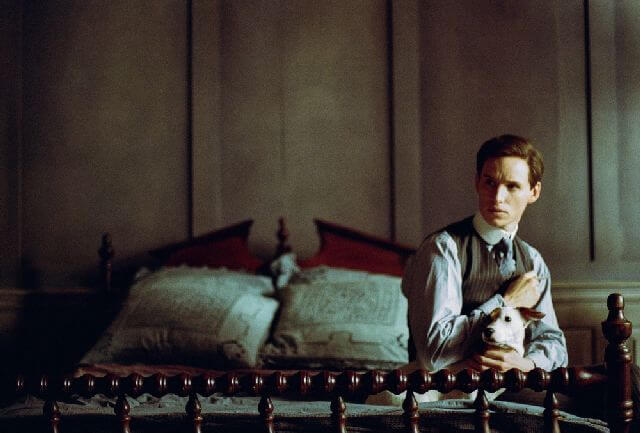
Consider Gerda’s pain in this conversation when she asks her husband (who has by now assumed a female outlook) to let her have the man she loved for once:
Gerda Wegener: I need to see Einar.
Einar Wegener: Let me help, please.
Gerda Wegener: I need my husband, can you get him?
Einar Wegener: I can’t.
Gerda Wegener: I need to talk to my husband, and I need to hold my husband. Can you at least try?
Einar Wegener: I’m sorry.
The real history vs. the film
The film compresses and rearranges a real marriage to fit a two hour arc. Here’s where. Einar Wegener and Gerda Gottlieb married in 1904, when Einar was 22 and Gerda was 19. By the time the film’s story begins in 1926, they had been married 22 years, not the six the script implies. The film also swaps who held the brush: it frames Einar as the painter and Lili as his discovery. Historically, it was Gerda who was the celebrated, prolific artist. Many of her portraits of Lili are the reason we have a visual record of her at all. And the ending softens something the real history complicates. By the time of her final surgery in 1931, the real Lili Elbe had already had her name and legal sex changed on paper, and had a fiance she hoped to marry and have children with. A life continuing, not a story closing. None of this makes the film less worth watching. It makes Gerda’s real courage, and Lili’s, sit a little differently than the script lets on.
And all this while Havappe sees the disintegration of what was his happy little family. He was loved by both but the poor dog had no tricks left in him to make them laugh anymore.
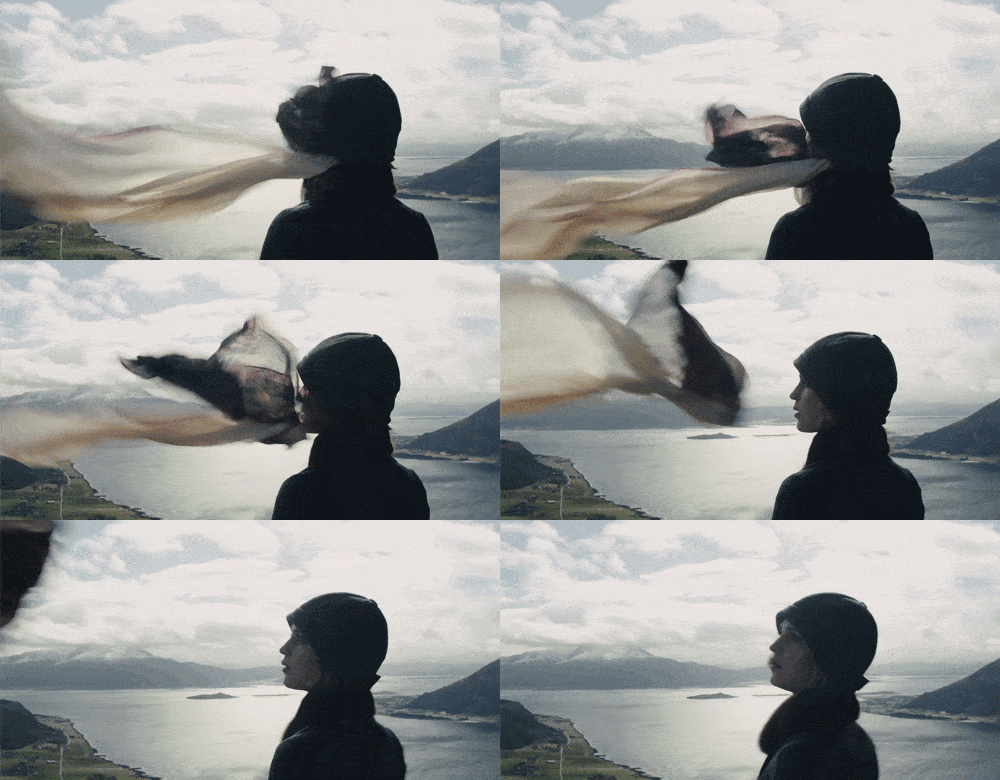
As Havappe would tell you, sometimes the best you can do for someone you love is, to never leave.
Part of our guide to the best dog movies, the quiet ones included.
Get more dog stories in your inbox. Join Woofs & Words on LinkedIn.
Subscribe on LinkedIn
This may be the best description of The Danish Girl I have ever seen. Thank you!
Thank you Eric!