
How to read dog body language
Your dog talks with its whole body at once: tail, ears, eyes, mouth and posture. The biggest mistake is reading one part on its own, like a wagging tail. A wag only tells you the dog is aroused, not whether it is friendly. Read the signals together and in context, and most of what your dog feels becomes clear.
Read the whole dog, not one signal
A dog holding a high, stiff tail with a slow wag, a hard stare, a closed mouth and its weight tipped forward is not happy because the tail is moving. That is a warning. Put the same tail on a loose, wiggly body with soft eyes and an open mouth and it is an invitation to say hello. Context decides meaning: what just happened, where you are, and who else is around.
Dog body language chart: signals at a glance
| What you see | Most likely state | What to do |
|---|---|---|
| Loose, wiggly body, soft eyes, open relaxed mouth, tail at mid-height | Relaxed and friendly | Carry on, safe to greet |
| Play bow (front down, rear up), bouncy, exaggerated moves | Inviting play | Play, or let the dogs play |
| Tail high and stiff, slow wag, weight forward, hard stare, closed mouth | Aroused, a warning | Stop, give space, do not reach over the head |
| Lip-licking, yawning, turning away, white of the eye showing | Stressed, asking for space | Take the pressure off, do not force contact |
| Cowering, tail tucked, ears flat back, low body, trembling | Fearful | Stay calm, do not loom, let the dog come to you |
| Stiff freeze, growl, lifted lip, raised hackles | Threatened, may bite | Back off slowly and respect the warning |
The tail: what a wag really means
A wagging tail means the dog is feeling something, not that it is happy. Speed shows how worked up it is. Height shows confidence: a tail held high and stiff is assertive, a tail at mid-level is relaxed, a tucked tail is unsure or scared. The friendly wag is the loose, full-body “helicopter” with a wiggly bum. Researchers have also noted dogs tend to wag more to the right when they feel positive and to the left when wary, a reminder that the wag is information, not a guarantee.
The ears
Ears forward means alert and interested. Ears pinned flat back means fear or appeasement. Neutral, loose ears mean a calm dog. Read floppy or cropped ears at the base where they meet the head, since the flaps hide the movement.
The eyes, including “whale eye”
Soft, blinking eyes belong to a relaxed dog. A hard, unblinking stare is a threat or intense focus, so do not stare back. Whale eye is the crescent of white you see when a dog turns its head away but keeps its eyes locked on something. It usually means discomfort, and you will often see it around food, a favourite toy, or an unwanted hug. Wide, dilated pupils with a tense face point to high arousal or fear.
Soft, frequent blinking is the opposite of the hard stare, a polite “I mean no harm.” It is also why the oldest rule in dog safety is simple: do not stare a dog down.
The mouth
A loose, open mouth that looks like a smile is a relaxed dog. Lip-licking and yawning when the dog is not tired or about to eat are stress signals, easy to miss and worth catching early. A tight, closed mouth with the corners pushed forward shows tension. Panting that starts suddenly, with no heat or exercise to explain it, can mean stress or pain.
Posture and weight
The play bow is the clearest signal dogs give: “everything after this is a game.” Weight forward shows confidence or intent, weight back shows doubt. A dog rolling over can be asking for a belly rub or trying to appease, so check the rest of the body. Raised hackles (the ridge of fur along the spine) mean arousal, not automatically aggression. The most missed signal of all is the freeze: a sudden stillness that often comes right before a snap.
Displacement behaviours: the out-of-place habits that signal stress
When a dog scratches mid-play, grabs a random object the moment a loud bike passes, or stops to sniff the ground the second you pause to chat with a neighbour, that is often a displacement behaviour: a normal action showing up at an odd moment to bleed off tension, much like a nervous person clicking a pen. Read it as “I am a little conflicted right now,” not as an itch or hunger. The grab-an-object version matters for safety, because some dogs swallow what they have picked up when an owner lunges to take it back.
Splitting: what looks like jealousy is often peace-keeping
A dog that wedges itself between two people hugging, or shoulders into two dogs playing too hard, is usually “splitting”, putting its body in the gap to bring the intensity down. Owners read it as jealousy. More often it is a request for calm. In homes with more than one dog, repeated splitting around food, toys or your attention can be an early sign of brewing tension, and a chance to step in before it escalates.
The paw lift
One front paw raised into a loose “L”. In pointing breeds it is partly hard-wired, but in everyday life a paw lift usually means intense focus, and sometimes a small “I come in peace” toward another dog. Even behaviourists debate this one, so read it alongside the rest of the body rather than on its own.
Zoomies and humping: the two most misread signals
Zoomies, the sudden frantic laps properly called FRAPs, are a release of pent-up arousal. That can be pure joy after a walk, or pent-up stress after a bath or a tense encounter, so the trigger matters more than the running. Humping outside mating is the other one owners get wrong: it is usually arousal, over-stimulation or stress, not dominance or a dirty habit, and it can even flag pain in the hips or groin. With both, the useful move is to calmly interrupt and ask what set it off.
The stress ladder: catch it early
Dogs almost always ask politely before they escalate. The ladder usually runs: look away, lip-lick or yawn, turn the body, walk away, freeze, growl, snap, then bite. Punishing a growl only deletes the warning and makes the next bite come with no notice. Reading the early “please give me space” signals prevents most bites in homes with children.
This escalation has a name. Veterinary behaviourist Kendal Shepherd mapped it in 2004 as the Ladder of Aggression, and the PDSA publishes a gentler version called the Canine Ladder of Communication. Both make the same point: the polite signals come first, and ignoring them is what teaches a dog to skip straight to the bite.
Calming signals
Trainer Turid Rugaas gave a name to the small gestures dogs use to defuse tension: yawning, licking the lips, sniffing the ground for no reason, curving around rather than walking straight up, and the full-body “shake off” to reset. Dogs use these with each other and with us. When your dog offers one, it is asking the situation to cool down.
How your dog reads you (words, tone and your body language)
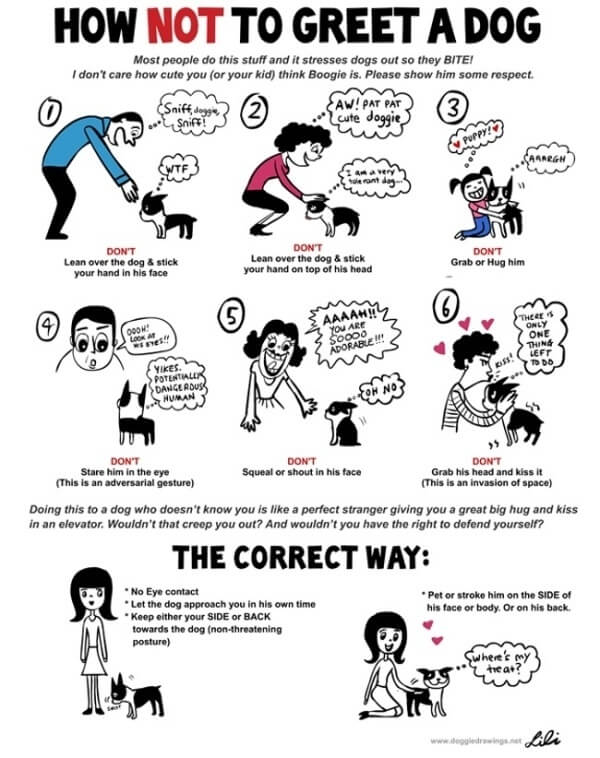
Communication runs both ways, and dogs read your body better than your words. Looming over a dog, walking straight at it, hugging and hovering all read as pressure. Turn slightly side-on, crouch low, and let the dog choose to come to you. Dogs do learn words, the average pet understands around 150, and they read your tone and posture even faster. If you want to “speak dog,” match your body to your message: relaxed shoulders and a soft voice say safe, a stiff lean and a hard stare say back off. For more on the everyday signals dogs send each other, see why dogs bark at other dogs and why dogs chase their tails.
How to train your eye
You will not learn this from a chart alone. Pick one signal, the nose lick is the easiest, and just count it for a day, noting what happened each time: a hand reaching for the face, a sudden noise, a stranger crouching to say hello. Film a few interactions and watch them back two or three times, because the quick signals pass in a fraction of a second. Researchers use the same frame-by-frame method, for example a 2020 video analysis of dogs during New Year fireworks, to catch fear signals the eye misses in real time. Within a week you will see a running commentary you used to miss. Two rules keep you honest: every dog is an individual, and the same signal means different things in different contexts, so read clusters, not single frames.
Indie and street dogs: the same alphabet, dialled up
Community and indie dogs use the exact same signals, they just read human intent very fast and value space and a way out. Approach low, side-on, and let the dog decide, and you will see the difference within seconds. It is the single most useful habit for anyone feeding or fostering street dogs, and it is the first thing we teach new adopters. If you are bringing a dog into a home with a child, read how to introduce your dog to the baby for the body-language cues that matter most.
Quick answers
How do you read a dog’s body language? Read the whole body at once, tail, ears, eyes, mouth and posture, and add the context. No single signal, including a wagging tail, means anything on its own.
Is a wagging tail always happy? No. A wag means the dog is aroused. A high, stiff, slow wag can be a warning, while a loose, wiggly, full-body wag is friendly.
Do dogs understand human body language? Yes, and better than words. They track your posture, where you face, and your eye contact, which is why looming or a direct stare can worry a dog.
What does whale eye mean in dogs? The white crescent of the eye showing as the dog looks sideways signals discomfort, often around food, toys or an unwanted hug. Give the dog space.
The body language of dogs is relatively easy as compared to humans – they growl when they are angry, they wag their tails when they are friendly, how many humans can we say that for?
Dogs so very often give us cues to their emotional state as well as to their reaction to the worldly elements around them, if only we are listening. Their facial expressions and body postures tell so much more than their barks.
More ways to understand your dog
Since dogs don’t speak the human tongue, they communicate most of their feelings to us through their instinctual body language. Dogs communicate with one another and with us using non-verbal language. Understanding your dog’s body language goes beyond just a wagging tail. While a happy pup might greet you with a flurry of tail wags, the position and intensity of the wag can tell you more. A relaxed wag held high shows confidence, while a low wag tucked between the legs might indicate fear. Leaning is another important signal.
Leaning against you is usually a sign of affection, but if your dog is also trembling or panting, it could be anxiety. By paying attention to these subtle cues, you can decipher your dog’s emotions and respond accordingly, creating a stronger bond with your furry friend.
These easy-to-read drawings by Lili Chin will help you understand your pooch much better!
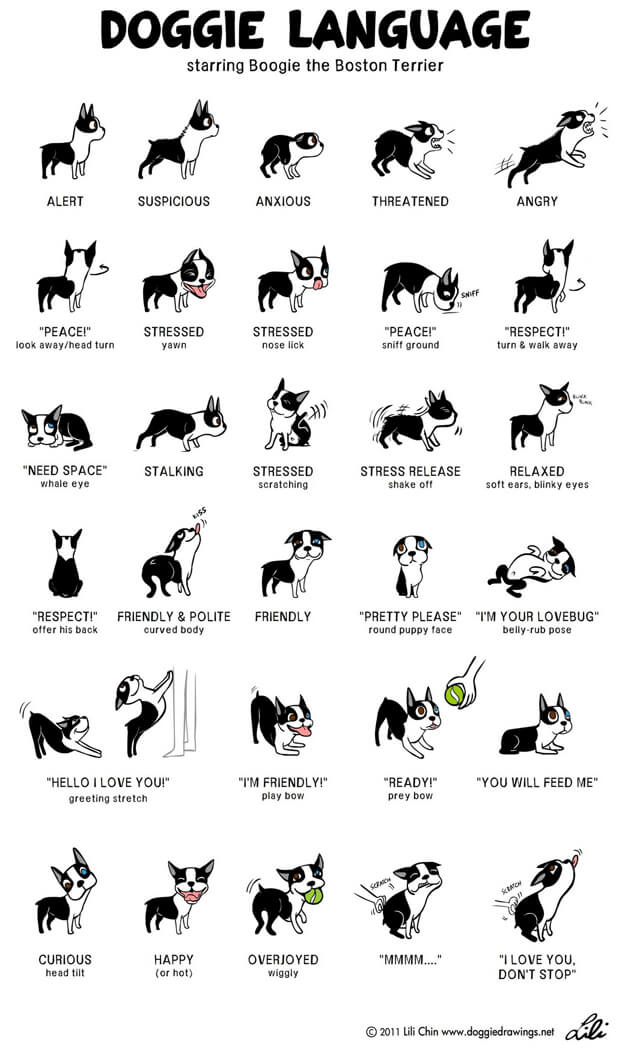
Dogs may not say the words, but they say a lot more once we realize their body language.
Unless you’re a cat living under a rock, you’d know how tricky it can get to listen to what your dog is saying. The Secret Life of Woofs isn’t that hard to comprehend even in today’s world of the internet and instant messages.
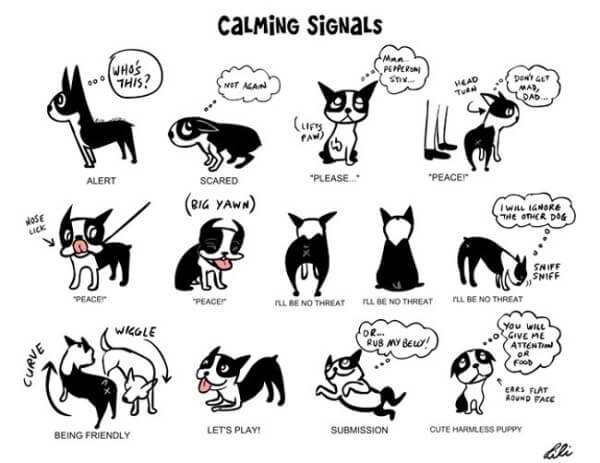
Learning the basics of canine body language helps us in better understanding our canine companions. Once a Dog Listener, we can ease our well-intentioned cross-species miscommunications.
How to tell if a dog is afraid?
An afraid dog would tuck his tail between his rear legs.
A fearful dog often displays bodily postures like leaning away or back, trembling, lowering his body or head – eyes wide open and a wrinkled forehead. Watch out for his tail, which may be lowered or tucked. If he’s too timid, he may try to escape or urinate when approached.
Is the dog displaying aggressive behaviour?
A dog exhibiting an aggressive tone may display a wrinkled muzzle, tense body, with weight either centered or over all four feet or leaning slightly forward onto the front legs. When a dog is feeling tense, his eyes may appear rounder than normal, or they may show a lot of white around the outside.
Also See: Why your dog barks at other dogs?
How Dogs Sense Our Emotions – And Why They Deserve Our Full Attention
Ever noticed how your dog just knows when you’re feeling off? Whether you’re stressed after a long day, annoyed there’s nothing good in the fridge, or just plain sad, your dog is often the first to pick up on it. A soft nuzzle, a gentle paw on your knee, or a quiet presence by your side—they’re experts in emotional support.
Dogs Understand Us More Than We Realize
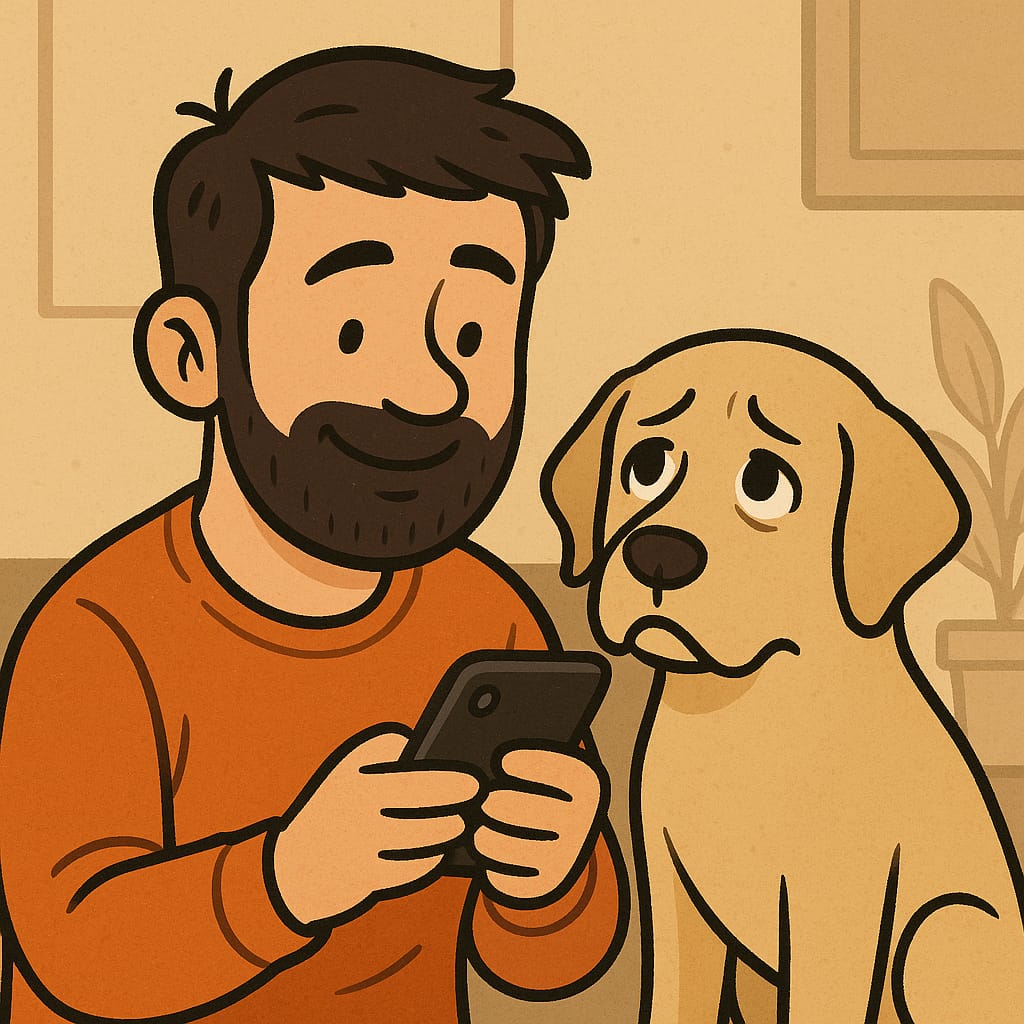
Dogs are incredibly perceptive. Their ability to read our emotions goes beyond wagging tails and eager eyes. Research has shown that dogs are not only attuned to our moods, but also react when they feel neglected. A recent UK study found that dogs exhibit signs of sadness when their humans spend too much time glued to their phones. Yes, really—excessive screen time could be causing emotional distress in your dog.
Dogs read our body language and expressions. So, if you’re buried in your phone and your dog is trying to connect, you’re essentially ignoring them—and they feel that. Time with your dog doesn’t just brighten their day—it’s great for your well-being, too. Numerous studies have proven that interactions with dogs significantly reduce cortisol (the stress hormone), lower blood pressure, and alleviate anxiety and depression.
15 Ways to Bond with Your Dog (Instead of Scrolling Your Phone)
If you’re looking for a sign to unplug and reconnect with your furry friend—this is it. Here are some easy, enriching ways to make your dog feel seen, loved, and engaged:
Outdoor Adventures
- Rake up a leaf pile and let them jump in joy
- Go for a walk and let your dog choose the route
- Plan a doggy playdate with their best four-legged pal
- Take a hike through a scenic trail or forest
- Bring a bag of tennis balls and head to an off-leash park
- Visit a dog-friendly beach for some sand-digging fun
Interactive Fun at Home
- Build a DIY ball pit with their favorite toys
- Try blowing bacon-scented bubbles and watch the excitement
- Give your pup a relaxing massage
- Teach them a new trick—clicker training works wonders
- Bake homemade dog treats together
- Read a book aloud while they curl up next to you
- Snuggle under the blankets for a cozy movie night
Every tail wag, happy bark, and soulful stare is your dog saying, “I’m here for you.” It’s only fair we return the favor—with our time, attention, and love.
Why do dogs chase their tails?
Dogs chase their tails for a variety of reasons: curiosity, exercise, anxiety, and predatory instinct or, they might even have fleas. For the behavioural aspects, try including more exercises in your dog’s daily routine – this would also help him reduce anxiety and stress.
We all know a happy pup’s tail wags with unrestrained enthusiasm, but did you know a wag can be like a secret code? That full-body wag held high? Pure confidence. A nervous wiggle tucked low between the legs? Fear might be creeping in. Just like us, dogs wear their emotions on their sleeves – well, tails, in this case. By learning to “read” these wags, you can become a doggy deciphering pro.
Why do dogs lean on you?
Dogs lean on us for a variety of reasons, most commonly to show affection or simply because they enjoy being close to their favorite people. This leaning behavior is a form of communication in dogs, similar to how humans might hug or hold hands. It can also be a sign of anxiety in some cases, so if your dog is leaning on you excessively and showing other signs of nervousness, it’s a good idea to consult a veterinarian or animal behaviorist.
Hope these handy tips will help you know exactly when your pup is bursting with excitement for a walk, or when a cuddle session is the perfect remedy for a less-than-stellar day at the dog park. All set to be Dr Dolittle, are you?
Also see, how to introduce your dog to the baby.
What Your Dog’s Greeting Really Says About Your Relationship—and the Best Way to Respond
Your dog’s behavior every time you walk through the door offers meaningful clues about your connection—along with cues about their overall happiness. From joyful jumps to quiet tail wags, learning what these signals mean can help you build a more trusting, confident relationship with your dog, whether you’re together or apart.
1. Over-the-Top Hellos: Jumping, Barking or Spinning
If your dog greets you by bouncing around, barking for joy, or spinning in circle – they’re showing an intense attachment and pent-up excitement. These exuberant welcomes are often stronger if you’ve been gone longer or if you use an overly enthusiastic tone when arriving home.
How to respond: Enter calmly and quietly. Don’t give attention or affection until your pup settles down. This teaches them that calm greetings are encouraged, helping to balance their emotions and reduce future frenzy.
2. Subdued or Shy Greetings: Lowered Eyes, Soft Tail Wag, Bowed Head
Not all dogs greet with fireworks. Some express affection by lowering their gaze, giving gentle wags, or keeping their head down. This reserved body language can reflect both happiness and respect—especially if they see you as a leader.
How to respond: Get down on their level and speak softly. Avoid looming or making quick movements, which can increase their nervousness. Gentle signals foster trust and help more sensitive dogs feel secure.
3. Presenting Gifts: Toys, Slippers, or Odd Objects
When your dog rushes over with a toy, slipper, or another random object, they’re inviting you to interact. Gift-giving is your dog’s way of saying, “Welcome home—let’s do something fun!” This behavior also hints that they’ve missed your company and may have felt bored on their own.
How to respond: Accept the gift and spend a few moments playing or showing appreciation. Recognizing their effort strengthens your bond and positively reinforces their desire to connect.
4. The Relaxed Greeter: Ignoring Your Arrival
If your dog barely acknowledges your return—no wild tail wagging, no barking, no rush to the door—it’s likely a sign of confidence and security. A relaxed reaction often means your dog feels safe and at ease being alone, with no fear of abandonment.
How to respond: Give them space and let them decide when to approach. Trusting their independence is important—some dogs prefer to reconnect in their own time, just like people do.
5. Vocal Welcomes: Whines, Barks, or Howling
Dogs use their voice to communicate a wide range of feelings. Excited barks and happy whines usually reveal joy, while drawn-out howls or persistent whining may point to stress or unmet needs. Body language—like a wagging tail or pinned-back ears—can help clarify their message.
How to respond: Observe both the sound and body cues. Celebrate joyful noises, but if your dog seems anxious, offer reassurance and check for possible stressors.
Dog Greeting Behaviors: What They Signal & The Best Owner Response
| Behavior | What It Means | Best Response |
|---|---|---|
| Jumping, barking, spinning | High excitement, strong attachment | Calm entrance, reward calm behavior |
| Lowered head, soft tail wag | Submissive affection, reassurance | Gentle voice, crouch to their level |
| Bringing a toy or object | Play invitation, engagement | Accept or play, show appreciation |
| Indifference/ignoring | Secure, well-adjusted, no anxiety | Let them decide when to interact |
| Whining, barking, howling | Expressing emotion, possible stress | Observe cues, comfort if necessary |
By understanding and respecting your dog’s unique behaviors, you not only strengthen your relationship but also support their emotional health—even when life keeps you apart.
Get more dog stories in your inbox. Join Woofs & Words on LinkedIn.
Subscribe on LinkedIn
Nice post Abhishek.. I have a saint Bernard (His name is Titan) at my home, his huge size makes me scared.. His behavior is kinda neutral towards me, he neither barks at me nor ever come near to me.. What does it means?? He likes me or not?
Hi Anjali, Dogs can smell apprehension, please let go of fear 🙂 Bernard(s) despite their size are very friendly hence the title Saint. Try to take it slow, bond with him by being the one who gives him food, takes him out for walks and I’m sure you’ll make great friends with him. All the best!
A lot of things I have learned from this blog.