
Medically reviewed by Dr. Catherine Nicolaou, DVM.
The night Kaalicharan died, the first sign wasn’t a collapse. It was the sound of her bark, muffled and distant, unlike the bark that had commanded every room she’d entered for 14 years. I was far away. I heard it through a phone. By morning, she was gone.
She had been telling us for weeks. Her eyes, once honey-warm, had gone cloudy at the edges. She had stopped greeting anyone at the gate. She was finding her corner of the house and staying there, turning inward the way old dogs who have decided something know how to do. We kept thinking she was just tired.
And here is the part nobody tells you: she was still herself. Still wagging when she saw us. Still interested in what we were eating. Still her, just slower, quieter, in a corner. We didn’t know what we were watching.
Most of us don’t. And that not-knowing is exactly what makes this so hard.
Why “she still seems happy” is the thing that confuses everyone
The question people ask when they come to this page is almost always some version of: the vet says prepare for the worst, but she’s still herself. She still wags. She still looks at me. How do I know?
This confusion is not denial. It is accurate observation of something real: a dog’s spirit and a dog’s body can be in very different places at the same time. A dog can be genuinely happy to see you (tail moving, eyes brightening) while their kidneys are failing, while their gut has stopped working, while their body is shutting down in ways that have nothing to do with how they feel about you in this moment.
The harder truth is that dogs hide pain. Not as a choice, but as instinct. It is what prey animals do, what pack animals do, what animals who cannot afford to appear weak do. They mask discomfort for far longer than we expect, and by the time it becomes visible, things have usually progressed further than they appeared. Your dog being happy to see you is real. It is also not the full picture of what is happening inside their body.
This is why the signs below matter: they are about the body, not the spirit. Both things can be true at once.
The signs that look like nothing at first
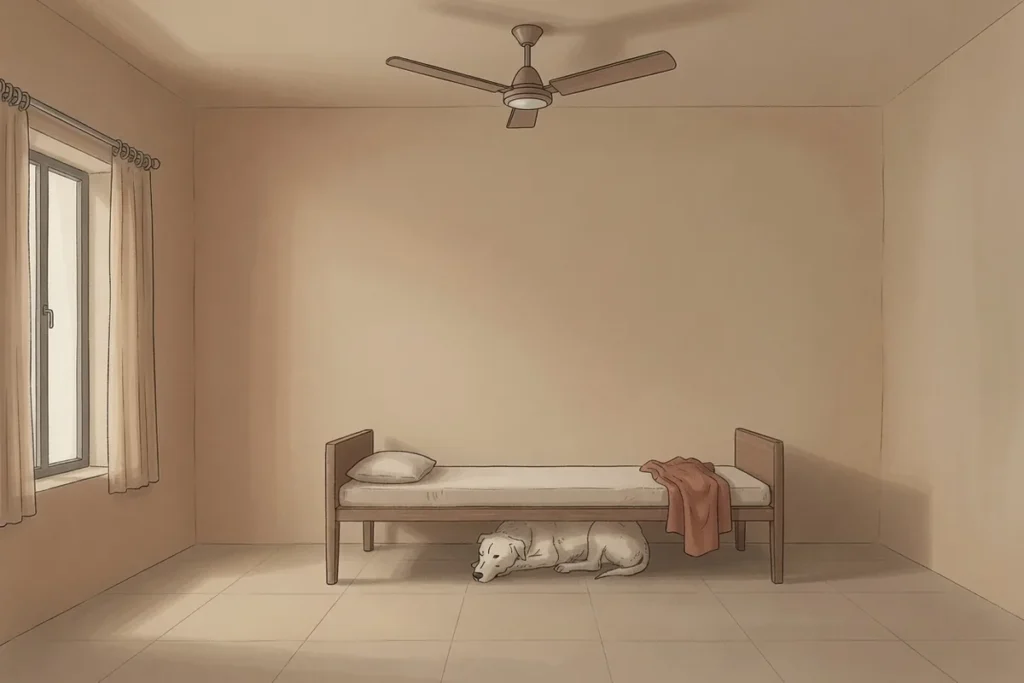
There is one thing almost every dog does before the end that owners describe without being asked: they withdraw. The dog who slept on your bed for twelve years starts sleeping under it. The one who greeted every visitor at the door moves to the back of the house and stays there. A dog who was always underfoot is suddenly alone in the corner of the terrace, or under the cot, or in the darkest room in the flat.
This is instinct, ancient and intact. A vulnerable animal hides. Not from you, but from everything. It isn’t rejection. It is the dog doing what the deep part of its nature tells it to do when it feels its body failing. Many Indian families describe their dog “going under the cot” in the final days. That is the same withdrawal every family describes everywhere. It is a sign.
Alongside withdrawal, watch for appetite changes that go beyond picky eating. Not a dog who turns down one meal or holds out for something better. A dog who has genuinely lost interest in food, whose eyes don’t light up at the sound of the bowl, who sniffs and turns away from things they have loved for years. When they stop drinking water, the timeline has shortened significantly. One skipped meal is nothing. Three days of refusing everything, including favourites, is something else.
Energy drops below what you’d call low. Not the normal slowing of an older dog but an inability to get up, a dog who doesn’t lift their head when you come home, no reaction to sounds that always drew them. Kaalicharan would come running at the sound of the gate for most of her 14 years. In her final weeks, she heard it and stayed where she was. Small, quiet, easy to explain away. I understood it only afterward.
Bowel and bladder changes also appear in this stage. Diarrhea, loss of control, accidents from a dog who was always clean. These are signs the digestive and nervous systems are struggling. They often arrive before the more obvious clinical signs and can be the first thing a family notices. A dog having accidents isn’t embarrassed. She doesn’t know. What it tells you is that the body is working harder than it looks.
The signs that tell you this is close
These are the ones that mean days, not weeks.
Breathing changes. The most reliable sign of imminent death in dogs is a change in breathing. Long pauses, sometimes 10 to 30 seconds of stillness, followed by a rush of shallow breaths. This is called Cheyne-Stokes respiration, and it happens as the brain’s breathing centres lose regulation. You may also notice the chest and abdomen moving separately, a laboured effort that looks uncomfortable even when the dog appears unconscious. Normal breathing in a resting dog is 15 to 30 breaths per minute and looks effortless. When it stops looking effortless, pay attention.
Gum colour. Pull the lip back gently and look at the gums. Healthy gums are pink and moist. In a dog who is dying, they go pale, white, bluish, or the colour of ash. Blood pulls away from the extremities to protect the vital organs. Press a fingertip to the gums and release it. Colour should return within two seconds in a healthy dog. If it takes much longer, or doesn’t return at all, that is the body failing to circulate.
Cold extremities. The paws and ears go cold first. The body draws heat inward to protect the core. A paw that is cold in a dog who is normally warm, paired with the signs above, is not incidental. In the final hours, the coldness moves up the legs.
Incontinence. Complete loss of bladder and bowel control (the kind where the dog no longer has any awareness of it) is the body releasing its hold on its own systems. It often comes in the final 12 to 24 hours. Don’t clean it in a way that disturbs the dog. Place an absorbent pad underneath, if you can do it gently. It is not distress. It is the muscles letting go.
Unresponsiveness. A dog who doesn’t track your movement, doesn’t turn at their name spoken clearly and close, doesn’t react when you touch them. Not sleep. Something that looks like sleep but from which they cannot be roused. The eyes may be half-open. The jaw slack. This is not the same dog who was tired yesterday.
What the final hours look like
It is quieter than most people expect.
The breathing slows and the pauses between breaths lengthen. There may be a rattle in the throat. It is the muscles releasing, not distress, and it is painless. The legs may twitch. The jaw may move slightly. Many dogs die with their eyes open, which is startling if you haven’t seen it. It doesn’t mean they were afraid.
If the dog is still conscious in the hours before, they may turn toward you. Many families describe their dog looking for them. Moving toward a familiar voice. That part is true, and it is the one thing you can do something about.
Stay. Sit close enough that they can feel your warmth. Whisper if you want to. Your voice is familiar to them, your heartbeat is familiar to them, and both of these things matter even when they can no longer lift their head to find you. Don’t try to move them to another room unless they are clearly in pain and you can reach a vet within the hour. What you are offering by being there is not nothing. For a creature whose whole life was organised around your presence, your presence at the end is everything you can give.
In India, most dogs die at home. This is not a failure of care. For a dog who is old and not in acute pain, a home death (familiar smells, the sounds of the household, the people who fed them) is not a worse death than a clinical one.
When to call the vet
If your dog is in the early stage: withdrawal, appetite loss, energy drop, bowel changes. A vet visit is worth making, not necessarily to intervene, but to understand what is happening and rule out something treatable. Sometimes what looks like dying is a kidney infection, severe anaemia, or a pain state that can be managed. A vet will tell you where things stand. A senior panel at a good private clinic in India runs ₹1,500–3,500 depending on the city. That cost buys you clarity, and clarity matters here.
If you are already in the final stage (the breathing changes, the cold paws, the unresponsiveness), the decision is harder. If a 24-hour clinic is within an hour and your dog is in clear pain (crying, unable to settle, distressed breathing), go. If the dog is calm and you are far from a clinic, staying is not wrong.
One thing worth knowing: euthanasia is legal in India under veterinary supervision, available through most private vets in metro cities. If your dog is in pain and the prognosis is final, asking about it is not a betrayal. People who have been through this more than once, who have sat with a dog at the end, say the same thing: you will know when it is time. And asking your vet to help end suffering is, for many families, the last act of love.
The cruelest part of loving a dog is that they live their whole life in the span of yours. Kaalicharan lived 14 winters. Rusty went before her, buried near the twin rosebuds. Both of them went the way all things that love without condition go: one last breath, and then they leave you to carry them.
People who have been here say they dream about their dogs. Always happy, always running, the way dogs are supposed to be. That comfort is real, and it belongs to you too.
Some families also find comfort in animal communication, not for answers, but for the feeling of continued connection.
If you are already in this, or just through it, we have written about what to do when your dog dies in India: the cremation and burial options, what they cost, what to expect in each city. And about what Kaalicharan’s own passing felt like in the days after. The words people have found worth keeping are there when you need them.
For the weeks before this, while you are still in them, the guide to caring for an aging dog is there too, not because it prevents this, but because it makes the time you have count.
Afterwards, when someone in the house is too young for any of this to make sense, people reach for stories. The one they usually reach for is A Dog’s Purpose, which imagines a dog returning again and again to the same person. A word of warning if you are considering it: the dog dies four times on screen. Give it a few months.